Bruno Rodríguez describes Washington’s contributions as “apparent generosity.”
 14ymedio, Havana, November 19, 2026 – On Wednesday, Cuban Foreign Minister Bruno Rodríguez devoted a syrupy tweet to “the solidarity of compatriots in Sweden” for the installation of solar panels in Cuban hospitals, as well as donations of rice and vegetable oil from Russia, Japan, and China. He forgot to mention the humanitarian aid arriving from the United States and distributed through the Catholic organization Cáritas in the Island’s most remote and vulnerable communities.
While Rodríguez shares images of the photovoltaic equipment that will be installed at the Aleida Fernández Hospital, the Antonio Guiteras Psychiatric Hospital, the National Institute of Angiology, the Cienfuegos Psychiatric Hospital, and the polyclinic in the municipality of Palmira, Cáritas continues distributing food packages and kits containing hygiene products throughout the Island, including its most remote and impoverished areas.
This Friday, the religious organization announced on its Facebook page that “approximately 700 vulnerable households in the parish of Palmira and its communities will receive the humanitarian aid from the U.S. Government to the Cuban people.” These contributions are part of the shipment to the Diocese of Cienfuegos.
Last July, the first shipment of humanitarian aid from the United States arrived in Cuba as part of $100 million in assistance offered by the administration of President Donald Trump. It was emphasized that distribution would be carried out in coordination with the Catholic Church and other independent and trustworthy organizations.
Cáritas Cuba reported that, of the $100 million humanitarian aid fund, $60 million is being managed through the Catholic Church.
Since the U.S. offer was announced last May, Foreign Minister Rodríguez has described the aid as “apparent generosity,” while also calling it “an inconsistency on the part of someone who subjects the Cuban people to collective punishment through economic warfare.”
At the time, the minister questioned whether the aid would be directed toward “the people’s most urgent needs at this moment, such as fuel, food, and medicine.” Last Tuesday, Cáritas Cuba reported that a flight carrying food kits and hygiene-product kits had arrived at Abel Santamaría Airport in Santa Clara. The organization’s director in the municipality, Vanesa Hernández Toledo, said the packages would be distributed in the rural area of Banao, located 22 kilometers southwest of Sancti Spíritus, as well as in other nearby communities.
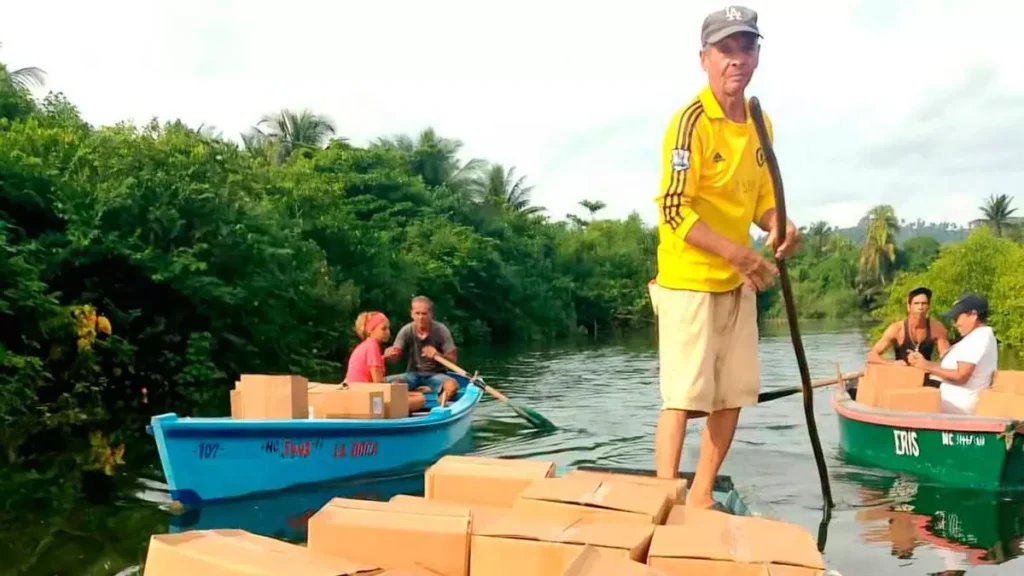
That same day, images were shared of small boats carrying boxes of humanitarian aid that had been distributed in Baracoa, Las María, Boca de Miel, Majana, and Majayara. “The situation in this remote area has become very difficult due to the economic situation, which limits access to resources in a coastal zone with no fertile land for cultivation and very few fishing resources,” Cáritas Cuba posted.
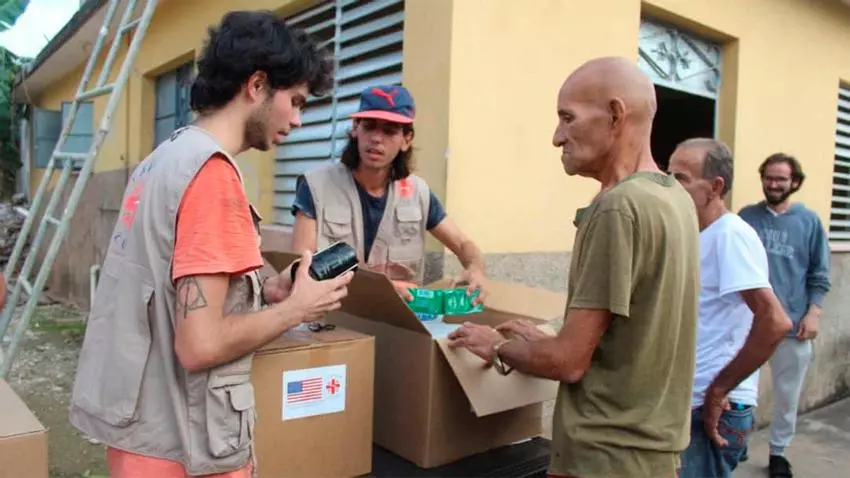
On November 4, Cáritas distributed the second package of aid from the United States: 700 food kits and 700 hygiene-product kits, which were allocated to the parish of La Santa Cruz, in the municipality of Cruces, and its surrounding communities.
The director of Cáritas Cienfuegos, Isabel Palenque Guillemi, explained that the donated supplies would be delivered through designated distribution points. They were also taken to the homes of people requiring care who were unable to travel to those locations.
Translated by Regina Anavy
______________________
COLLABORATE WITH OUR WORK: The 14ymedio team is committed to practicing serious journalism that reflects Cuba’s reality in all its depth. Thank you for joining us on this long journey. We invite you to continue supporting us by becoming a member of 14ymedio now. Together we can continue transforming journalism in Cuba.