“The sugar sector is undergoing a process of reconversion, not abandonment,” declared the president at a meeting with Azcuba executives.
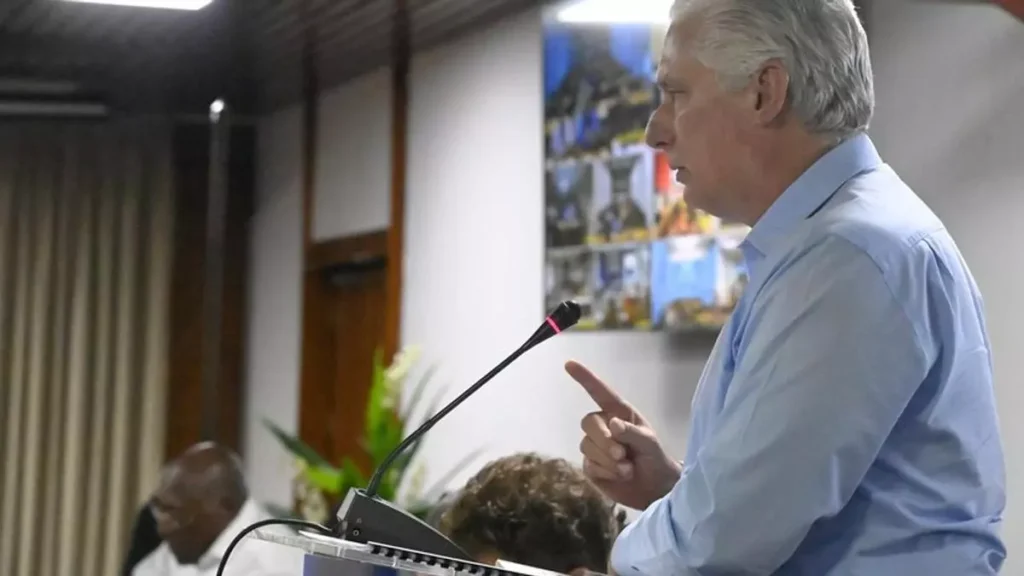
 14ymedio/EFE, Havana, November 15, 2026 / Miguel Díaz-Canel’s meeting with executives from the state-owned Azcuba group and producers in the sector, held Thursday at the Havana Convention Palace, was marked by a request from the president: “Reconvert” the sugar industry, which he described as devastated, and dedicate it to electricity generation and the production of sugarcane derivatives. This idea has been suggested for some time by independent experts.
Jorge Piñón, for example, who heads the Energy Institute at the University of Texas at Austin, emphasized this point in a recent interview with 14ymedio. “Today’s sugarcane isn’t just sugar; it’s also ethanol,” the specialist stressed, citing Brazil as an example, where 6% of electricity is generated by burning bagasse in power plants. In the same interview, he lamented, “It is a shame that Cuba abandoned the sugar harvest, but it represents great potential for the Cuba of tomorrow,” and predicted that the principle for a future transition would be “recapitalizing the agricultural sector, because sugarcane isn’t just sugar; it’s energy, and Cuba can be a major producer.”
Without citing or referring to these experts, Díaz-Canel stated that the sector will now be measured by “the energy it generates, the molasses it produces, the debt it pays, and the wages it provides.”
Díaz-Canel stated that the sector will now be measured by “the energy it generates, the molasses it produces, the debt it pays, and the salary it provides.”
The president acknowledged “unacceptable figures,” salary debts with workers, non-payments to sugarcane producers, and the deterioration of the harvests, at the same time as he urged the application of the 176 reforms to decentralize the economy, as a process of “reconversion” because, from the country’s leadership, “sugarcane has not been abandoned.”
“The sugar sector is undergoing a process of reconversion, not abandonment,” read the desperate headline of the article about the meeting in the official press. Díaz-Canel urged workers in the sector not to be “spectators” of this reconversion, while also noting, in reference to the United States embargo against the island, that “the blockade is not an excuse,” but rather “an obstacle that must be overcome with intelligence.”
This industry, he recalled, “is part of the history and culture of this country,” which is why “its rescue is an urgent imperative.” Indeed, what was once the economic engine of Cuba—which produced more than eight million tons in 1970 and exceeded four million before the 1990s—the sugar harvest is experiencing its worst crisis in more than a century.
According to calculations by the Spanish agency EFE based on official sources, the 2024/2025 sugar harvest in Cuba did not exceed 150,000 tons, which was the worst result in more than a century in a nation that was once the world’s leading sugar exporter and had up to 160 sugar mills.
______________________
COLLABORATE WITH OUR WORK: The 14ymedio team is committed to practicing serious journalism that reflects Cuba’s reality in all its depth. Thank you for joining us on this long journey. We invite you to continue supporting us by becoming a member of 14ymedio now. Together we can continue transforming journalism in Cuba.