Merchants resist accepting low-denomination pesos and customers protest when they receive them as change, in an economy where the dollar already costs 880 pesos
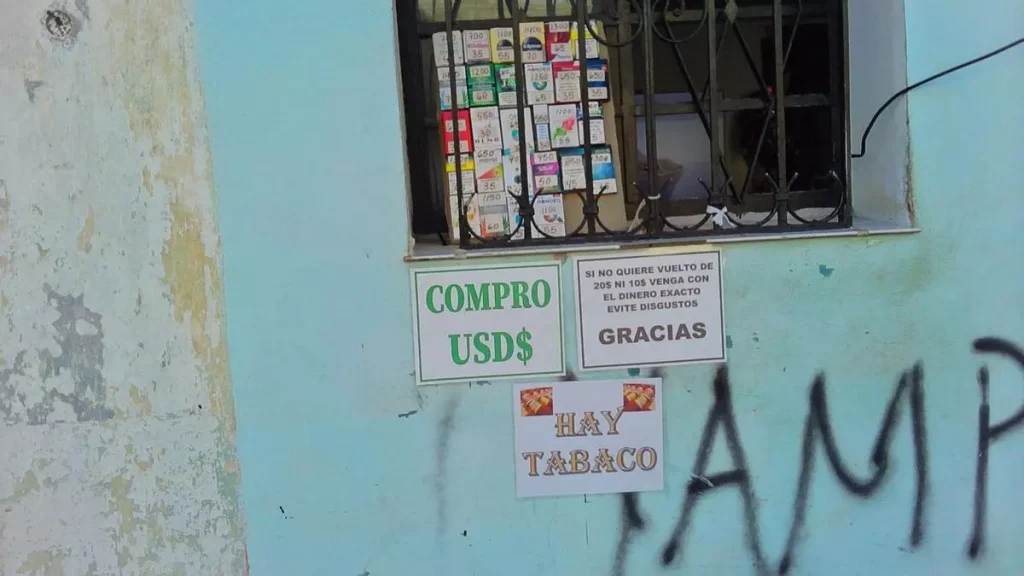
 14ymedio, Juan Diego Rodríguez, Havana, October 31, 2026 / Money can also become a nuisance. In Cuba, where prices rise from one day to the next, low-denomination bills are now the poor relation of the national currency. In a small business in Luyanó, in Havana, the signs tell the state of the economy better than any official speech. One announces, in green letters and without beating around the bush, “I buy USD.” Another warns: “If you don’t want change in 20 or 10 peso bills, come with the exact amount. Avoid trouble.”
The warning has something of an ultimatum about it. The merchant wants no arguments over a few pesos that are still legal tender, even though they can be exchanged for fewer and fewer goods and services. The customer, for their part, has no wish to walk out with pockets full of colorful scraps of paper that will hardly be of any use on their next purchase. Between the two, a low-intensity war is being waged, with the counter as the trench and the change as the ammunition.
The problem is not that 10 pesos have stopped being money, but that it is increasingly hard to find anything to buy with them. Inflation has gradually shrunk them into an amount that barely makes a dent in the price of any item. They are disappearing from circulation not by decree, but by a far more implacable sentence: the one handed down by reality.
The next sign could announce an even more brutal development: “Bills accepted, but try to make sure they’re not Cuban.”
This Saturday, the dollar is trading at 880 pesos on the informal market, a rate that just a few years ago would have seemed absurd and that is now greeted with a mixture of resignation and dread. Each new rise in the US currency pushes the value of the national currency down a little further and fuels the race of prices. The Cuban peso is losing value so fast that it seems to shrink inside your pocket.
That is why the most revealing thing about the Luyanó notice is its last phrase: “Avoid trouble.” It does not recommend checking the merchandise or verifying the amount of the purchase. It simply asks that nobody get upset at receiving low-denomination bills. The next sign could announce an even more brutal development: “Bills accepted, but try to make sure they’re not Cuban.”
Translated by GH.
______________________
COLLABORATE WITH OUR WORK: The 14ymedio team is committed to practicing serious journalism that reflects Cuba’s reality in all its depth. Thank you for joining us on this long journey. We invite you to continue supporting us by becoming a member of 14ymedio now. Together we can continue transforming journalism in Cuba.