The main shareholder, holding 70% of the business, comes from the food service sector and claims the State has no stake
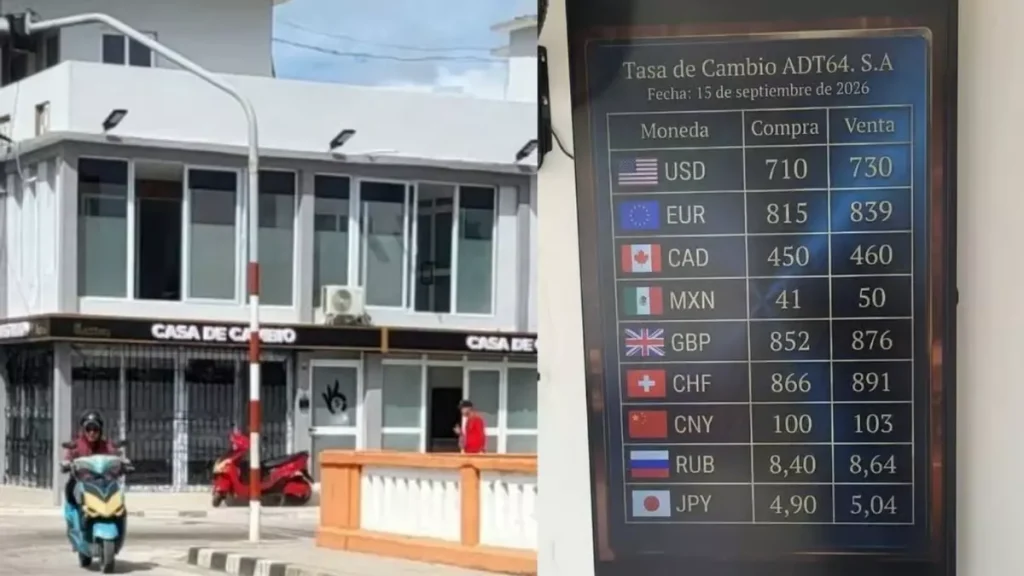
 14ymedio, Madrid, September 18, 2026 / Cuba’s first private currency exchange house has the dollar through the roof. On the first day after it emerged that it was already operating, ADT 64 was buying the US currency at 710 pesos and selling it at 730. The rate was not only much higher than the official Cadeca rate – 664 this Thursday (three pesos less than today, Friday) – but it also beat the demonized rate published by El Toque, set at 700 since Wednesday.
Located at Aires de Tristá Street No. 64, in Santa Clara, ADT 64 is close to the Santa Clara Libre hotel and a state-run currency exchange house. According to the independent outlet El Toque, which has thoroughly examined the new business, the company’s stated line of business was food services, at least according to what is on record in the registry. There are online references describing it as an ice cream parlor and seller of pizzas and hamburgers, but also old images of a sign reading Bar-Cafetería.
The photographs of its façade that began circulating this Thursday showed a different picture: digital screens displaying the changing value of nine international currencies. The euro, for example, is bought at 815 pesos and sold at 839. Nobody is selling, neighbors told El Toque.
Martí Noticias was able to speak with Arnel Matos Freire, whose contact details – phone number and address – matched those of the company, and who confirmed he is the owner of 70% of the business. “Asked by Martí Noticias whether the remaining 30% belonged to the Cuban State, the businessman said no. Matos explained that the business operates under the structure of a micro, small, or medium-sized enterprise (mipyme), with another private partner”, the report states.
The owner did not give many more details, but maintained that he submitted a proposal to the authorities to set up the business and received approval for it to become a pilot experience that could be extended to the rest of the country. The project was advised by a doctor of Economic Sciences, and operations began on August 31.
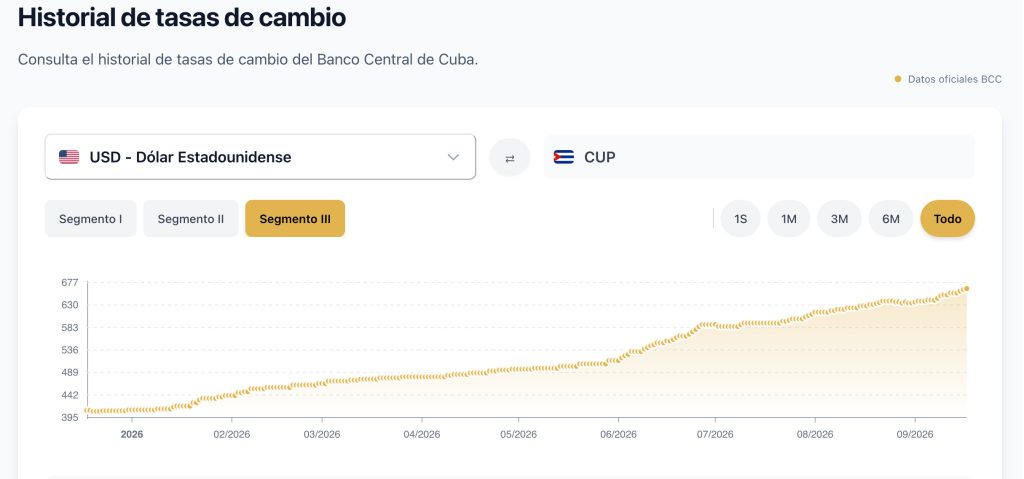
It is not known at what rates it has been exchanging the currency, but there is public record of the trend in official rates, which have risen sharply over the same period. On September 1, the price of the US currency according to the Central Bank of Cuba (BCC) was 636 pesos; a week later it was already at 644, and on the 15th, at 659. And rising.
Matos told Martí Noticias that the price of the currency is not set by the informal market – as with El Toque’s estimate – but is established by calculating a percentage above the BCC rate, which must authorize it daily. As of today, that commission stands at 7%. The owner stated in the interview that the dollar via bank transfer currently stands at 950 pesos, implying how profitable his business is. However, there is no evidence that this is so.
The businessman also stated that there is no limit on the purchase of foreign currency, though there is for its sale. In addition, people must prove the origin and destination of the money to prevent money laundering and fraud. In the case of companies and self-employed workers, company documents are required, along with “justifying the purchase through the offer of a foreign or domestic supplier certifying the use of the funds”. Information on the financial activity is submitted daily to the Central Bank of Cuba.
Cuban economist Pedro Monreal, based in Spain, has analyzed the initial information about ADT 64. The expert addresses two very different aspects: on one hand, he questions the opacity surrounding the operation and the authorization to open the establishment. On the other, its practical scope.
“As long as the detailed regulation is not published, the authorization of private currency exchange houses functions more as a discretionary power of the BCC than as a right that any interested party could aspire to under known conditions,” he notes regarding the first issue. Monreal acknowledges that the regulator has not only the power to create this mechanism but, almost, the duty to do so, in order to monitor the situation through a concrete, controlled example to learn from and correct the official market.
“This does not mean, he stresses, that it can operate ‘without detailed public regulations’, something that ‘affects legal certainty, competition, oversight, and the credibility of the officially announced opening’”
This does not mean, he stresses, that it can operate “without detailed public regulations”, something that “affects legal certainty, competition, oversight, and the credibility of the officially announced opening”. The discretionary nature, he adds, will not favor the incorporation of other players, the promotion of competition, or the flow of information.
Furthermore, the economist warns of the practical need for the activity to expand if the idea is to build a reference rate. “A diverse and statistically adequate sample is needed: different cities, multiple owners, both sides of the market – buying and selling – different scales of customers, and mechanisms to filter out atypical days and circumstantial inventories,” he warns.
Monreal also believes that the first piece of evidence left by the ADT 64 rate is that the accusations the regime made against El Toque for years were mistaken, if not malicious. Official discourse even attributed crimes to the outlet’s founders, whom it accused of intending to trigger social unrest by inflating currency prices, which in turn drove up the cost of living. Now, the rate approved by the BCC is even higher than that of the informal market.
“For the BCC, the risk is twofold. On one hand, the segment III rate (private actors) could end up moving closer to the ‘street’ rate and losing the current anchor of 1 dollar = 660 pesos. On the other, if the central bank ignores the pilot’s initial data and keeps the administered rate, the experiment would remain a costly showcase, inconsistent with the exchange rate the State itself publishes,” he concludes.
Translated by GH.
______________________
COLLABORATE WITH OUR WORK: The 14ymedio team is committed to practicing serious journalism that reflects Cuba’s reality in all its depth. Thank you for joining us on this long journey. We invite you to continue supporting us by becoming a member of 14ymedio now. Together we can continue transforming journalism in Cuba.