Fourteen of the 27 cars left the tracks, blocking the passage of a train carrying 873 passengers, who were taken to Havana by bus.
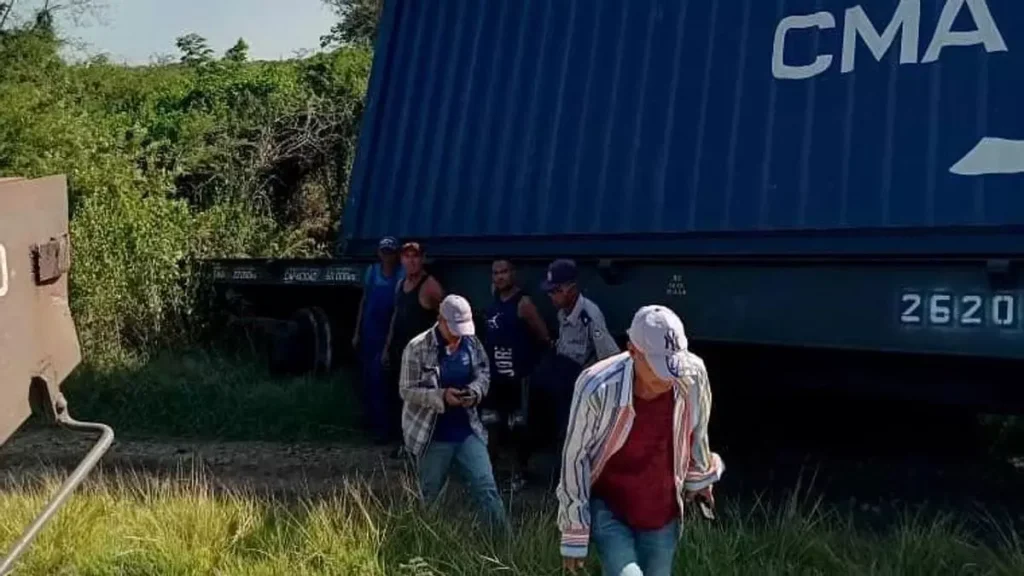
 14ymedio, Madrid, August 21, 2026 – The railway line between Havana and Santiago de Cuba has been interrupted since Thursday, when a freight train derailed near the town of Piedrecita, in Camagüey. The train was traveling from Artemisa to Holguín and, judging by images released by the authorities, was transporting goods from the Port of Mariel, the Island’s main commercial terminal.
Among them, in fact, were containers belonging to the French shipping company CMA CGM, which had suspended its shipments to the Island in mid-May because of the threat of sanctions posed by U.S. President Donald Trump’s Executive Order 14404, dated May 1. There is no public information indicating that the company has resumed its arrivals in Cuba, but the company’s search engine shows that since last July, three CMA CGM ships have arrived in Mariel from Kingston, Jamaica.
At that port, the authorities reported last month, five containers carrying medical supplies were stranded. It can be assumed that they arrived on one of the vessels that reached the Artemisa terminal: the Alexandria on July 27, the Ceara on July 28, or the Iremos on August 15.
As for the accident in Camagüey, according to a publication by Cuban Railways, 14 of the convoy’s 27 cars left the tracks. Of these, 25 were carrying containers, but the containers were not damaged. In that same post, it was reported that measures were being taken to assist passengers on another train that was traveling from Guantánamo to the capital at the time and whose journey was halted because the so-called Central Line was affected.
“Under very complex conditions due to the availability of fuel, arrangements have been made to transport all passengers to their respective destinations,” the agency said in a subsequent report. The 873 passengers on that convoy would be distributed among a total of 25 buses.
The largest number of them were headed to the capital. Between Camagüey and Havana, 15 vehicles were hired for 625 passengers, and two more between Sancti Spíritus and Havana, for 81 passengers.
“In compliance with the established protocol, an investigative commission was created to clarify the causes and conditions that led to the occurrence of the incident”
“In compliance with the established protocol, an investigative commission was created to clarify the causes and conditions that led to the incident,” the institution also indicated, adding that officials from the Railway Transportation Administration, as well as police and Ministry of the Interior agents, went to the scene of the accident.
This type of accident has become more frequent in recent years on the Island. On June 2, a passenger train with 900 people on board, also traveling on the route between Santiago de Cuba and Havana, derailed in the vicinity of Las Tunas, with no injuries reported. Although authorities said at the time that they would investigate the causes, they have not commented on the matter since.
The previous railway incident occurred in November of last year, when a passenger train traveling the Havana-Sancti Spíritus route suffered an accident near the municipality of Placetas, in Villa Clara, with no injuries reported among passengers or crew.
Las Tunas, precisely, has recorded at least three of these incidents in less than two years. In addition to the aforementioned accident, another occurred in Jobabo in August 2024, when the Manzanillo-Havana train derailed without injuries or significant damage, and in Bartle, in October 2025, with 577 passengers on board. No injuries were reported in that incident either.
The deterioration of Cuba’s railway system, affected by a lack of maintenance, an aging locomotive fleet, and shortages of spare parts, has turned derailments into another symptom of the national transportation crisis. It is estimated that 67% of the tracks and 40% of the infrastructure require maintenance in the country.
In recent years, the Government has announced plans to modernize both the tracks and machinery with foreign investment—mainly from France and Russia—but the improvements have not materialized.
Translated by Regina Anavy
______________________
COLLABORATE WITH OUR WORK: The 14ymedio team is committed to practicing serious journalism that reflects Cuba’s reality in all its depth. Thank you for joining us on this long journey. We invite you to continue supporting us by becoming a member of 14ymedio now. Together we can continue transforming journalism in Cuba.