The decision deepens the regime’s isolation, after it was already forced this year to withdraw its personnel from Ecuador and Costa Rica.
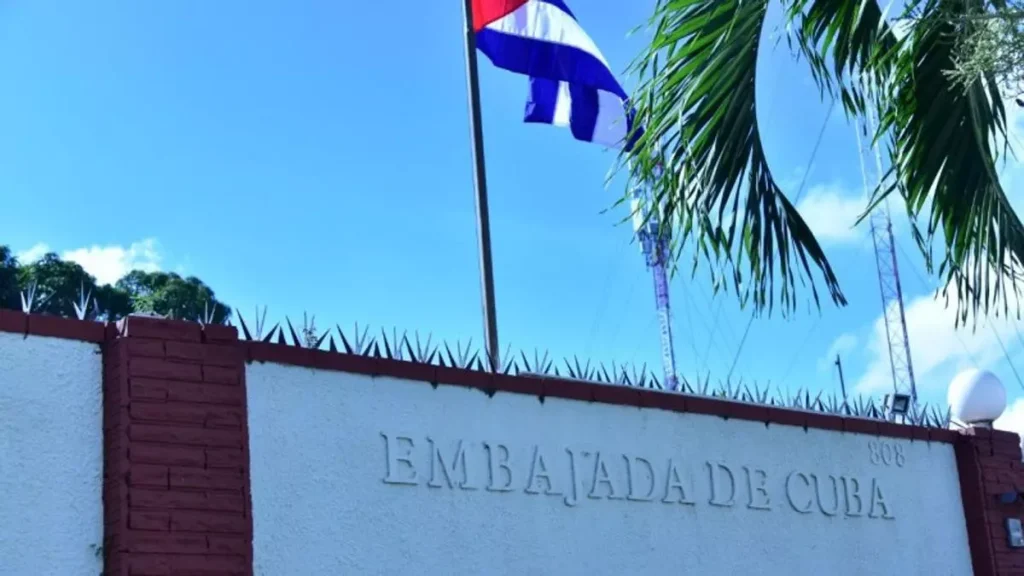
 14ymedio, Havana, August 13, 2026 – The Dominican Republic ordered nine members of the Cuban diplomatic mission and their families to leave the country on Thursday, in one of the most severe measures adopted by a Latin American government against Havana in recent years.
The Dominican Ministry of Foreign Affairs gave the officials and their relatives seven days to leave the country but avoided explaining the reasons for the decision. In a brief statement, the Foreign Ministry limited itself to saying that the measure was adopted in accordance with the Vienna Convention on Diplomatic Relations and that it would provide no further details because they involved diplomatic communications.
Although Santo Domingo did not publicly use the expression persona non grata, the decision is consistent with Article 9 of the Vienna Convention, which allows a state to demand the withdrawal of any member of a diplomatic mission without having to justify the measure.
The lack of information has fueled speculation about a possible case involving intelligence activities or actions incompatible with diplomatic status
Dominican Foreign Minister Roberto Álvarez later confirmed the expulsion and said the Government was handling the matter “with discretion” in order to preserve bilateral relations, making clear that the decision does not imply a break in ties with Cuba, but rather an action directed against specific officials. The Foreign Ministry also did not reveal the identities of the nine diplomats or their responsibilities within the Cuban Embassy in Santo Domingo. That lack of information has fueled speculation about a possible case involving intelligence activities or actions incompatible with diplomatic status.
For its part, Cuba’s Ministry of Foreign Affairs rejected the expulsion “in the strongest terms” and said its diplomats had acted in accordance with the Vienna Convention and Dominican laws. Havana attributed the decision to the supposed “submission” of Luis Abinader’s Government to pressure from the United States and presented it as part of a Washington strategy to isolate Cuba. The statement warned that the measure “seriously damages” ties between the two governments, although it maintained that it would not affect the “deep and historic ties” between the Cuban and Dominican peoples.
The scale of the measure is striking. Individual diplomatic expulsions are usually used as political gestures or responses to specific incidents. By contrast, the simultaneous departure of nine officials is a much more exceptional action and points to a problem that Dominican authorities consider to be broader in scope.
The deterioration in relations between Santo Domingo and Havana had been evident for months. In May, President Luis Abinader said that Cuba “obviously is not a democratic state,” and in July his country abstained in the UN General Assembly vote on the resolution calling for the lifting of the U.S. embargo on the island. A year earlier, moreover, the Dominican Government had excluded Cuba, along with Venezuela and Nicaragua, from the 10th Summit of the Americas, initially scheduled to take place in Punta Cana.
Quito justified its decision in March by citing repeated interference by Cuban officials in Ecuadorian internal affairs
Santo Domingo’s decision comes just five months after Ecuador declared all Cuban embassy personnel persona non grata, ordered the closure of the diplomatic mission, and suspended relations between the two countries, in the biggest diplomatic setback Havana has suffered in the region in recent years. In response, Havana immediately withdrew all its officials and closed the diplomatic mission.
Quito justified the decision at the time by citing repeated interference by Cuban officials in Ecuadorian internal affairs, while Cuba’s Ministry of Foreign Affairs described the measure as “arbitrary,” “unjustified,” and “an unfriendly act.”
Two weeks later, Costa Rica announced the closure of its embassy in Havana and requested the withdrawal of Cuban diplomatic personnel from San José – with the exception of consular officials – citing the deterioration of human rights on the island and reducing bilateral relations to the consular sphere.
Cuban diplomacy is going through one of its periods of greatest isolation in Latin America
The expulsion of the nine diplomats also comes just one day after the official Cuban news agency Prensa Latina published an extensive article highlighting the historic ties between Fidel Castro and the Dominican Republic on the occasion of the centennial of the revolutionary leader’s birth. The text reviewed everything from Castro’s participation in the Cayo Confites expedition in 1947 to his official visit to Santo Domingo in 1998 and the close relationship he maintained with former President Juan Bosch.
In recent years, Havana has seen its relations deteriorate with several conservative Latin American governments, while other countries have increased criticism over the human rights situation on the island following the repression of the July 2021 protests and subsequent demonstrations. Havana is also facing a new front with Colombia. President Abelardo de la Espriella, sworn in on August 7, confirmed that he would break diplomatic relations with Cuba and Nicaragua, a decision that ends the rapprochement promoted by Gustavo Petro and leaves the island without another regional ally.
The secrecy with which both sides are handling the episode suggests that the specific reasons for the expulsion are unlikely to become known in the short term. However, the combination of a measure of this magnitude, Santo Domingo’s refusal to provide explanations, and the recent precedents involving Ecuador and Costa Rica reinforce the perception that Cuban diplomacy is going through one of its periods of greatest isolation in Latin America since the beginning of Díaz-Canel’s current term.
Translated by Regina Anavy
______________________
COLLABORATE WITH OUR WORK: The 14ymedio team is committed to practicing serious journalism that reflects Cuba’s reality in all its depth. Thank you for joining us on this long journey. We invite you to continue supporting us by becoming a member of 14ymedio now. Together we can continue transforming journalism in Cuba.