The outgoing president refuses to recognize Abelardo de la Espriella’s victory, encourages “resistance,” and erodes the legitimacy of the presidential handover
 14ymedio, Clara Riveros, Bogota, August 7, 2026 / Gustavo Petro closed out his international agenda as president and head of state of Colombia with a visit to Cuba. That trip brought his total to 85 international trips. He was in Cuba for barely 48 hours – a trip with no apparent relevance for Colombia, but one that will hold some significance for the Colombian politician given the regard he holds for the Castro regime.
This Friday, August 7, President Abelardo de la Espriella takes office, with a foreign-policy program markedly different from the one carried out by the Historic Pact, Petro’s political movement, which prioritized the Colombian president’s ideological affinities, even at the expense of the country’s traditional diplomatic interests and guidelines. Among the new government’s foreign-policy announcements, it stands out that it will break relations with the dictatorships of Cuba and Nicaragua and will repair the damage Petro inflicted on the bilateral relationship with Israel.
In the twilight of his term, the outgoing president remains convinced that he plays a leadership role in what progressivism calls the Global South. Hence his call to fraternize with the Havana regime when he urges that “humanity show solidarity with Cuba.” Petro’s has not been a call for solidarity with the Cuban people, who suffer poverty and repression and who are demanding change, openness, rights, and freedoms – the kind of call Yotuel made on Saturday night in Bogota during the 7th Concert of Hope. Hollman Morris must have taken little pleasure in that dose of reality from the Orishas vocalist. Morris is the widely questioned manager of the Public Media System, which has been turned into a propaganda apparatus for the Historic Pact and, further still, into a conveyor belt for the populisms and autocracies aligned with it.
The soon-to-be former president of Colombia is addressing his base with the aim of keeping the spark alive and generating chaos, “civil disobedience,” and insurrection once he leaves power
Petro also said from Havana that he had asked the Trump Administration to “respect the diversity of peoples” and that “by coming here I’m getting myself into trouble,” a reference to his inclusion, since 2025, on the list of those sanctioned by the United States. Since returning from Cuba, the Colombian president has kept up a tone even more inflammatory and authoritarian than the one he had struck in recent weeks and throughout the election process.
Petro never acknowledged Abelardo de la Espriella’s victory and continues to declare his own candidate, Ivan Cepeda, the winner – a man who has been unable to break from his boss and who has named him leader of the opposition. Petro is stirring up delirious accusations of fraud, all of them theories and speculation with no foundation whatsoever.
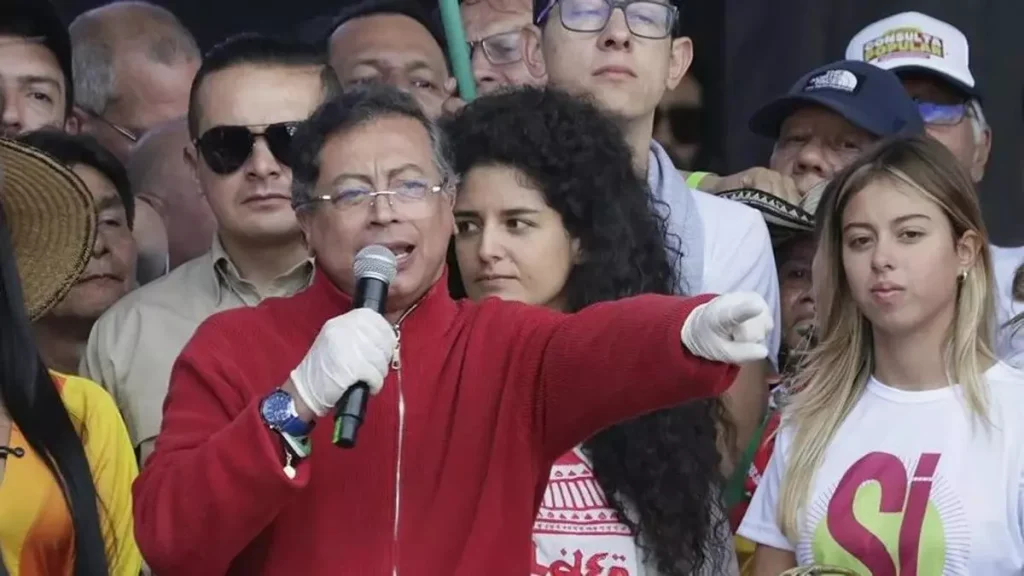
The soon-to-be former president of Colombia is addressing his base with the aim of keeping the spark alive and generating chaos, “civil disobedience,” and insurrection once he leaves power. On Tuesday night, Petro openly refused to recognize the president-elect while addressing his supporters in a public square. It can be inferred from his words that he is urging them to form a kind of Chavista-style militia – that is, paramilitary groups – to defend his legacy and to refuse to recognize the new government.
The president’s words have been rejected by public opinion, though not by his fellow party members and militant intellectuals. “How long will the effects of that fraud last? They’re already saying, in Marco Rubio’s offices, ‘Abelardo the brief’ – they already sense that he won’t even last the full four-year term, that the Colombian people will force him to resign,” Petro declared. His crowd then chanted in response: “Cepeda for president. Resistance.”
“Petro is a coup-monger. He’s no longer just talking about fraud and refusing to recognize the president-elect – now he’s openly calling for him to be removed from power before his term even ends”
Santiago Velez, a columnist for El Espectador, noted on X this week that despite governing badly, lying, and improvising, Petro “completely dominates the public conversation” – proof of this being that nine of the ten most-liked tweets in Colombia over the past 30 days are his. Following the president’s inflammatory remarks, Velez stated in a couple of tweets that “Petro is a coup-monger. He’s no longer just talking about fraud and refusing to recognize the president-elect – now he’s openly calling for him to be removed from power before his term even ends. He is practically calling for a coup d’etat. That cannot be normalized.”
In another tweet he expanded on his observation: “Petro calling for the formation of paramilitary groups and calling for the president-elect to be brought down doesn’t surprise me. After all, he has always been an insurgent who took up arms against the State and never stopped holding legality and institutions in contempt. What is truly terrifying, to paraphrase Martin Luther King, is not the shouting of bad people, but the silence of good ones: the silence of so many important, educated, influential, and supposedly institutional people who today prefer to say nothing. In two days Petro has called for the formation of paramilitary groups and for a coup d’etat. And I am not exaggerating,” the lawyer stated.
This state of tension and uncertainty toward which the outgoing president is pushing the country – unprecedented until now in the recent history of Colombian politics – no longer merely reflects a bad loser and an antidemocratic politician, but confirms the enormous damage Gustavo Petro has caused to the dignity of the office he holds, in addition to using that position to damage and erode trust in institutions, as well as the forms, customs, and practices governing the transfer of political power in Colombia – practices that, until his arrival at the Casa de Narino, had been respected regardless of the sitting president’s political and ideological leanings.
The widespread suspicion is that Petro does not act this way because he genuinely believes all the outlandish claims he makes, without evidence or any real basis, but because he needs to distract from and downplay the multiple corruption scandals that have erupted around him in recent months, adding to those that have been piling up since he took office.
Translated by GH.
______________________
COLLABORATE WITH OUR WORK: The 14ymedio team is committed to practicing serious journalism that reflects Cuba’s reality in all its depth. Thank you for joining us on this long journey. We invite you to continue supporting us by becoming a member of 14ymedio now. Together we can continue transforming journalism in Cuba.