While Díaz-Canel insists that socialism is not being abandoned, some members of the single party and intellectuals warn against “the country’s return to a pure and hard capitalist regime.”
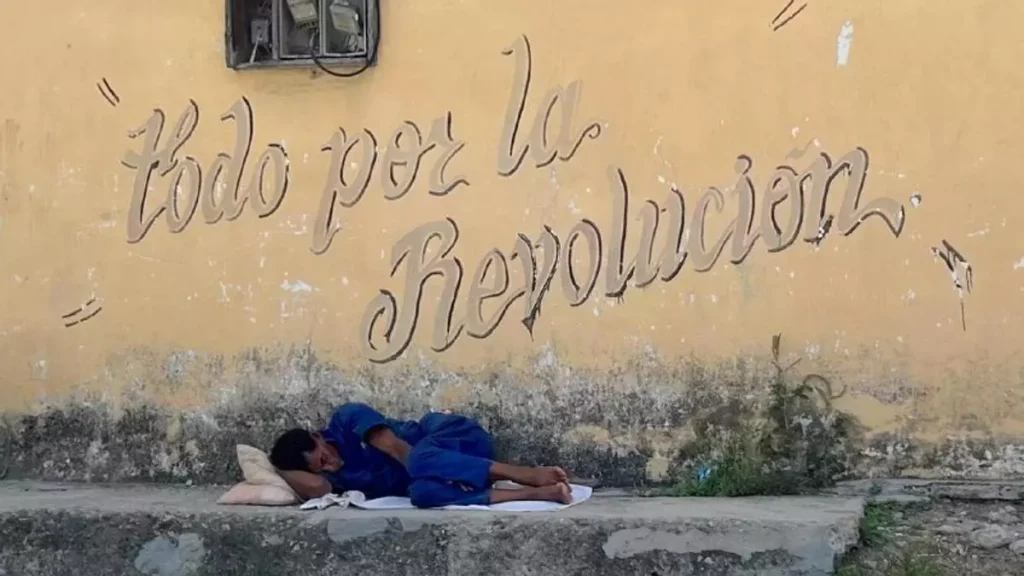
 14ymedio, Madrid, August 4, 2026 / Although for more than six decades the main decisions of the Cuban leadership have been accepted with the same “unanimity” and vertical discipline, without public debate or democratic consultations, the new economic reforms promoted by the regime and the recent prominence of Raúl Guillermo Rodríguez Castro – grandson and protégé of Raúl Castro, known as El Cangrejo, The Crab – have revealed the discontent of sectors within the communist apparatus itself.
In the recent session of the National Assembly, where a package of 176 measures restructuring the economy and state administration was approved, top leaders insisted that the changes do not represent a renunciation of the political and economic model the regime has defended for more than six decades. Faced with critiques that interprets them as an opening to the market, President Miguel Díaz-Canel reiterated during the closing session: “The transformations we are implementing today are not for more capitalism, but to defend and advance socialist construction.”
“The transformations we are implementing today are not for more capitalism, but to defend and advance in the construction of socialism.”
That does not appear to be the interpretation of some sectors within the official regime itself. Some political figures, intellectuals, and activists believe that the opening implied by the reforms breaks with historical tenets of Cuban socialism or that, at the very least, it will favor new power groups over the population. Díaz-Canel himself had already admitted in an interview with the Puerto Rican newspaper Claridad that there are “divided opinions” within the Communist Party regarding these measures. “These are measures that have contradictions, that have risks.”
Very severe criticisms have come from sectors of the official left. The digital media outlet Punto y Aparte [literally ‘period, new paragraph’], which presents itself as an alternative left-wing platform comprised of members of the Communist Party and the Union of Young Communists, denounces in an editorial that some reforms “imply the country’s return to a pure and simple capitalist regime, that will accentuate inequalities.”
“Today the nation walks a tightrope: on one side, imperial voracity and the promise of invasion and death; on the other, the arrogance and pettiness of a group of officials and businessmen who have already shown too many times that they are not up to the historical moment,” Punto y Aparte publishes.
The media outlet demands that, in order to “redirect this period of change towards a horizon of equity,” popular participation must be called for “with a demand for even further review and modification for all those measures that threaten to plunge the people into poverty, precariousness and defenselessness…”
These preoccupations had already been raised by critics of the regime from other perspectives. Cuban economist Pedro Monreal qualified the package of measures as “anti-worker” because, he argued, “it does not balance the rights of workers and employers within an economy governed by market rules. Nor does it recognize democratic mechanisms of checks and balances for workers in the workplace.”
Furthermore, a document obtained by the EFE news agency, signed by members of the Communist Party and titled “Promoting Socialism from People’s Power,” states that some measures “far exceed what has historically been considered acceptable and even contradict the traditional representations of socialism among our people.” The text also demands that these transformations be openly debated within the communities.
Another of the critical voice within the ruling party itself has been that of Alejandro Sánchez, secretary of the Union of Young Communists at the University of Havana. “The necessary discussion is who will be the real beneficiaries of these transformations. If the answer is ‘everyone,’ that would be false,” he wrote. Sánchez also calls for greater popular participation in these decisions: “That power cannot be exercised solely from above; it must also come from greater popular participation and oversight. This latter point remains a shortcoming of the Cuban political system.”
“That power cannot be exercised solely from above; it must also come from greater popular participation and oversight. This latter point remains a shortcoming of the Cuban political system.”
Some of the reforms have also been criticized by the scientific community. Among the measures approved was the Law on the Organization of the Central State Administration, which, as part of the reduction of the government apparatus, led to the elimination of the Ministry of Science, Technology and Environment (CITMA) and the redistribution of its institutions between two new ministries. The head of the National Seismological Service, Enrique Diego Arango Arias, described the agency’s elimination as a “grave error” and criticized the fact that the measure was adopted without consulting the workers or presenting any supporting studies.
“More than a few specialists, including many founders, have opposed this dismantling. We opposed it because this decision was never preceded by an explanation or an analysis with the workers and directors of these institutions; the reasons were never explained to us,” he wrote. He also warned that the disappearance of the Ministry of Science, Technology and Environment (CITMA) amidst the country’s current crisis jeopardizes the stability of internationally recognized scientific institutions and undermines the morale of their professionals.
The other element of controversy for these sectors is the role that Raúl Guillermo Rodríguez Castro has been assuming. Raúl Castro’s grandson and bodyguard acknowledged in an interview with USA Today the privileges he enjoys and presented himself as one of the Cuban side’s interlocutors in contacts with the US, despite not holding any known public office. This position has drawn criticism even from within the government.
Michel Torres Corona, presenter of the program Con Filo, publicly questioned Rodríguez Castro and Sandro Castro about the privileges that both grandsons display on social networks and in public spaces: “There is no harangue or complaint that calms the indignation caused by these fruits of ‘socialist’ nepotism: what justifies their impunity?”
In statements to EFE, Torres Corona defended the existence of “very heterogeneous” positions within the Island and affirmed that these can be expressed “even from critical or divergent positions,” as long as unity is not broken.
______________________
COLLABORATE WITH OUR WORK: The 14ymedio team is committed to practicing serious journalism that reflects Cuba’s reality in all its depth. Thank you for joining us on this long journey. We invite you to continue supporting us by becoming a member of 14ymedio now. Together we can continue transforming journalism in Cuba.