Cuba’s ruling party is divided in its criticism of Raúl Castro’s grandson, and the prime minister calls for unity: “Character assassination, manipulation, and calls for division and fracture are part of a well-designed plan.”
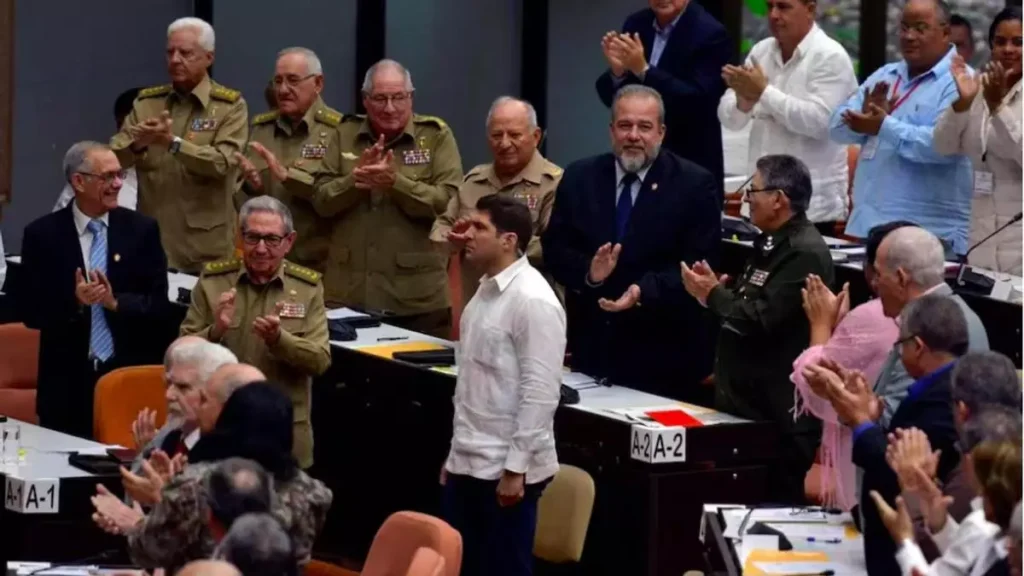
 14ymedio, Madrid, July 10, 2026 – The Cuban Communist Party (PCC) and the Government’s previously tacit support for Raúl Guillermo Rodríguez Castro’s role as a key figure in negotiations with the U.S. became explicit on Thursday. El Cangrejo [‘The Crab’] as the grandson of former President Raúl Castro is known on the Island, received an unmistakable endorsement from the PCC through Elier Ramírez Cañedo, an official in the Ideological Department of the Central Committee.
The party official forcefully rejected the many criticisms directed at the young Castro from within the regime itself and made the Party’s position unmistakably clear midway through his post. “The manipulation and lies, the yellow journalism surrounding Raúl Guillermo, as the Cuban side’s interlocutor, by decision of the country’s highest leadership, serve that objective,” he wrote.
Last Monday, the U.S. newspaper USA Today published a lengthy article based on two interviews with Rodríguez Castro, people close to him, and experts on Cuban politics. The piece portrayed the general’s grandson as someone groomed by his grandparents, for whom he expressed genuine admiration, as well as for his great-uncle Fidel, aware that he had lived a life of privilege and who sees himself as capable of helping the country prosper through negotiations with the United States.
“The manipulation and lies, the yellow journalism surrounding Raúl Guillermo, as the Cuban side’s interlocutor, by decision of the country’s highest leadership, serve that objective,” he wrote
The article struck a nerve among some regime supporters who were upset by Rodríguez Castro’s prominence and by the selection of someone technically outside Cuba’s political class. María del Carmen Hernández Carús, the mother of Miguel Díaz-Canel’s communications chief, openly lashed out in a post that many believed had the backing of the presidential inner circle. “Why is this young man allowing himself to be interviewed and assuming a role that is not his? Could someone please bring this boy back down to earth? Could someone tell him to keep quiet?” she wrote. The post also suggested that “Cuba’s enemies” were behind the situation, seeking to claim that only members of the Castro family can have a voice in Cuba and therefore to undermine the president.
A similar view was expressed indirectly by Israel Rojas, one of the musicians most closely associated with the regime. Responding on Facebook to a post by historian and journalist Ernesto Limia, Rojas wrote: “No familiarity or casualness on the part of a revolutionary leader can justify bypassing, even symbolically, the country’s institutions.” The member of the duo Buena Fe lamented that Castro’s grandson represents the opposite of the Revolution’s ideal, describing instead “men and women who bear the burden of the embargo and internal blunders. Far removed from luxuries, yachts, indecent gifts, and VIP areas, he complained.”
“Men and women who bear the burden of the embargo and internal blunders. Far removed from luxuries, yachts, indecent gifts, and VIP areas,” he complained
The situation shifted after Elier Ramírez Cañedo’s remarks. While defending El Cangrejo’s appointment, he blamed the U.S. press for trying to distort negotiations that, he argued, should remain discreet. “What marks a break from the past is that the current U.S. administration has been neither serious nor discreet during the process, causing leaks that put it at risk and create uncertainty about its true intentions,” he said.
Although Rodríguez Castro himself voluntarily spent several days speaking with USA Today reporters, the party official referred to “a media operation from the U.S. aimed at promoting a narrative of division within our country’s leadership, including character assassination, something that is not new but takes on greater significance in the context of the crisis Cuba is experiencing.”
Although Ramírez’s post received overwhelming support, many commenters demanded an explanation for why El Cangrejo agreed to the interviews. “But this man’s public appearances are real, even on our own media outlets. Don’t the people deserve an explanation? Trust is not requested blindly; it is built,” one user wrote. Another added: “The interview is a total insult to the people and to their intelligence. If the interviewee really is playing a role in some negotiation and that role is supposed to remain secret, he should have refrained from speaking publicly with such recklessness and arrogance. And if he made a mistake, then it is up to the country’s leadership to clarify whatever is necessary. The country belongs to all of us, not just a small group of chosen people.”
Former Culture Minister and former president of Casa de las Américas Abel Prieto, however, praised Ramírez’s post on Facebook: “Thank you, Elier, for that precise and necessary text. Today, more than ever, it is essential to preserve unity and avoid falling into our enemies’ traps. They shall not pass!!!”
The disagreement escalated to the point that Prime Minister Manuel Marrero addressed it on X on Thursday using language strikingly similar to Ramírez’s, suggesting he supports the same position. “As President Miguel Díaz-Canel has stated, in keeping with the Revolution’s consistent policy, talks have been held with representatives of the U.S. government aimed at seeking solutions to bilateral differences through dialogue,” he began in a short thread.
The prime minister went on to say that it is not the Revolution’s leadership’s practice “to respond to speculative campaigns” about such sensitive matters and that “the working team entrusted with this strategic responsibility enjoys the confidence, support, and mandate” of Raúl Castro and Díaz-Canel. “Character assassination, manipulation, and calls for division and fracture are part of a well-designed plan to generate uncertainty and distrust. Every step taken at this decisive historical moment is in defense of the Revolution and our sovereignty,” he said. Given the similarities with Ramírez’s statement, it is widely assumed that, without naming El Cangrejo, Marrero was acknowledging that he is indeed the designated negotiator.
Given the similarities with Ramírez’s statement, it is widely assumed that, without naming El Cangrejo, Marrero was acknowledging that he is indeed the designated negotiator
USA Today followed up on the controversy Friday, consulting additional sources. “Many Cubans were caught off guard this week by Rodríguez Castro’s freedom to speak openly about sensitive diplomatic negotiations,” said Michael Bustamante, a history professor at the University of Miami.
Bustamante believes there is confusion within the ruling establishment over El Cangrejo’s prominence, but says it is now effectively acknowledged that he is the key figure. The newspaper notes that Castro’s grandson is virtually the only member of the leadership and its relatives not subject to sanctions. “People are asking: ‘Who is this guy, speaking this way? Has he fallen into a trap? Is he the person chosen by the U.S. media to sow division?’ This open approach is not consistent with the style and discretion of traditional Cuban diplomacy. But the truth is that no one has denied it,” Bustamante added.
The astonishment was also reflected in the comments of former Cuban diplomat and former ambassador to the European Union Carlos Alzugaray, who responded directly to the USA Today article: “I cannot believe that any level of the Cuban leadership authorized something so crude and clumsy regarding such a delicate matter.”
Translated by Regina Anavy
______________________
COLLABORATE WITH OUR WORK: The 14ymedio team is committed to practicing serious journalism that reflects Cuba’s reality in all its depth. Thank you for joining us on this long journey. We invite you to continue supporting us by becoming a member of 14ymedio now. Together we can continue transforming journalism in Cuba.