The “total disconnection” comes three days after the most recent breakdown at the country’s largest thermoelectric power plant.
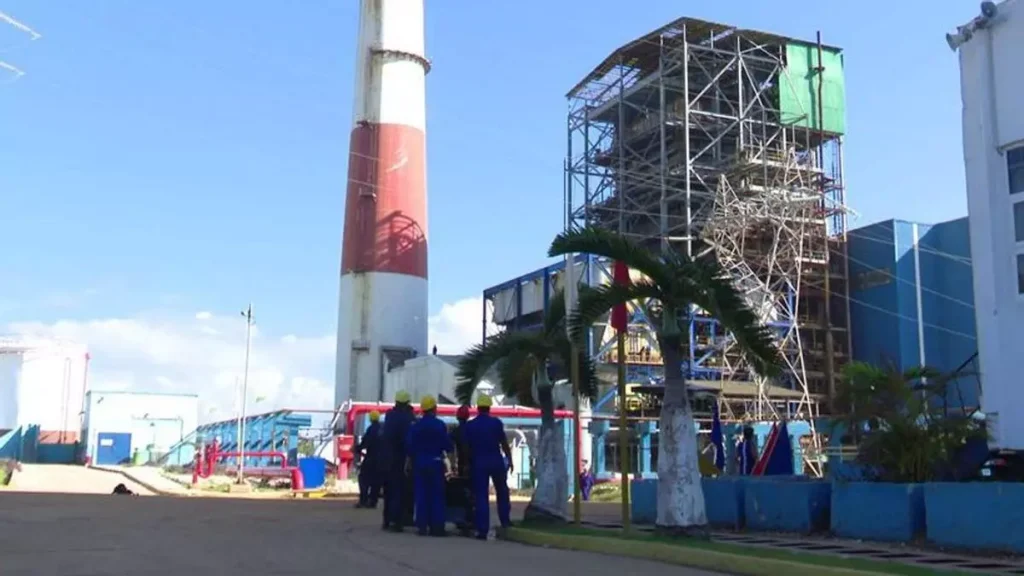
 14ymedio, Havana, July 6, 2026 – This Monday, three days after the latest shutdown of the Antonio Guiteras thermoelectric power plant in Matanzas, the country’s largest, those Cubans who still have internet access were able to read the words they fear most from Cuba’s Electric Union (UNE). “A total disconnection of the National Electric System has occurred,” the state company announced in a brief Facebook post, ending, as it usually does, by stating that “the causes are under investigation.”
The post was immediately filled with humorous comments, demonstrating the resignation of the island’s inhabitants. “The research team has certainly been busy lately,” said Litsandra Rodríguez. “The UNE is the new research department in Cuba; they investigate more than the DTI,” wrote Eliza Enamorado, referring to the National Revolutionary Police Department of Technical Investigations. And Rodolfo Tercero quipped, “Oh, they’ve got me intrigued. What could be the reasons?”
From the moment the National Electric Union (UNE) issued its report early this morning , the outlook for the day was bleak, quite literally. The country awoke with less than 900 megawatts (MW) of available power, and this was expected to remain the case. This was nothing extraordinary, given the list of thermoelectric plants out of service or undergoing maintenance, in addition to the Guiteras plant, covering the entire country: the Máximo Gómez plant in Mariel (Artemisa); the Ernesto Guevara plant in Santa Cruz (Mayabeque); the Diez de Octubre plant in Nuevitas (Camagüey); the Felton plant in Holguín; and the Renté plant in Santiago de Cuba.
The country woke up with less than 900 megawatts (MW) of available power, and this was expected to continue.
With the distributed generation plants and the Regla ‘patana‘ [floating power plant] out of service due to lack of fuel, for peak hours, for a demand of 3,100 MW, only 935 MW were expected to be available, and an outage of 2,195 MW. That is, more than 70% of the energy needed.
This total blackout is the third so far in 2026 and no less than the eighth in two years. The previous ones, which occurred on March 16 and 21 , respectively, were caused precisely by the Guiteras plant, the most important in the country, being taken offline. Therefore, since Friday, when the latest breakdown at the plant occurred, adding to the other units out of service, this was expected.
In previous instances, “micro-islands” have been used to reconnect the system, which are then unified. Nearly two hours after the incident, the Havana Electric Company confirmed that “one of the generating units at Energás Boca de Jaruco,” the plant where reconnection always begins, was already back in service. Shortly before 4:00 p.m., the National Electric Union ( UNE) stated on its social media: “Microsystems are now operational throughout the country to guarantee the protection of vital services.”
Much of the population, in any case, hadn’t even noticed this collapse of the National Electric System. In several Havana municipalities, for example, residents had already endured more than 20 hours of power outages.
The incident casts a cruel irony on the words spoken last Tuesday by Edier Guzmán Pacheco, director of thermal generation at UNE, who assured that the month of July, with the incorporation of several thermoelectric units into the system, would be better .
Translated by Regina Anavy
______________________
COLLABORATE WITH OUR WORK: The 14ymedio team is committed to practicing serious journalism that reflects Cuba’s reality in all its depth. Thank you for joining us on this long journey. We invite you to continue supporting us by becoming a member of 14ymedio now. Together we can continue transforming journalism in Cuba.