This group joins the 40 who decided not to return to the island and to sign directly with the Caribbean country
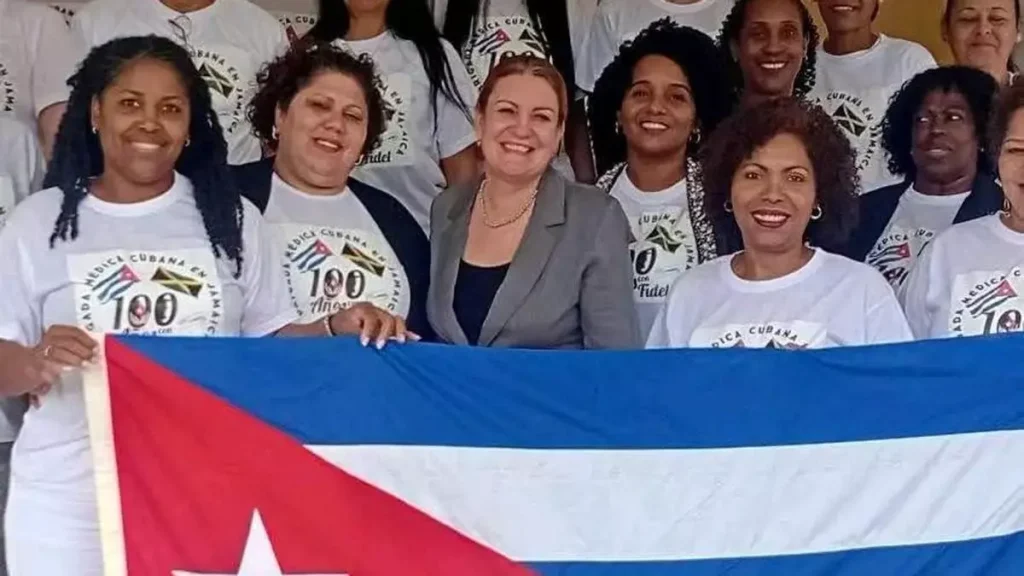
 14ymedio, Madrid, July 6, 2026 / Jamaica’s Minister of Health, Chris Tufton, announced this weekend that around 50 Cuban nurses will return to the country to address the staffing shortage. If that number materializes, the island’s health workers joining the Jamaican system through individual contracts would approach a hundred.
The contract under which the Cuban government supplied health professionals to Jamaica broke down in March after the parties failed to agree on a renewal that would meet Washington’s demands. Cooperation between the two states went back half a century at that point, and the last signed contract had expired in 2023, but nearly 300 workers remained in the Caribbean country awaiting an extension.
Since March 2025, US Secretary of State Marco Rubio began pressuring governments that maintained contracts with Cuba for the export of medical services to end them. Washington held – based on complaints from workers and various international organizations – that the agreements amounted to a form of labor slavery and violated workers’ rights, though the underlying goal was to cut off the clear flow of foreign currency that the export of doctors provided to the regime.
Cooperation between the two states went back half a century at that point, and the last signed contract had expired in 2023, but nearly 300 workers remained in the Caribbean country awaiting an extension
Rubio, during a visit to Kingston, tried to convince Prime Minister Andrew Holness, who initially tried to sidestep the issue, stating that his government was “very careful not to exploit Cuban doctors,” but things gradually began to shift.
Jamaica, in dire need of health workers, spent weeks trying to convince Havana to accept new conditions that would allow it to comply with the US. The idea was to establish individual contracts that would keep the regime out of it, at least formally. But there was no way to make it work. “The Government of Jamaica has made the decision to suspend the current agreement on the deployment of medical professionals in the public health sector by the Government of Cuba,” the Foreign Ministry stated this past March.
“This comes after the two governments were unable to agree on the terms and conditions of a new technical cooperation agreement, following the expiration of the previous one in February 2023,” the statement added. Nevertheless, Kingston left the door wide open for the specialists to remain on the island.
“In the interest of continuity of the valuable service provided by the Cuban medical professionals present in the country, and for their certainty and personal wellbeing, the Government of Jamaica has expressed the willingness of the Ministry of Health and Wellness to engage these medical professionals on an individual basis, in accordance with local labor laws,” the statement added.
A total of 40 nurses decided to accept, according to what Tufton himself said shortly afterward, in an interview in May. The Health Minister put the number of Cuban specialists in the country at 278 at the time of the break. “Of that number, more than 40 decided not to return [to Cuba] and were given individual contracts. Now, they are working in the system,” he said.
“Everyone was offered a letter telling them that, if they’re interested, we would be willing to bring them back on based on their own interests, but on the basis of individual contracts. Some have expressed interest in doing so, even though they’ve returned [to Cuba]. So, yes, there is an open invitation, which we have extended, and we have information that some are interested. If they come, we would be prepared to receive them,” he added.
“So, yes, there is an open invitation, which we have extended, and we have information that some are interested. If they come, we would be prepared to receive them”
This Saturday, in stating that around 50 Cubans were set to return, Tufton added that there are professionals from other countries interested as well, including Ghana, on an individual basis, and Nigeria, India, or the Philippines, through agreements with those countries.
The breakdown of the agreement between Jamaica and Cuba opened a small rift between the two countries. While the Cuban government accused Jamaica of caving to US pressure to withdraw the medical mission, the Caribbean island’s version was that Havana ignored its proposals for direct payment and chose instead to withdraw the entire team. The Ministry of Foreign Affairs and Foreign Trade said in March that it was “disappointed” by the outcome.
Washington’s pressure has led most of the countries that contracted health workers with the Cuban state to end their agreements. This is the case with Honduras, Guatemala, Antigua and Barbuda, Dominica, Guyana, and Saint Vincent and the Grenadines. For now, Mexico, several Persian Gulf countries, and the Italian region of Calabria are holding out.
Translated by GH.
______________________
COLLABORATE WITH OUR WORK: The 14ymedio team is committed to practicing serious journalism that reflects Cuba’s reality in all its depth. Thank you for joining us on this long journey. We invite you to continue supporting us by becoming a member of 14ymedio now. Together we can continue transforming journalism in Cuba.