The 2026 Global Passport Index ranks Cuba 143rd in the world, the lowest in Latin America.
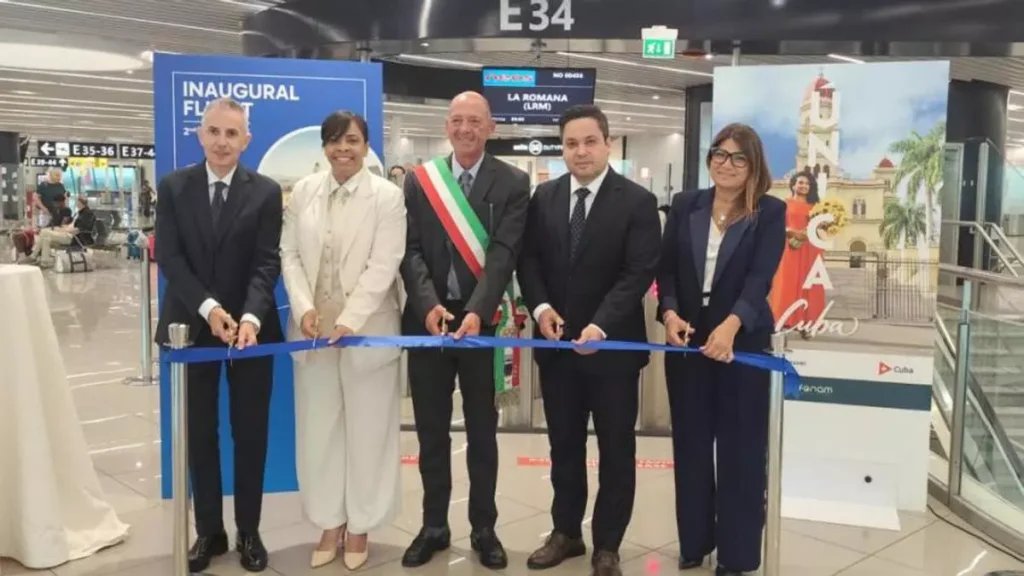
 14ymedio, Madrid, July 3, 2026 – Italian airline Neos inaugurated a new direct route between Rome and Holguín, Cuba, on Thursday, one of the few positive developments for Cuba’s tourism sector at a time when the island continues to lose international air connections and faces the consequences of the energy crisis.
The inaugural flight departed from Leonardo da Vinci International Airport in Fiumicino, Rome, and landed at Frank País Airport in Holguín with 238 passengers on board. The airline will operate the route once a week, directly linking Italy with one of eastern Cuba’s main tourist destinations.
The departure was marked by an official ceremony at the Rome airport, attended by Cuba’s ambassador to Italy, Jorge Luis Cepero, along with Neos executives and representatives of Aeroporti di Roma. The Cuban diplomat said the new connection “represents a significant step toward strengthening connectivity between Italy and Cuba” and will make it easier for European travelers to reach Holguín, a destination the Cuban Government promotes for its beaches, natural landscapes, and cultural heritage.
The inauguration also included a photography exhibition featuring the official Cuba Única campaign, through which the regime is trying to attract foreign visitors despite the difficulties facing the tourism sector.
“We needed this air connection; the trip was perfect, although it’s a 14-hour flight, and now I still have to continue on to Santiago de Cuba”
The new route also provides an alternative for Cubans living in Italy who travel to eastern Cuba to visit relatives, sparing them the long overland journey from Havana to provinces such as Holguín, Santiago de Cuba, Granma, Las Tunas, and Guantánamo. However, reaching the easternmost provinces will still not be easy because of the Island’s transportation shortages. “We needed this air connection; the trip was perfect, although it’s a 14-hour flight, and now I still have to continue on to Santiago de Cuba,” one passenger told the official press.
Neos had already warned about operational difficulties resulting from Cuba’s aviation fuel shortage. In a statement released in February, the airline said that its flights to the Island could experience schedule changes and might even be forced to make technical stops in nearby countries to refuel before continuing the journey.
Neos’ commitment is one of the few positive developments in Cuba’s aviation market. Since the beginning of the year, numerous airlines have reduced frequencies or withdrawn from the Island because of weak demand, operational problems, and fuel shortages at Cuban airports.
In recent weeks, Iberia temporarily suspended its Madrid-Havana route at least until November; Delta Air Lines canceled its Atlanta-Havana service because of declining passenger numbers; Air Transat indefinitely ended its flights to Cuba; and earlier, Air Canada, WestJet, and Air France had already reduced part of their operations due to difficulties refueling.
The Dominican Republic’s Tourism Minister, David Collado, acknowledged that several airlines have redirected routes to his country because of the situation facing Cuba
The situation has also affected Air Europa, which last month announced a fourth weekly flight between Madrid and Havana, making it the only Spanish airline maintaining regular operations to Cuba after the withdrawal of Iberia, World2Fly, and Plus Ultra. However, its Boeing 787 aircraft must stop in Punta Cana to refuel before returning to Spain, a direct consequence of the jet fuel shortage affecting all of Cuba’s international airports since February.
The decline in flights has been accompanied by a reduction in international tour operator activity and the withdrawal of most foreign hotel chains associated with Gaesa, which have been threatened by U.S. sanctions.
Other Caribbean destinations acknowledge that they are absorbing part of the market lost by Cuba. On Thursday, Dominican Republic Tourism Minister David Collado admitted that several airlines have redirected routes to his country because of the situation affecting the Island.
“Cuba is going through a very difficult political and tourism situation, where hotels have closed,” he said while presenting the Dominican Republic’s tourism sector results. Although he insisted that the Dominican Republic “does not take advantage of the situation in specific countries,” he acknowledged that airlines, including some that previously operated from Canada, have shifted flights to the Dominican Republic. He also noted that Condor has added three new routes from Germany and that the country has recorded a 10% increase in flights this year, along with approximately 300,000 additional airline seats.
The 2026 Global Passport Index, compiled by Global Citizen Solutions, ranked the Cuban passport 143rd in the world, the lowest in Latin America
The loss of international air connections adds to the difficulties Cuban citizens face when traveling abroad. The 2026 Global Passport Index, compiled by Global Citizen Solutions, ranked the Cuban passport 143rd in the world, the lowest in Latin America. The Cuban passport allows visa-free entry to only 26 countries and requires visas for approximately 100 destinations, a limitation that affects not only tourism but also the educational, employment, and emigration opportunities of millions of Cubans.
Translated by Regina Anavy
______________________
COLLABORATE WITH OUR WORK: The 14ymedio team is committed to practicing serious journalism that reflects Cuba’s reality in all its depth. Thank you for joining us on this long journey. We invite you to continue supporting us by becoming a member of 14ymedio now. Together we can continue transforming journalism in Cuba.