Human Rights Watch points out that 26% of the 4,453 deportees originating from the Island had no criminal charges at all.
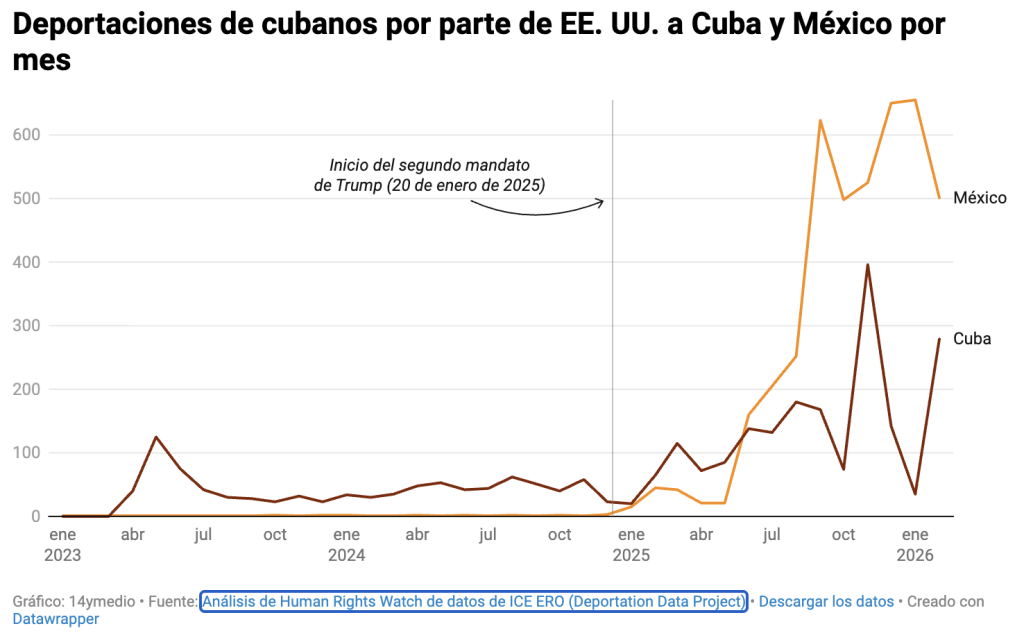
 14ymedio, Madrid, May 27, 2026 — The deportations of Cubans to Mexico have multiplied exponentially during the second term of Donald Trump, reaching 4,453 when counting from January 2025 through March 2026. Of the total, 55% had criminal records in the United States, 16% had pending charges without conviction, and 26% had no criminal case at all. In addition, only 16% had, as their most serious conviction, a violent or potentially violent crime.
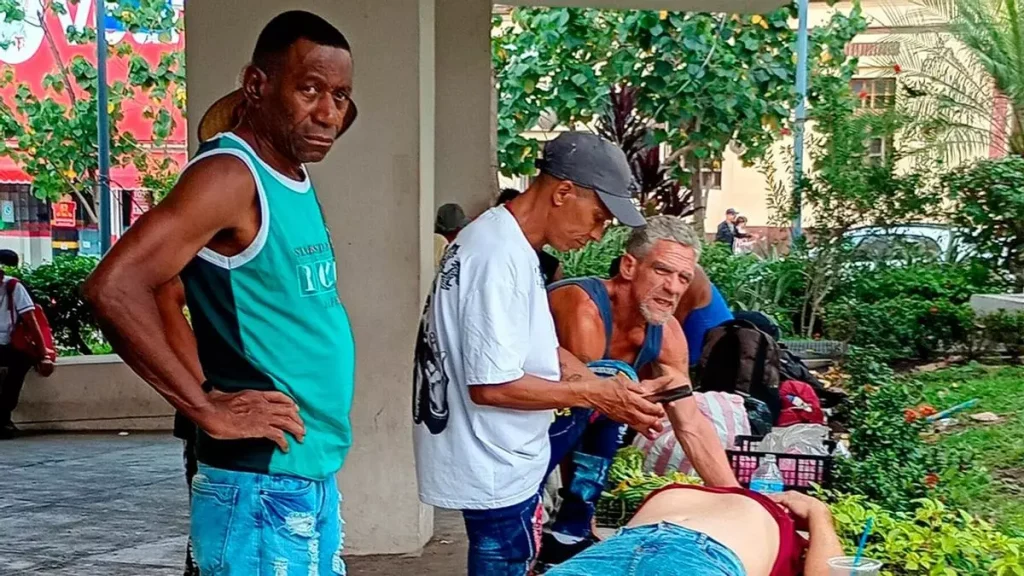
Many of them, moreover, are elderly people with serious health problems who lived many years in the U.S. and now find themselves in Mexico under an opaque agreement signed between both countries, and their situation is one of great helplessness, as denounced by a report by Human Rights Watch (HRW) published this Wednesday. The 66-page document is titled “Casting Us Aside to Die” and includes interviews with citizens from other countries who were also handed over to Mexican authorities, although the majority were from Cuba, a peculiar situation, since never before had the Island accounted for the bulk of deportations.
“The Trump Administration is using Mexico as a dumping ground for people it cannot deport to their countries of origin, including many Cubans who have been in the United States for decades,” said Alcira Silva Hava, HRW researcher, who also extends responsibility to the Mexican Government. “It offers them no pathway to obtain durable legal status outside the asylum system, leaving many in limbo, without housing, without medication, and at the mercy of criminal organizations.” Of the 18,000 deportees, 13,000 were sent to the neighboring country (70%), with Cubans being the nationality with the highest number.
“The Trump Administration is using Mexico as a dumping ground for people it cannot deport to their countries of origin, including many Cubans who have been in the United States for decades”
To prepare the document, 53 people deported to Tapachula (Chiapas) and Villahermosa (Tabasco) were interviewed, of whom 41 were Cuban men. Most had lived for years or decades in Florida, where they arrived fleeing misery and/or the lack of freedoms in Cuba. “Many had created businesses, owned homes, and left relatives in the United States. Most are 60 years old or older and suffer from chronic illnesses requiring continuous medical treatment,” the report specifies, denouncing that none of them even had the opportunity to challenge the deportation, which constitutes a violation of rights and due process, according to U.S. and international law.
Those affected revealed numerous abuses by the U.S. Government. “In immigration detention centers they suffered overcrowding, extreme temperatures, inadequate food, poor access to medical care, and lack of access to information about their cases, as well as physical and verbal violence by guards.” Some interviewees described situations in those places as unheard of as consuming contaminated food. “The water was contaminated, it contained feces, and you could see them on the floor when you went to shower… People had spots all over their bodies, their fingers were rotting; that’s what Alcatraz was like,” said a Cuban named Miguel Ángel.
“Fifteen days without seeing daylight. Fifteen days without going out, without calls, receiving food through a slot in the door. I was alone, isolated. They drive you crazy, they don’t tell you how long you’ll be [in isolation],” another described about the center in El Paso, Texas. In this place, another interviewee, Gonzalo, spoke about a violent incident involving a detainee to whom “they put a foot on his neck,” and who later died from the injuries. The account matches the case of Geraldo Lunas Campos, classified as a homicide caused by “compression asphyxia of the neck and torso” in a forensic report.
Things have not improved much upon arriving in the neighboring country either. “They are leaving us here to die,” said one of the Cubans. “There is no help. We cannot work because we have no papers. They give us nothing, absolutely nothing… How are we supposed to eat, pay rent?” Interviewees revealed problems obtaining work and medical care; in addition, they are in cities struggling to provide basic services and with high levels of violence. The report also denounces that U.S. aid cuts to UNHCR — the U.N. refugee agency — have influenced this situation.
Until April 2026, Mexican law also did not facilitate movement, since valid identification is required to travel through the country in search of better options
Until April 2026, Mexican law also did not facilitate movement, since valid identification is required to travel through the country in search of better options. Asylum has been the only option, but it is difficult to obtain for various reasons, from the complexity of bureaucracy to lack of resources, not to mention the fact that, after decades outside Cuba, many exiles lack the ability to prove a well-founded fear of persecution on the Island.
All the Cubans interviewed, except one, said they had had legal permanent residency at some point, although 35 of them lost it because of offenses that may be considered minor, such as driving after drinking alcohol, falsification of documents, or minor drug-related charges. Six of them had more serious offenses, such as assault or weapons possession. They were never returned to Cuba because of the absence of migration agreements and remained in the U.S.; most rebuilt their lives, obtained work permits, and lived normally — under supervision, some of them — until 2025.
Of all those interviewed, only three agreed to be deported to Mexico, “including two who said they had relatives kidnapped or murdered there.” “If you are 60 or 70 years old, why do they send you here?” Mario, 60, said through tears. “They send us here to die.”
The report includes details from several interviews, such as that conducted with Javier, 62, who arrived in the U.S. at age 18 and combined his studies with a job as a waiter. “I have spent 44 years in the United States. I went to college and kept working nonstop.” When he was detained he had two different jobs, one at a car dealership and another at a convention center. “You know? Some of the people I met [in the ICE detention center] had been in the United States for more than 40 years; it’s incredible,” said Manuel, 63, a resident of West Palm Beach, after leaving Cuba at age six.
“You know? Some of the people I met [in the ICE detention center] had been in the United States for more than 40 years; it’s incredible,” said Manuel
The document contains extensive sections on the background of migration policies in both the U.S. and Mexico, as well as the reasons and methods for leaving Cuba, mostly during the Mariel boatlift. Some also spoke about recent political motives, an occasion HRW uses to recall that “repression continues on the Island, where authorities continue punishing dissent and arbitrarily detaining critics and protesters.” Added to this is the progressive worsening of economic conditions.
The report highlights other issues, such as those who lived for years with deportation orders that were never enforced, contributing to a false perception of security. There is also a meticulous review of their medical problems, since 20 of the 41 interviewees had illnesses, 14 of them chronic and some as serious as cancer. Several have depression and trauma related to their current status.
A significant number of respondents also spoke about their established situation in the U.S., where they left their relatives behind, and the desperation of finding themselves trapped in Mexico without dignified conditions.
The report includes a series of demands for the countries involved. It calls on the United States to guarantee people facing deportation an individualized review, access to evaluations to assess their protection claims, and humane detention conditions if detention is considered necessary.
It demands that Mexico provide emergency access to shelter, medical care, and a pathway toward permanent legal status for the deportees it has received. And for Cuba it also has at least a couple of messages: that it respect the right of its citizens to return to their country, as established by international law; and that it ensure consular authorities in Mexico attend to and provide consular services to those affected, whether they wish to obtain permanent residency in the country or voluntarily return to the Island.
Translated by Regina Anavy
______________________
COLLABORATE WITH OUR WORK: The 14ymedio team is committed to practicing serious journalism that reflects Cuba’s reality in all its depth. Thank you for joining us on this long journey. We invite you to continue supporting us by becoming a member of 14ymedio now. Together we can continue transforming journalism in Cuba.