“Spanish hotel companies could discover that their historical advantage rests on a more fragile foundation than it seemed,” says an expert
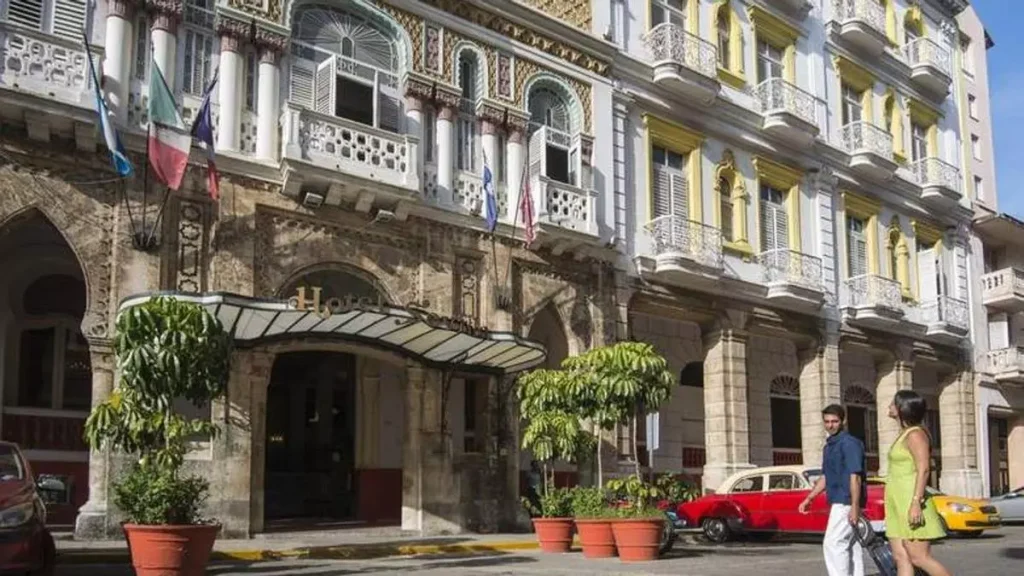
 14ymedio, Madrid, May 26, 2026 — Decades of investments by Spanish companies in Cuba could be reduced to ashes if Donald Trump’s administration demands the tourism sector as spoils in its negotiations with the Island. The theory is laid out in a report published this Tuesday by El Confidencial, which starts from the undeniable premise that no foreign hotel company actually owns the establishments it manages.
“It would be very easy, under pressure, for a new Cuban government to terminate the contract with a Spanish company and give the contract to an American company,” says Paolo Spadoni, professor at Augusta University in the United States and an expert on Cuban tourism. The specialist reinforces the newspaper’s argument by considering tourism the only sector capable of producing immediate returns.
“Few things appeal to Trump more than a grand luxury hotel,” writes the reporter, who begins the article by discussing the U.S. president’s need for a quick and effective victory after the fiasco in Iran. In Venezuela, it became clear that the objective was control of the oil industry, the article continues, and in Gaza there was even a presentation of a far-fetched project to build a luxury resort after the signing of a peace agreement.
Cuba has nothing, the article says, except one thing: its global brand as a paradisiacal tourist destination.
Cuba has nothing, the article says, except one thing: its global brand as a paradisiacal tourist destination. “If the United States succeeds in forcing Cuba’s economic opening and lifts travel restrictions, the impact would first reach airlines, cruise companies, booking platforms, tour operators, vacation rental businesses and, of course, hotel chains,” the expert says, referring to a marketthat Spanish entrepreneurs have dominated for decades.
Meliá, Iberostar, Barceló and NH “learned how to operate on the Island, assumed the political cost of doing so and positioned themselves in one of the few Cuban sectors capable of generating foreign currency,” the article argues, maintaining that the goal was to be well positioned when change finally arrived in Cuba. However, things could change overnight if Washington claims the prize.
“American companies would arrive late, but with the backing of the actor that forced the change. The Spanish companies, meanwhile, could discover that their historical advantage rests on a more fragile foundation than it seemed.”
The article addresses the relationship with the military conglomerate Gaesa, the main actor with whom the Spanish companies had to negotiate and which is now completely tainted by sanctions. Most companies operate within this scenario, according to an interview also published today in the Spanish press.
The article focuses on the shrinking arsenal of legal defenses currently available to European companies. When the Helms-Burton Act was approved in 1996, the European Union responded by creating the Blocking Statute, which protects European companies from extraterritorial measures. There was also a diplomatic offensive that led to the suspension of Titles III and IV of that law, which were activated by Trump’s first administration two decades later.
Now, since 2023, the European Union has another weapon: the Anti-Coercion Instrument, better known as the “trade bazooka,” which allows direct commercial retaliation if authorities determine that measures are intended to influence EU policies or those of its member states. What remains uncertain is whether the 27 EU countries would decide to enter that battle while they already face more significant disagreements with the U.S. administration, including the war in Ukraine and Washington’s decision not to enter the conflict with Iran.
“Spanish hotel companies do not have much room to maneuver in this. They are at the mercy of whatever happens”
“Spanish hotel companies do not have much room to maneuver in this. They are at the mercy of whatever happens,” says Spadoni. The expert believes there is only one obstacle to the possible American plan to seize control of the tourism sector: the need to completely transform all of the Island’s infrastructure, from airports to payment systems, telecommunications networks, roads, electricity and countless other things.
In the Dominican Republic, the professor says, tourism eventually pulled the rest of the economy along with it, but in Cuba it will not be so easy. There are factors dragging everything down, such as the weak presence of the private sector in a country where every large company is state-owned and also dependent on imports. “Tourism in Cuba is not embedded in an economy capable of creating productive linkages. It is an exhausted, inefficient and overly centralized economy, and that is why tourism cannot play the same role it does in other countries,” he warns.
The article concludes on a pessimistic note for the population, as the expert adds that it will take “a very long time” for improvements to translate into salaries, consumption and opportunities for ordinary citizens. “Until then, Rubio’s promised new Cuba could look far too much like the old one: an Island where dollars enter through the hotel door, but rarely make it to the street.”
Translated by Regina Anavy
______________________
COLLABORATE WITH OUR WORK: The 14ymedio team is committed to practicing serious journalism that reflects Cuba’s reality in all its depth. Thank you for joining us on this long journey. We invite you to continue supporting us by becoming a member of 14ymedio now. Together we can continue transforming journalism in Cuba.