The Cuban activist says the Cuban Classical Liberal Party was born as “a challenge to tyranny” and promises to prepare proposals for a democratic transition.
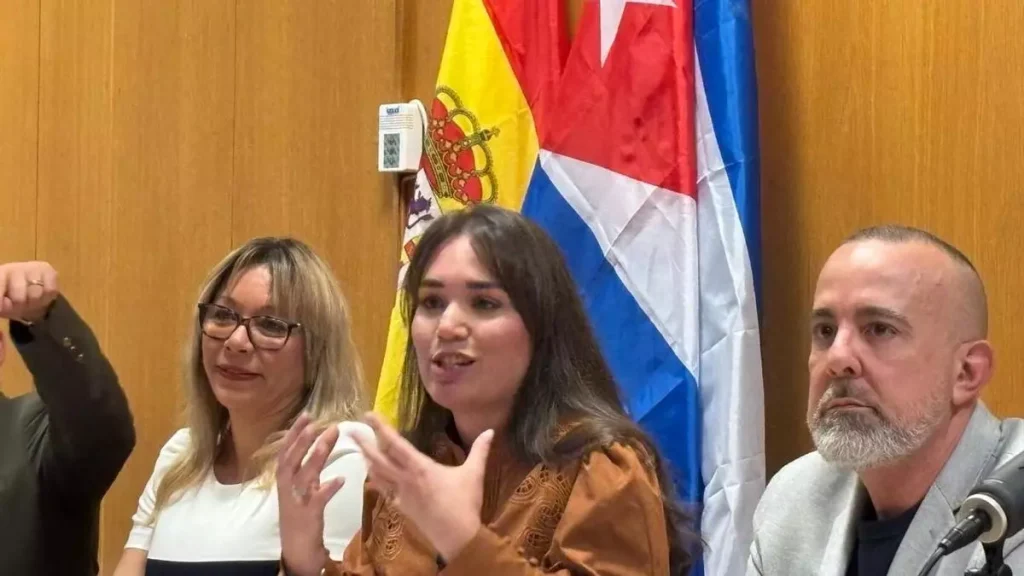
 14ymedio, Madrid, May 21, 2026 – At the Casino de la Reina in Madrid, before nearly fifty Cubans, activist Amelia Calzadilla presented this Tuesday the Cuban Classical Liberal Party (Partido Liberal Clásico Cubano, PLC), a political organization opposed to the Havana regime that aspires to bring together Cubans inside and outside the Island around a proposal for a future democratic transition.
The event served to officially launch a project that Calzadilla had announced weeks earlier as the Cuban Orthodox Liberal Party. The new name, its promoters explained, seeks to better define its ideology: classical liberalism, defense of private property, reduction of state control, separation of powers, and rule of law.
“This is, above all, a challenge to tyranny,” Calzadilla said during the presentation. “Here we are, free Cubans, organized, trying to defend what belongs to us.” The activist insisted that the opposition cannot limit itself to denouncing the regime but must begin preparing answers for the future. “Governing a country is not a prize, it is a responsibility,” she stated.
The activist insisted that the opposition cannot limit itself to denouncing the regime but must begin preparing answers for the future
Calzadilla, known for her social denunciations from within Cuba and for her later exile, sought to distinguish political commitment from improvisation. The new party, she said, was not created to distribute positions or feed vanity, but to think about the “day after” the dictatorship. Its proposal, she explained, starts from the idea that the State must stop occupying everything. “The State is not a decision-maker; it is a servant. The decision-makers are the citizens,” she argued.
“We are not center-right, but right-wing,” said Lucio Enríquez Nodarse, the party’s treasurer, repositioning the party, which Calzadilla had originally described as centrist. The definition, he explained, does not imply an extremist position nor the complete disappearance of the State, but rather a clearer defense of classical liberalism.
“We believe the State has to participate in some very controlled aspects,” he said. A physician by profession, Enríquez used healthcare and education in a future Cuba as examples: “We need a strong healthcare system, and the healthcare system as we conceive it is mixed: public and private. So there is a social component there. As you can see, there is no extremism there.” The same, he added, should apply to education. According to Enríquez, the party does not rule out State participation in certain areas, always with the aim of helping the most vulnerable people.
Registration in Spain places the PLC in a unique situation. Legally it is a Spanish party, but politically Cuban and diasporic in its social base. Calzadilla made clear that she does not plan to run in any electoral process in Spain, something Spain’s Party Law does not require, although it does require political activity.
The presentation brought together several well-known figures from the Cuban exile communities in Madrid and Miami. Among those present were journalist Juan Manuel Cao, activist Elena Larrinaga, and playwright and dissident Yunior García, along with activists, journalists, and supporters of the new project. Also attending were Ileana Álvarez, director of Alas Tensas, and Francis Sánchez, director of Árbol Invertido, as well as collaborators and figures linked to independent media outlets such as CubaNet, Diario de Cuba, and 14ymedio.
One of the most significant attendees was physician and Cuban exile Tony Guedes, former leader of the Cuban Liberal Union and a figure close to the liberalism of Carlos Alberto Montaner
One of the most significant attendees was physician and Cuban exile Tony Guedes, former leader of the Cuban Liberal Union and a figure close to the liberalism of Carlos Alberto Montaner. His presence, together with that of Linda Montaner, widow of the Cuban intellectual, gave the event a sense of continuity between the exile’s liberal tradition and a new generation of activists trying to organize politically around Calzadilla.
According to the statutes published by the organization, the PLC presents itself as a Spanish political party representing the Cuban diaspora, headquartered in Madrid until it can register in Cuba. The document also contemplates the creation of branches in other countries where legally possible. The organization defines itself as a right-wing liberal democratic party focused on individual freedom, the market economy, equality before the law, and limits on State power.
The provisional leadership is headed by Calzadilla as president. Activist and journalist Iliana Hernández serves as vice president; Lucio Enríquez Nodarse is listed as treasurer; Emilio Arteaga Pérez and Avana de la Torre were introduced as board members. Omar Antonio Díaz Peña appears in charge of digital infrastructure.
As collaborators or initial supporters, Lázaro Mireles Galbán, Yoelkis Torres Tápanes, Maribel García González, Antonio F. Díaz Hernández, and Raidel Argudín Pose were mentioned. Calzadilla stated that the party had already received more than one hundred membership applications, many from people inside Cuba. For those cases, she explained, a private registry would be used to protect those living under regime surveillance.
“Limiting information is the best resource we can use today to protect Cuban citizens who are inside Cuba and want to participate in the party,” she said.
“Limiting information is the best resource we can use today to protect Cuban citizens who are inside Cuba and want to participate in the party,” she said
The launch, however, has not been free of criticism. Some sectors of the exile community question the proliferation of opposition organizations without a verifiable structure inside Cuba. Others reproach Calzadilla for the speed with which she moved from social media activism to creating a political party. Independent media and social networks have repeatedly raised doubts about the project’s viability, its territorial base, and its ability to coordinate with political prisoners, relatives, and activists within the Island.
Calzadilla herself referred to the personal attacks she has received. “To tell you I handled it well would be to lie to you. And I don’t like deceiving anyone. Nobody feels good when they are attacked,” she said. However, she assured that the messages she receives from the Island have ended up functioning as a counterweight to the criticism. “Every person who writes to me from Cuba saying ‘I want to belong to your party’ creates an emotional shield in me.”
Translated by Regina Anavy
______________________
COLLABORATE WITH OUR WORK: The 14ymedio team is committed to practicing serious journalism that reflects Cuba’s reality in all its depth. Thank you for joining us on this long journey. We invite you to continue supporting us by becoming a member of 14ymedio now. Together we can continue transforming journalism in Cuba.