In an interview on ABC News, Foreign Minister Bruno Rodriguez hesitates in his answers about free elections and political prisoners.
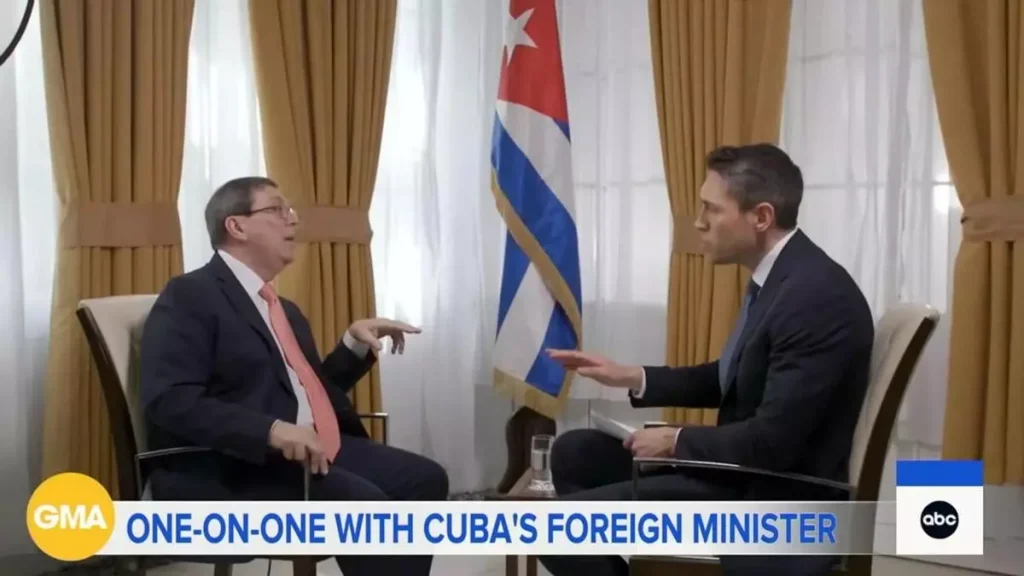
 14ymedio, Madrid, May 11, 2026/ Cuban Foreign Minister Bruno Rodríguez experienced awkward moments in front of ABC News cameras while trying to answer questions about free elections in Cuba, political prisoners, and reforms demanded by Washington.
Rodríguez gave the interview last Thursday in Havana to reporter Whit Johnson, but this Sunday the program Good Morning America highlighted the answers that the foreign minister gave in broken English, when the journalist asked him what changes the Cuban government would be willing to make in the face of pressure from Washington.
The Foreign Secretary, stammering and visibly struggling with the language, managed to reply, “I reject those accusations,” referring to the issues of political prisoners, human rights, and free elections in Cuba. Johnson pressed on: “What do you reject about free elections? It is a single socialist party—essentially, a single family—that has practically ruled Cuba for almost seven decades.”
“Cuba is a democracy, a different kind of democracy.”
Notably nervous, Rodríguez responded that he would return to that topic at another time, maintaining that Cuba “is a country with its own history and its own particularities, and we are a free and independent nation […] but Cuba is a democracy, a different kind of democracy.” Johnson was quick to point out that it cannot be called a “democracy” when there is only one party and a single candidate for whom the population can vote, and asked directly: “What are you worried might happen if there were free elections in Cuba?”
The chancellor hesitated and managed to say: “You are presenting a prejudice.”
Johnson pointed out to viewers that Rodríguez never answered this direct question, which was repeated several times. However, he did answer a question about political prisoners, stating that they “didn’t exist” in Cuba.
In response to Rodríguez’s refusal, the ABC journalist countered by mentioning reports from international organizations and independent monitoring groups that document hundreds of people imprisonedfor political reasons, including protesters from 11 July 2021: to this day, Prisoners Defenders reports 1,258 prisoners of conscience on the Island.
Bruno Rodríguez asserted that “there has been no progress” in recent talks with the US, and that Washington’s threats would provoke a “bloodbath in Cuba.”
Good Morning America ‘s Cuban-American host, Gio Benitez, noted how “shocking” it was to see a foreign minister responding to those questions in this way. Johnson added that in Cuba he saw the population surviving this desperate crisis on their own and that the citizens he spoke with do want change.
In other fragments from the interview that had been published last Friday, Bruno Rodríguez had asserted that “there has been no progress” in recent talks with the US, and that Washington’s threats were going to provoke a “bloodbath in Cuba.”
The conversation took place amid a new escalation of tensions between Washington and Havana, after the Trump Administration announced new sanctions against the Business Administration Group (Gaesa), the military business conglomerate that controls much of the Cuban economy.
From the outset of the report, ABC described a country exhausted and on the verge of economic collapse: “There is a growing sense of despair and exhaustion here in Cuba, and the government remains defiant.”
______________________
COLLABORATE WITH OUR WORK: The 14ymedio team is committed to practicing serious journalism that reflects Cuba’s reality in all its depth. Thank you for joining us on this long journey. We invite you to continue supporting us by becoming a member of 14ymedio now. Together we can continue transforming journalism in Cuba.