This money comes from the 375 million euro investment fund created in exchange for forgiving Havana part of its public debt to Madrid.
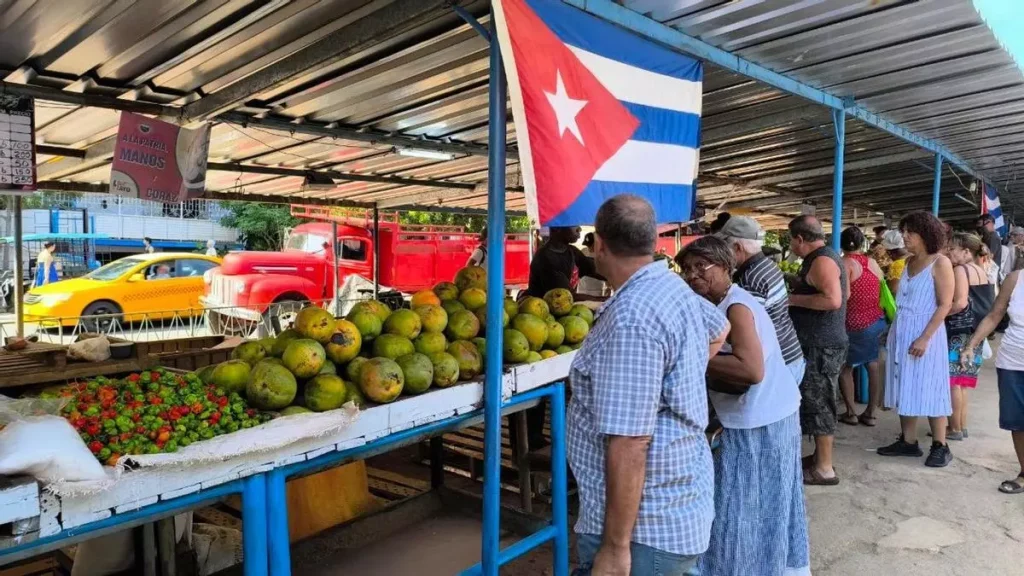
 14ymedio, Madrid, May 11, 2026 — The debt conversion program signed between Spain and Cuba ten years ago is being used to donate food to the Island, according to the newspaper El País this Monday. The bilateral committee managing the program authorized last February a 500,000 euro project to purchase food as urgent aid for the population, following the model of an earlier initiative in which agricultural cooperatives in the eastern region supplied schools with food.
The fund — a mechanism in which debt is forgiven in exchange for investment in projects of common interest — has a value of 375 million euros and was signed in 2016, although it was not until last year that an agreement was reached on how to channel the money. In July 2025, the Economy Ministers of both countries signed an agreement stating that the money would be used to finance sustainable development projects in sectors such as energy, water, and food security.
Technically, according to sources from the Secretariat of State for Trade speaking to El País, that money could not be used for current expenses, as this case would be considered. However, the committee decided to authorize it because of the Cuban crisis, aggravated at that time by the recent publication of the executive order through which the U.S. prevents oil shipments to the Island under threat of sanctions.
Cuba’s public debt to Spain amounts to nearly 2 billion euros, most of it originating from the former Development Aid Fund
Cuba’s public debt to Spain amounts to nearly 2 billion euros, most of it originating from the former Development Aid Fund during the 1980s and 1990s, which the European country considers impossible to recover. In an effort to resolve the situation, different governments have signed three agreements with the Island, two during the second term of Mariano Rajoy(2015 and 2016) and a third during the first government of Pedro Sánchez (2021).
The first agreement, part of a broader pact with the Paris Club, was signed in November 2015 and consisted of a short-term debt restructuring agreement worth 201 million euros, of which 110.8 million were forgiven. Another 40 million were used to create a counterpart fund that provides grants to Spanish companies investing in Cuba for their local currency expenses. In March 2024, Spain reported that the fund had almost been fully used.
In 2016, the second agreement was signed, valued at 2.242 billion euros in medium- and long-term debt. Of that amount, 1.492 billion euros were forgiven, and another counterpart fund of 375 million euros was organized: the one now being used to donate food. The last agreement, signed in 2021, involved a reorganization of payments without debt forgiveness.
Although the decision to activate this first 500,000 euro project was made last February, El País notes that this mechanism could continue to be used, becoming an option for donating aid to the Island. On April 19, Prime Minister Pedro Sánchez, Brazilian President Luiz Inácio Lula da Silva, and Mexican President Claudia Sheinbaum signed a statement at the summit held in Barcelona calling for ways to cooperate in resolving the crisis in Cuba.
“We express our enormous concern over the grave humanitarian crisis facing the Cuban people and call for the adoption of the necessary measures to alleviate this situation and avoid actions that worsen the living conditions of the population or are contrary to international law,” the text stated.
However, private companies owed money by Cuba are not pleased, according to the newspaper. The amount of debt was estimated at around 350 million euros owed to 300 companies, according to the Catalan organization Fomento del Trabajo Nacional, although El País speaks of 316 million euros claimed by about 200 companies grouped in the Platform of Those Affected by Non-Payment by the Cuban Government.
‘El País’ speaks of 316 million euros claimed by about 200 companies grouped in the Platform of Those Affected by Non-Payment by the Cuban Government
This group, made up of 50% companies from Catalonia and 20% from the Basque Country, has criticized the move while also considering that there has been inactivity when it comes to demanding payment of the private debt from the Cuban Government. On May 5, the Senate debated a motion urging the Executive Branch to implement measures “that help Spanish companies working or trading with Cuba to collect outstanding amounts owed by the Cuban Government and Cuban state companies.”
The initiative received support from the People’s Party, a center-right opposition party with a majority in that chamber, and Catalan and Basque nationalist parties (Junts and PNV, allies of the Government), while all others abstained. During that session, the spokesperson for the Socialist Party argued that the Government pressures the Cuban state to pay but cannot use public funds to cover private defaults.
“The Secretariat of State for Trade constantly monitors the situation through the debt survey prepared by the commercial office and has made numerous claims before Cuban authorities on behalf of those companies,” he explained. “The commitment to ending non-payment by the Cuban Government is total. What we cannot support is the payment of compensation by the Spanish state as a consequence of commercial operations between private companies and the Government of Cuba. Public spending cannot be allocated to items not authorized by law.”
As a result of that session, the motion was approved, urging the Government to quantify the private debt, develop a plan to defend the interests of companies, study liquidity support instruments for affected businesses, and bring the situation before the competent bodies of the European Union in order to adopt a joint position demanding from “the Cuban Government legal certainty, respect for contracts, verifiable payment mechanisms for European companies, and real progress in freedoms, human rights, and the rule of law.”
Translated by Regina Anavy
______________________
COLLABORATE WITH OUR WORK: The 14ymedio team is committed to practicing serious journalism that reflects Cuba’s reality in all its depth. Thank you for joining us on this long journey. We invite you to continue supporting us by becoming a member of 14ymedio now. Together we can continue transforming journalism in Cuba.