Elderly people sell nylon bags, guard their turns in line, and hope for opportunities in the doorways of this municipality in Mayabeque.
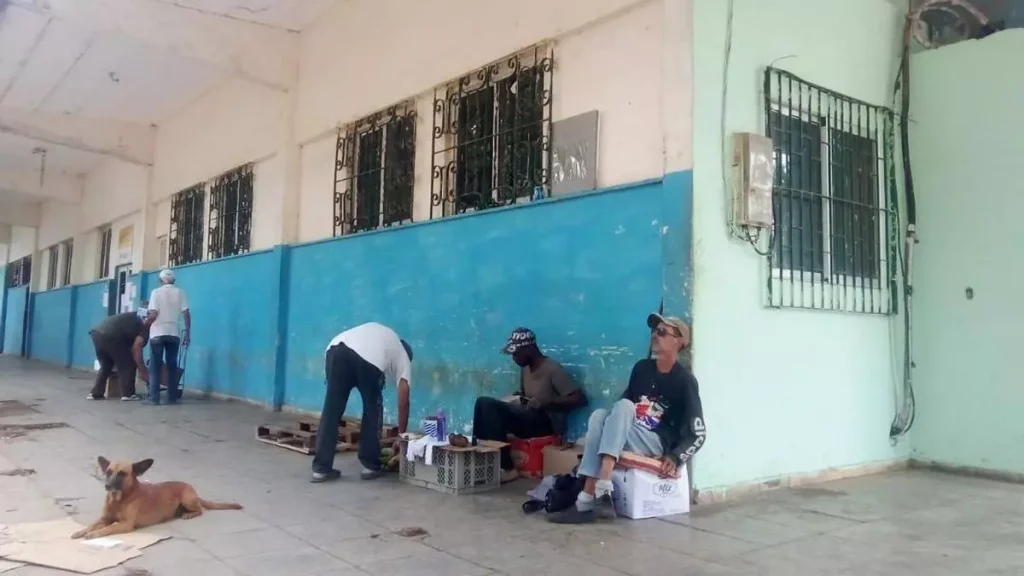
 14ymedio, Julio César Contreras, San José de las Lajas (Mayabeque), May 3, 2026 / Under the peeling roof of the arcades at La Micro market in San José de las Lajas (Mayabeque), the morning unfolds with a leisurely pace that seems tailor-made for those who are no longer in a hurry, but neither are they restful. Seated on empty crates, on pieces of cardboard, or leaning against the peeling blue wall, several elderly men while away the time while they wait for a customer, an opportunity, or at least someone willing to offer them a cup of coffee. The market, which once bustled from early morning, is now more of an improvised refuge for retirees who have traded the tranquility of old age for the uncertainty of daily survival.
Away from the hustle and bustle of the town center, but within easy reach of those living in the microbrigade buildings, Rodrigo and his companions have found a fixed place in these doorways where they spend eight to nine hours a day. There they sell whatever they can get their hands on: plastic bags, recycled bottles, chili peppers, loose cigarettes, or any merchandise that can be exchanged for a few pesos. The scene repeats itself every morning. Some arrive before seven, shuffling along, carrying a worn-out bag or pushing a rusty wheelbarrow. Others appear later, when the sun has already warmed the cement and the shadows begin to dwindle.
Our presence here is an open secret. Everyone knows it, but they leave us alone so we can ‘escape’ however we can.
“Here, we’re not trying to avoid the inspectors, just pretending. This isn’t about getting rich,” Rodrigo says, carefully checking the contents of a plastic crate where he keeps his merchandise. His voice is measured, as if weighing each word. “We have plastic bags for 20 pesos and jars of chili peppers for 120. I keep the cheap cigarettes hidden, because if they catch me selling the cartons for 340 pesos, I could be in trouble.” Around him, other men nod silently, used to this tightrope walk between necessity and illegality. “Our presence here is an open secret. Everyone knows it, but they leave us alone so we can slip away however we can. That’s how the system works: on one side, they tighten the gasket, and on the other, they release pressure so it doesn’t explode,” he adds.
A few meters away, a dog stretches out on a piece of cardboard, indifferent to the comings and goings of people. The animal seems like just another resident of the doorway, another survivor of the daily grind. Nearby, Andrés intently watches the street, alert to any movement. For decades he worked as a locksmith in a state-run workshop and still keeps a master key, which he guards like a talisman. “People come to us to take out their trash, unclog a drain, or, in my case, to open their front door,” he explains, proud of the skills that allowed him to earn a living for years.
“We have a single checkbook worth 3,000 pesos. We are diabetic and are not on any social security benefits list.”
The market popularly known as La Micro hasn’t received any food rations for over a month. The empty stalls and dusty shelves are the best testament to this neglect. “A clerk told me they’re going to start giving out two pounds of rice to vulnerable people tomorrow,” Rodrigo says, shrugging his shoulders. “Of course, that concept of ‘vulnerable’ is convenient for the government. My wife and I live alone in a crumbling tile house. We have a single checkbook worth 3,000 pesos. We’re diabetic and we’re not on any social security coverage list.”
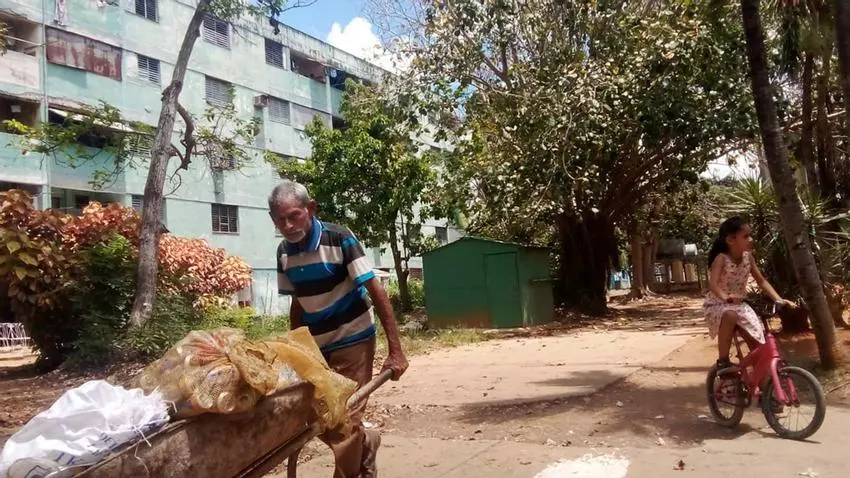
As he speaks, the old man nods his chin toward the street, where another man is slowly pushing a wheelbarrow loaded with crushed cans and dirty sacks. The effort is evident in the stoop of his back and the sweat trickling down his forehead. Each step seems like a battle against exhaustion. Behind him, a little girl pedals a small bicycle, oblivious to the scene, as if time had two different speeds in that very place: one for the old who endure and another for the children who still play.
As former day laborers, the elderly men gather every morning at their “command post,” as they call it, to try and make a living. Sitting on the ground, they share stories of times when work was hard but secure; they complain about current needs and remain alert for any opportunity to earn a few pesos. When someone appears seeking help carrying a sack, cleaning a yard, or holding a place in line, the group springs into action immediately.
According to Andrés, when liquefied gas is available in the area, business is usually a little better. “It’s true that we go two or three nights without sleep, but we pocket 1,000 pesos for each person who requests our gas cylinder delivery service,” he says. “We divide the numbers among ourselves so that everyone wins. The problem is that there’s almost never any gas, and while the gas is coming and going, we struggle to make three or four pesos, which isn’t enough for anything.”
My father taught me that things don’t fall from the sky and that, being a poor black man, I would have to work very hard so I wouldn’t go to bed on an empty stomach.
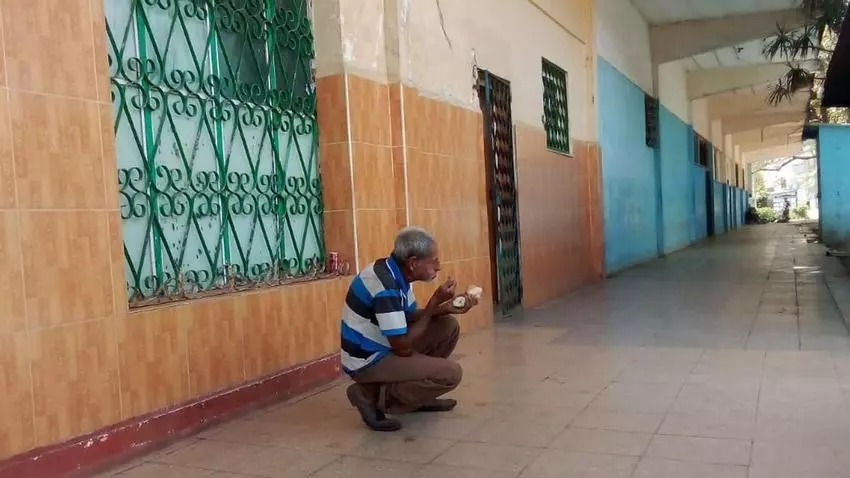
The hours in the market’s doorways drag on with agonizing slowness. Sometimes they share a sliver of stale bread to stave off hunger; other times, a shot of rum that appears suddenly, passed from hand to hand. Conversation is punctuated by long silences, vacant stares, and resigned sighs.
“My father taught me that things don’t fall from the sky and that, being a poor Black man, I’d have to work very hard to avoid going to bed hungry,” says Andrés, his gaze fixed on the horizon. “At 72 years old, I’ve chosen not to give up. As long as I have a master key and my hands still work, I’ll keep opening doors and selling whatever needs selling.”
_____________________
COLLABORATE WITH OUR WORK: The 14ymedio team is committed to practicing serious journalism that reflects Cuba’s reality in all its depth. Thank you for joining us on this long journey. We invite you to continue supporting us by becoming a member of 14ymedio now. Together we can continue transforming journalism in Cuba.