Electric tricycle drivers in San José de las Lajas face long waiting times, few passengers, and rising costs that threaten their daily sustenance.
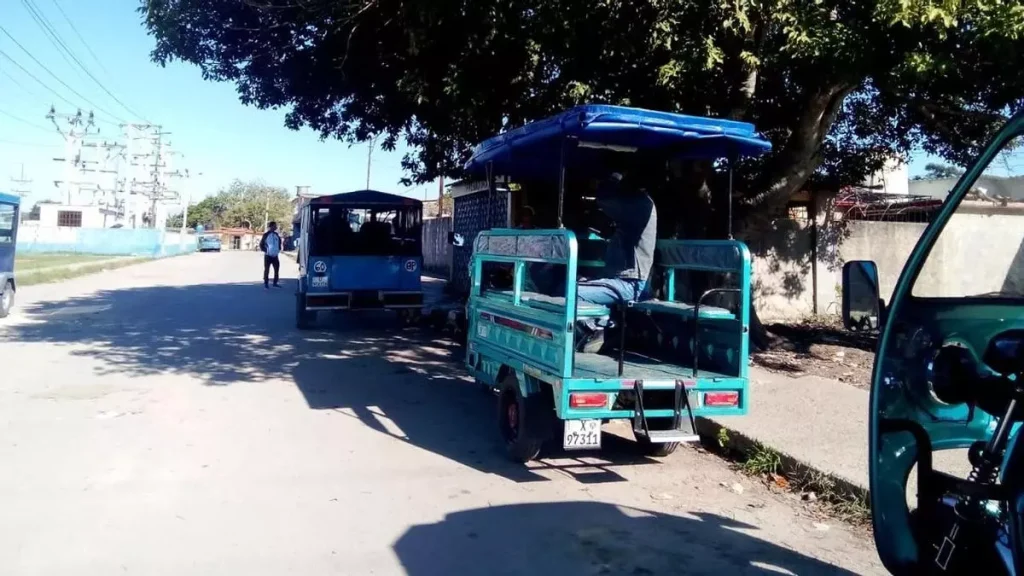
 14ymedio, Julio César Contreras, San José de las Lajas (Mayabeque), April 29, 2026 / The taxi stand at the old train station in San José de las Lajas wakes up before the rest of the city. At that early hour, when the sun is just beginning to warm the asphalt and the first bicycles listlessly cross the avenue, several electric tricycles are already lined up as if waiting for the order to leave. Under the green, blue, or red tarpaulins, the drivers converse in hushed tones, drink coffee from small plastic cups, and anxiously watch the road, waiting for the first customer of the day to appear.
“Most people have no idea how much time and money it takes to earn four pesos on these three-wheeled critters,” says Alexander, a tricycle driver who arrives early every day at the taxi stand without a fixed route. His vehicle, painted a bright blue and with a freshly charged battery, sits alongside others like it, forming an irregular line, like a small, makeshift parking lot.
Alexander explains that he always tries to arrive before 6:00 a.m. so the line of drivers isn’t too long and he has enough time to make a few trips before noon, when passenger numbers drop considerably. At that early hour, there’s still some activity: workers heading to their jobs, students with backpacks, and elderly people walking slowly to the pharmacy or clinic. But after nine or ten, the scene changes, and the taxi stand falls into a kind of lethargy.
“Although there are very few cars on the road, people can’t afford the luxury of spending 300 or 400 pesos either.”
His daily route can take him anywhere from Cotorro to Catalina de Güines, or even as far as Madruga, if he can find enough customers willing to pay the fare. Sometimes, these longer trips are the only way to make ends meet, because within the city itself, the rides are short and customers haggle over every peso. “Even though you see very few cars on the road, people can’t afford to spend 300 or 400 pesos to go from the farmers market to the Pastorita neighborhood,” he says. “We can’t ask for less than that either, because then it doesn’t add up. It’s a vicious cycle where everyone, in some way, loses out.”
The everyday scene around the terminal confirms his words. By mid-morning, several tricycles are parked in the shade of a leafy tree while their drivers seek refuge from the sun. Some check their battery cables, others discuss the price of spare parts. A young man gets out of his vehicle, stretches his legs, and observes the almost empty road with resignation.
The tricycles parked at the taxi stand confirm, indeed, that passengers are scarce. The line of vehicles seems frozen in a prolonged wait that can last for hours. “Giving rides is getting worse and worse, because the number of tricycles keeps increasing and the number of passengers is decreasing day by day,” says Ismael, sitting under the tarp of his motorcycle, shielding himself from the blazing sun. “It doesn’t matter if it’s Wednesday or Sunday anymore, the taxi stand is empty, and you have to be a magician to have a few bills in your pocket at the end of the day, because they disappear like water.”
The daily wage I’m earning is barely enough to buy the essentials for the house.”
The driver explains that he is seriously considering giving up passenger transport and dedicating himself to hauling goods for a local small business. He says his current earnings barely cover basic expenses. “What I make each day is barely enough to buy the essentials for the house,” he says. “If the tricycle happens to break down, I don’t have the money to fix it right now.”
This uncertainty is echoed by many drivers who see how the business, which seemed promising just a few years ago, has become increasingly unstable. The proliferation of electric tricycles has saturated the market, while passengers’ purchasing power continues to decline. The result is fierce competition for every customer that appears on the street corner.
On the other side of the coin are those who approach the tricycles, sweating, trying to negotiate a price that will give them some breathing room. At the side of the road, a man stops in front of one of the vehicles to ask how much the ride to his neighborhood costs. The answer elicits a gesture of displeasure and a brief exchange before the customer decides to continue on foot.
“I don’t understand why electric tricycles are as expensive as those that run on gasoline or diesel,” says Mario, a self-employed worker who makes the daily commute from his home in Tapaste to San José de las Lajas. He explains that he has to use this mode of transportation two or three times a week out of necessity, and the cost, which started at 200 pesos, has been rising rapidly, reaching 800 or 1,000 pesos at certain times and days. “There’s no stopping this,” he complains.
“I don’t understand why electric tricycles cost as much as those that run on gasoline or oil.”
For Mario, the solution to the problem doesn’t necessarily lie in stabilizing fuel prices or increasing the presence of state inspectors who control the prices of fares. In his view, the key is to restore a public transportation system that offers real alternatives to citizens. “As long as transportation is in crisis, anyone with three or four wheels will think they have the right to charge whatever they want,” he emphasizes.
Meanwhile, daily life in San José de las Lajas remains marked by waiting. The electric tricycles sit lined up at the taxi stand as if they were part of the urban landscape, silent witnesses to an economy that barely moves. Under the relentless midday sun, the drivers gaze at the horizon with patience and resignation, hoping that the next passenger will appear at any moment and allow them to set off again.
______________________
COLLABORATE WITH OUR WORK: The 14ymedio team is committed to practicing serious journalism that reflects Cuba’s reality in all its depth. Thank you for joining us on this long journey. We invite you to continue supporting us by becoming a member of 14ymedio now. Together we can continue transforming journalism in Cuba.