From driving an almendrón [classic American car in use as a shared taxi] to managing a private fleet, he dreams of a modern bus network in a city trapped between fuel shortages and improvisation.
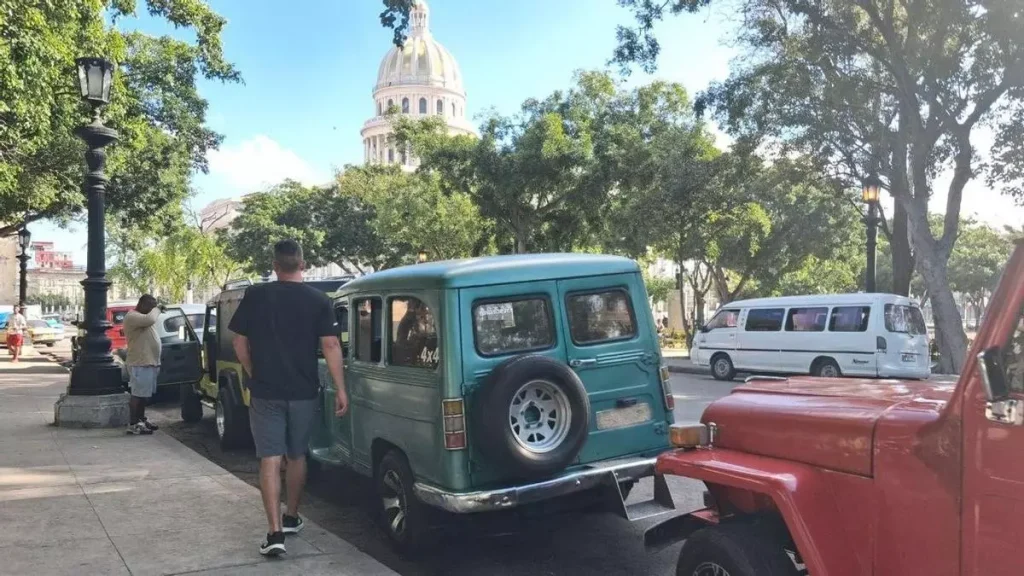
 14ymedio, Natalia López Moya, Havana, April18, 2026 / The hustle and bustle begins early in Fraternity Park. Under the shade of the trees, a line of jeeps and pickup trucks adapted for passenger transport wait their turn while the drivers chat, check the engine, or lean against the open doors. The Capitol Building looms in the background, imposing, as if watching over this small universe where necessity, ingenuity, and daily survival intersect. In this private taxi stand, where each vehicle represents a story of hard work, Ricardo, a 48-year-old Havana resident, moves with a calm gait. He feels transportation as a vocation that runs in his veins.
Ricardo, a name changed to avoid reprisals, doesn’t wear a uniform or any special insignia. He dresses simply, speaks in a measured tone, and greets each driver by name. His role now is that of manager and supervisor of a small fleet he and his brother have built up over decades of work. However, as soon as he stops in front of one of the vehicles, a green minibus with a capacity for a dozen passengers, his gaze becomes technical, almost professional. He checks the condition of the tires, asks about fuel consumption, and reviews the day’s schedule as if he were inspecting a complex transportation network.
“I was born for this,” he tells 14ymedio, with a brief smile. And he doesn’t seem to be exaggerating.
When the boys were born, I couldn’t afford to continue studying without earning a penny. I had to find money as quickly as possible.
Ricardo studied Transportation Engineering at the José Antonio Echeverría Technological University of Havana, the well-known Cujae, until his fourth year. He didn’t graduate. Life, as it happens to so many young people in Cuba, forced him to take a more urgent path. He married young, had twins, and the need to support his family took precedence over books and classrooms.
“When the boys were born, I couldn’t afford to continue studying without earning a single penny. I had to find money as quickly as possible,” he recalls.
His entry into the world of almendrones — classic American cars operating as shared taxis — was almost a natural progression. His father had worked for the railroad for decades, and at home, trains, routes, and schedules were always a topic of conversation. Even his great-grandfather was involved in managing Havana’s old streetcar system, a family legacy that shaped his childhood. As a boy, while others played ball, he built imaginary cities with toy cars. That passion remains with him: in his living room, he maintains a meticulous collection of miniature cars.
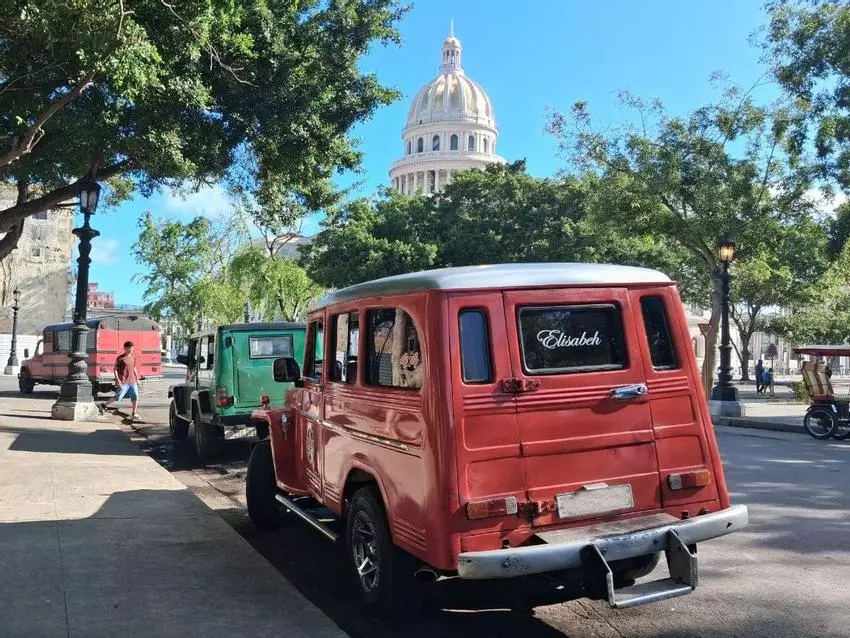
The first vehicle he drove was his father’s old Chevrolet, a car that had already accumulated years and repairs when Ricardo decided to convert it into a shared taxi. Those beginnings, he says, were tough.
“There were days when I went out to work not knowing if I would be able to return home with enough money for food. The car was constantly breaking down and the parts were hard to find. But there was no alternative.”
On the route connecting Fraternity Park with Santiago de las Vegas, he learned to deal with impatient passengers, deteriorating streets, and a public transportation system that was already showing signs of exhaustion. That experience taught him to calculate times, costs, and routes with almost mathematical precision.
Over time they managed to build a small fleet that today includes six electric tricycles and five car-type vehicles, capable of transporting between 10 and 14 passengers each.
His brother, also a driver, joined the business, and together they began to grow slowly. They reinvested part of their profits in repairs, fuel, and the purchase of new vehicles. Over time, they built a small fleet that today includes six electric tricycles and five passenger vans, each capable of carrying between 10 and 14 passengers.
Ricardo no longer lives “glued to the wheel,” as he himself says, but he remains connected to the daily operation of the vehicles. He visits the taxi stand frequently, supervises the drivers, and reviews the day’s income and expenses. His presence, discreet yet constant, reflects a mixture of responsibility and pride.
At Fraternity Park, the flow of passengers never stops. Women with heavy bags, students with backpacks, and workers trying to get to their jobs gather around the vehicles, asking about destinations and fares. The sound of the engines mingles with the murmur of conversations and the metallic slam of closing doors.
Ricardo observes this scene with a critical eye. For him, transportation in Havana is not just a business, but a structural problem that requires technical solutions and political will.
There is no real coordination between the different modes of transport, and this leads to losses of time and resources.
As he explains, the principal obstacles facing passenger transportation in the capital are the lack of fuel, the deterioration of the vehicle fleet, the shortage of spare parts and the absence of efficient route planning.
“The whole system is improvised. There’s no real coordination between the different modes of transport, and that causes a waste of time and resources,” he says. “The authorities see us as if we were the enemy, even though we’re the ones keeping this city moving,” he points out. “They bombard us with fines and inspections, but what they should be doing is working with us, hand in hand.”
He also points out that current regulations limit the growth of the private sector. He considers it essential to create a legal framework that allows for the direct import of vehicles and parts in an expedited manner and “without so much paperwork,” access to financing, and the possibility of establishing stable contracts with the government.
“If we want to improve transportation in Cuba, we have to let those who know how to do it do their jobs,” he argues. “Private transport operators know this city better than the Ministry of Transportation; we’ve designed more efficient and comprehensive routes and connections than the Havana Bus Company.”
“If we want to improve transportation in Cuba, we have to let those who know how to do it do their jobs.”
His incomplete academic training hasn’t prevented him from maintaining a technical approach to the subject. Ricardo has dedicated years to studying route behavior, passenger flow, and operating costs. His notebook contains detailed notes on schedules, distances, and fuel consumption.
His greatest ambition is to run a bus route in Havana. This isn’t just a whim. He has developed a complete project that includes route planning, frequency calculations, and income and expense estimates.
In his mind, the city is divided into high- and low-demand zones, with stations strategically located to facilitate passenger access. He speaks of waiting times, cargo capacity, and preventative maintenance with the confidence of a professional.
“I have all the numbers done. I know roughly how many buses are needed, the municipalities that need to be connected because they are currently isolated, the type of bus that will best meet the needs of the conditions we have here, and something that is not allowed now, which is to turn the buses into rolling advertising options so that businesses can pay to promote their products in these display cases on wheels, which is a way to generate income,” he says.
His plan includes the use of modern technologies to optimize the service. It proposes the incorporation of electronic payment systems, the creation of rechargeable cards with special discounts for students and senior citizens, mobile applications for route tracking, and hybrid or electric vehicles that reduce fuel consumption.
“Cuba could skip stages if it adopts efficient technologies. There’s no need to repeat the mistakes of other countries,” he points out.
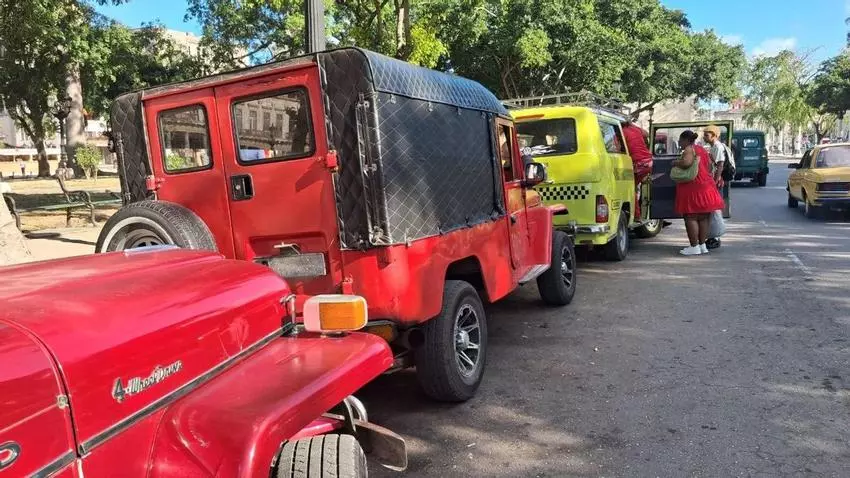
As he speaks, a group of passengers gets into one of the vehicles parked on the sidewalk. A woman in a red dress settles into the back seat, followed by two young men carrying their backpacks. The driver starts the engine and the vehicle slowly merges into traffic.
Ricardo watches the maneuver intently, as if evaluating every detail. His experience allows him to detect flaws and anticipate problems.
Despite the economic difficulties and uncertainty that characterize life on the Island, the entrepreneur insists that his future is in Cuba.
“I’ve never wanted to emigrate, even though almost all my friends are outside the country,” he admits.
He believes the island needs professionals willing to work for the recovery of public services and the development of infrastructure.
For him, transportation is more than a job. It’s a personal mission that combines family tradition, technical expertise, and social commitment. He believes the island needs professionals willing to work toward the restoration of public services and the development of infrastructure.
At Fraternity Park, the line of vehicles continues to grow. The sun illuminates the colorful car bodies and casts long shadows on the pavement. Drivers chat, passengers wait, and the city keeps moving with the precarious energy that characterizes Havana.
Ricardo walks among the cars with a firm step, greeting each worker and checking the details of the service. His presence conveys the feeling of someone who refuses to accept the decline, who believes in the possibility of organizing the chaos and building a more efficient transportation system.
In his mind, the maps and calculations keep turning like invisible gears. There, in that universe of numbers and routes, he envisions the future he imagines for the city: a modern, punctual, and accessible bus network, capable of restoring to Havana the dynamism it once had.
And although that project still belongs to the realm of dreams, Ricardo continues to prepare for the day he can make it a reality.
______________
This article was produced in collaboration with Cuba Siglo 21 as part of the project “Cuba: Stabilize and Develop.”
______________________
COLLABORATE WITH OUR WORK: The 14ymedio team is committed to practicing serious journalism that reflects Cuba’s reality in all its depth. Thank you for joining us on this long journey. We invite you to continue supporting us by becoming a member of 14ymedio now. Together we can continue transforming journalism in Cuba.