The lack of transportation turns every trip into an odyssey of hours and money in the Mayabeque municipality

 14ymedio, Julio César Contreras, Madruga (Mayabeque), April 12, 2026 – The traffic sign next to the bus stop has blank boxes. There could be no better symbol to define the lack of public transportation, the void that stretches along the central highway for those who have to travel. In Madruga, Mayabeque, the stop has become a place of waiting without promises, a point where time stretches and patience is tested under the clear sky and the dust kicked up by the few vehicles that manage to pass.
“The route that used to go to San José de las Lajas twice a day no longer exists. Now you have to go segment by segment, getting on whatever stops,” explains Ignacio, a self-employed worker who comes to the town frequently. The man, with a backpack slung over his shoulders and rubber boots still stained with dirt, watches the road as if salvation might appear at any moment in the form of a truck, scooter, or improvised pickup.
According to Ignacio, speaking to 14ymedio, he managed to get on an electric tricycle that charged him 500 pesos to Catalina de Güines, from where he managed to climb onto a cargo truck for another 600 pesos. “To get here I was lucky, but the return is very complicated. I’ve been here at the stop for four hours and not even flies are passing. My only hope is that by holding out a 1,000-peso bill, some driver will want to take me,” he laments, pacing restlessly back and forth along the sidewalk.
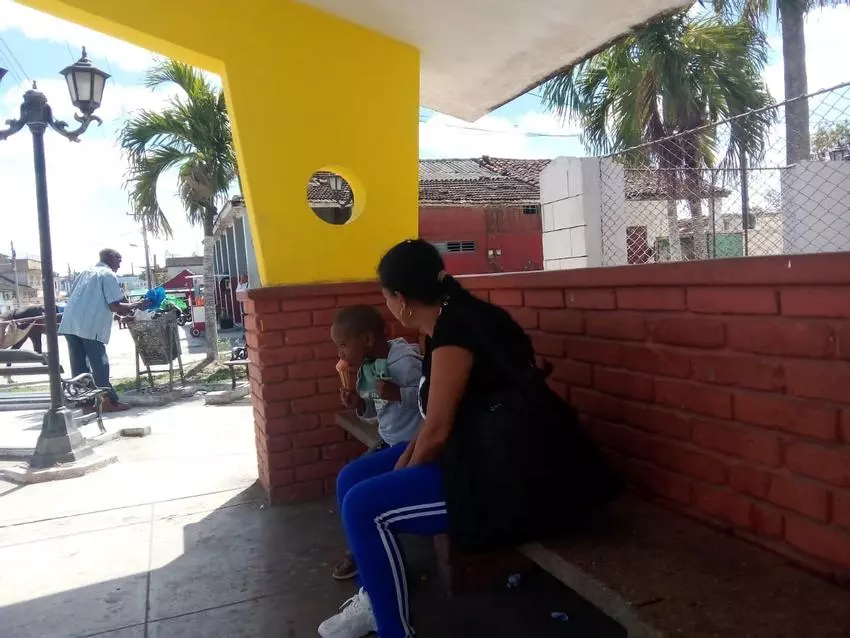
Next to the stop, the taxi stand from which private taxis used to depart is also deserted, leaving no way to travel to Ceiba Mocha or Matanzas. The metal bench, once contested by passengers, remains empty for long stretches of time. Only a woman with a small child shelters under the yellow roof of the terminal, trying to protect themselves from the heat and the fatigue accumulated after hours of waiting.
“It’s already past 2:00 in the afternoon and not a single car has come through today. Now things are really bad, because even with money in your pocket you can’t get out of here,” says a young man, for whom the municipality of Unión de Reyes feels farther away than ever. The man checks his phone frequently, although he knows the battery will run out before a vehicle willing to pick up passengers appears. “The few that are circulating are from the same town. No private driver will go to Matanzas for less than 40,000 pesos. Honestly, it’s an abuse,” he complains.
Worried that night will fall without being able to leave, the man from Matanzas has gone several times with his four-year-old son to a nearby cafeteria, where tractor-trailers stop to eat. The child, sitting on the edge of a bench, plays with an empty cup while curiously watching the road. “Only two or three big trucks have passed. All the drivers tell me they’re loaded, that they can’t take me. My child keeps asking when we’re leaving. He asks for water, food, and we’re stuck in the middle of the road. We left San Nicolás de Bari before dawn and we’re still wandering around. Hopefully we won’t have to sleep on a bench,” says the young father, visibly exhausted.

You could cross the road without looking both ways, if not for the occasional electric scooter breaking the silence of the roadway. The sounds of combustion engines have practically disappeared from the central highway. There is little movement in the surroundings: a street vendor pushes a cart with agricultural products, a cyclist passes slowly, and occasionally a truck raises a cloud of dust that forces those present to cover their faces.
“I need to take medication to my mother who lives in Aguacate, just a few kilometers from here. A trip that can be done in minutes takes a whole day because there are no intermunicipal buses running,” says a woman, sitting in the same spot since mid-morning, without even leaving to get a coffee for fear of missing a vehicle that might stop. She grips her bag tightly and anxiously watches every point that appears on the horizon.
“The traffic sign is there for nothing. I got tired of raising in accountability meetings that this stop needs an inspector, but no official cares about the hardships people go through, because they all have ways to get around,” the woman argues, unable to hide her frustration.
As the afternoon goes on, the sun beats down on the sidewalk and the shadow of the yellow roof becomes the only refuge for travelers trapped in the wait. Time seems to stand still in Madruga. Only the young man with his son and four other people persist in trying to embark on a journey whose wait becomes unbearable due to the heat and uncertainty.
Translated by Regina Anavy
______________________
COLLABORATE WITH OUR WORK: The 14ymedio team is committed to practicing serious journalism that reflects Cuba’s reality in all its depth. Thank you for joining us on this long journey. We invite you to continue supporting us by becoming a member of 14ymedio now. Together we can continue transforming journalism in Cuba.