“Today we have about 30 sarcophagi in reserve,” assures the state company to reassure the population, traumatized by the deficiencies of that sector during the covid pandemic and the arbovirosis outbreak
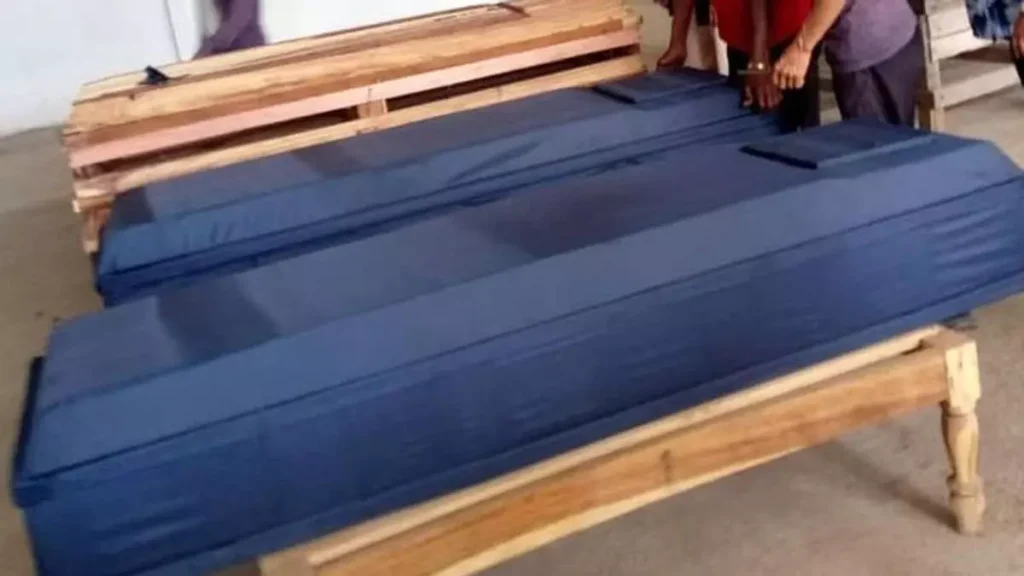
 14ymedio, Madrid, April 6, 2026 – The specter of scarcity in the face of death returns to the Island. As already happened in the covid-19 crisis, due to the sudden increase in deaths, the energy emergency Cuba is experiencing puts at risk an element as sensitive as the manufacture and distribution of coffins. Faced with this situation, the Company of Various Productions (Emprova) in Sancti Spíritus has opted to decentralize production so that municipalities do not depend on the scarce fuel.
“At this time, Fomento produces its own and those of Cabaiguán; Trinidad and Yaguajay, their own; Jatibonico, its own and those of La Sierpe; Sancti Spíritus makes those needed in its territory and those of Taguasco,” notes a report published this Monday in the official media Escambray. The initial experience is based on what was learned during the pandemic, when coffins began to be made in Trinidad and in the carpentry workshop of Sancti Spíritus.
“At this time, Fomento produces its own and those of Cabaiguán; Trinidad and Yaguajay, their own; Jatibonico, its own and those of La Sierpe; Sancti Spíritus makes those needed in its territory and those of Taguasco”
The director of the state company, Alberto Rodríguez, told the newspaper that manufacturing itself also suffers from serious problems that are being resolved thanks to private actors. “Before, everything came through national allocation for coffin manufacturing, and today only fabric and wood arrive; the rest we have to find with private suppliers, for example, nails of different sizes,” he said.
It is not the only inconvenience, because the forestry company needs energy to saw wood, which causes delays. “But this issue has been handled with considerable responsibility,” he says, without further explanation. “Today we have about 30 sarcophagi in reserve, not counting the daily production that continues to come out,” he reassures.
During the pandemic, the shortage of materials led to diversification of production in very different ways. One of the most striking was the proliferation of white coffins, due to the lack of black fabric, as several funeral home employees in different parts of the Island told this newspaper.
The state Communal Services company had to look for all kinds of products, including wood and cardboard or fabric covering, causing distress among relatives at such a delicate moment. “It was a frame of poor-quality wood, covered in fabric, and the base was very thin cardboard; we were afraid the body would fall out,” said the sister of a deceased person at the time. “As soon as they lowered it into the grave, it opened at one corner; it was a terrible sight.”
The situation led to seeking solutions such as negotiating with a Mexican company, Industrias VEQ, to purchase eco-coffins, which are produced at a much lower price than traditional wooden ones. “With national investment and raw material derived from Tetra Pak products such as milk, juices, and purée, the EcoCoffin is already on the national market, and the entrepreneurs have begun talks with funeral business operators in Cuba, Honduras, and Guatemala for export in the coming months,” one of its executives told the local press.
Last year, with the surge in arbovirosis infections, shortages once again took their toll in death. The lack of hearses, already a very scarce asset on the Island, meant that transport from state companies had to be used to move the deceased, leaving grieving relatives following vehicles from the state telecommunications company Etecsa — which were put into service as hearses — an image as striking as it was painful.
Last December, President Miguel Díaz-Canel presented the new electric vehicles for funeral services, announced last July by the Minister of Transport, Eduardo Rodríguez Dávila, who specified that the Government planned to acquire at least 120 units. Of these, 50 were to be for Havana and 50 for five other provinces: 20 to Santiago de Cuba, 10 to Holguín, allocations to Camagüey, and five each to Villa Clara and Ciego de Ávila.
Translated by Regina Anavy
______________________
COLLABORATE WITH OUR WORK: The 14ymedio team is committed to practicing serious journalism that reflects Cuba’s reality in all its depth. Thank you for joining us on this long journey. We invite you to continue supporting us by becoming a member of 14ymedio now. Together we can continue transforming journalism in Cuba.