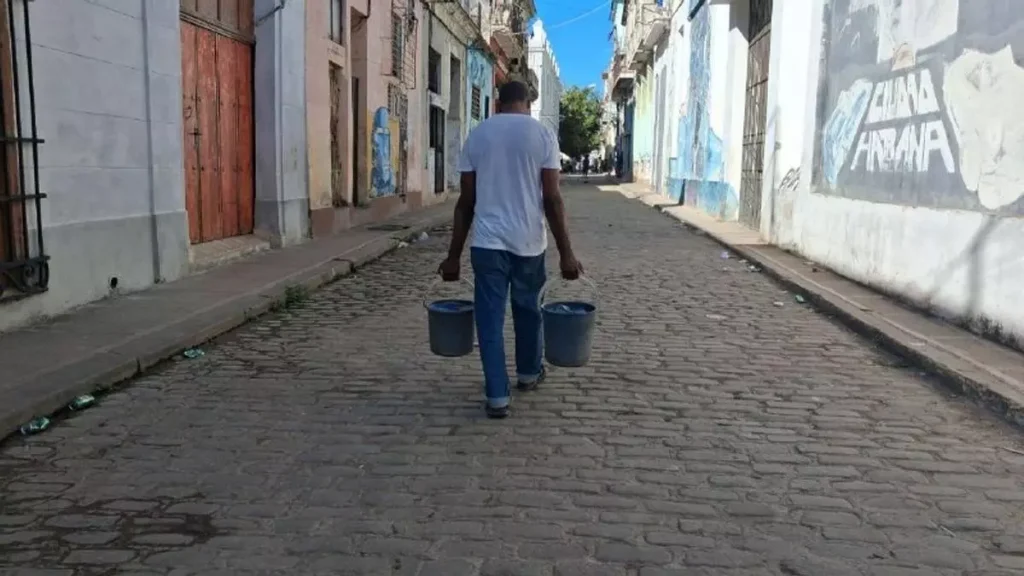
Instead of the ‘almendrones’ that used to crowd the streets of the capital, now you only see people carrying water
 14ymedio, Yoani Sánchez, Havana, March 24, 2026 — Tsssss! Tsssss! This is the second time since I woke up that I’ve had to put on insect repellent. There was a time when we used to say that any fly or mosquito that made it to this 14th floor deserved a medal and we should let it bite us. But now, with the garbage piling up everywhere, there are days when it’s better to keep the patio door closed if we want to avoid the buzzing all around us. Slathered in that liquid, I go out into the street.
Today I have to go near Havana Bay. The electric tricycle I manage to catch at Boyeros and Tulipán drops me off at the corner of Carlos III, and I have to walk the rest of the way. I like to walk as long as I’m not carrying a bag. I decide to go along Zanja, a street I know so well I could walk it with my eyes closed. Although better not. There isn’t a single section of sidewalk that isn’t broken, full of potholes, or with sewage running down it. I have to watch every step.
When I earned a living showing this city to Germans who came to learn Spanish, many asked me how we Cubans could tell they were tourists. Beyond skin tones—since I had students from various ethnic backgrounds—the smell of sunscreen, or the better-quality clothes, the key was that the foreigners were always gazing upwards, mesmerized. That art nouveau balcony, on the verge of collapse, captivated them. That cornice, once stately and now riddled with moss and cracks, left them speechless.
Those of us born and raised here, however, know that we have to keep our eyes on the ground. If you’re not careful, you’ll twist your ankle, fall into an open manhole, or end up stepping in a puddle of waste straight from the toilets of a tenement. Looking up is a luxury we can’t afford. We’re forced to focus all our attention on what’s at ground level. Heights are for others.
I’m already at Neptuno. On the corner of Manrique, a shirtless man leans out of the front door of his house. He shouts a string of insults at the top of his lungs. They’re not directed at anyone in particular, they’re aimed at everyone and everything. I manage to hear him complaining that he’s been without water for over a week and that he’s about to head “to Revolution Square” to protest. I imagine this Havana resident with his empty buckets, standing in front of the “raspadura” (the José Martí monument), begging to fill his containers. He wouldn’t last a minute in that heavily guarded and inhospitable plaza.
Although I took a detour, it stirred a wave of nostalgia to pass near my old neighborhood of San Leopoldo again. I can’t say that everything is exactly the same. I struggle to recognize some of the buildings that have fallen into ruin, and the people seem so subdued. That constant hustle and bustle has given way to short, harsh sentences. Even the clatter of the old American cars that used to travel along Neptuno Street is barely audible anymore. The fuel shortage has confined many of these rolling bathyscaphes to garages, and electric tricycles are trying to take over passenger transport, but it’s not easy.
I miss the smell of oil that used to greet me when I stepped out of shared taxis. I’d arrive at a friend’s house after a long ride in one of those classic American cars, and at the first hug, he’d already know I’d made the trip in an old Chevrolet or a beat-up Cadillac. It was a strong smell, but it conveyed movement and life. Now we smell of paralysis.
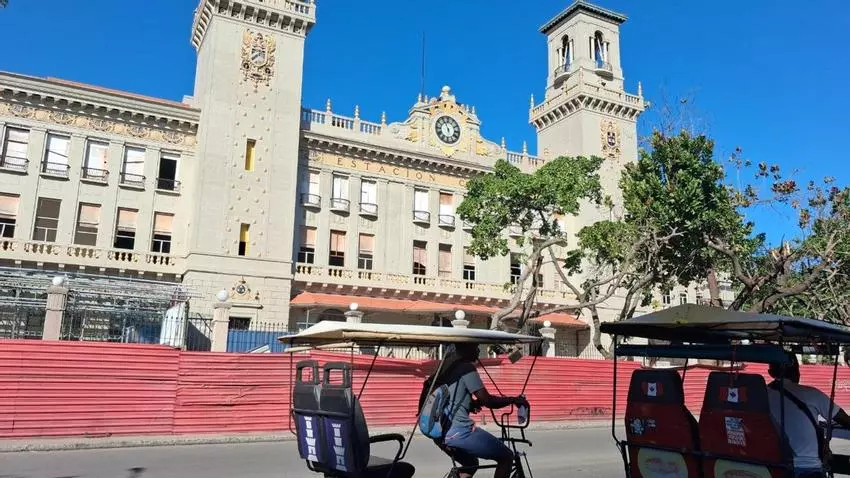
I walk quickly past the Central Train Station. I don’t like looking at that imposing building where I have so many memories. As the daughter and granddaughter of railway workers, the destruction of the railway in Cuba pains me deeply. They say that only one train leaves every eight days on this long, narrow island where the lines once seemed to reach everywhere. It’s been a while since I’ve heard a whistle at the 19 de Noviembre station on Tulipán Street, or the clatter of moving train cars.
I’ve arrived at Desamparados Street. An old woman is selling tiny paper cones of peanuts for 20 pesos each. I buy two, pay with a 50-peso bill, and leave her the change. The woman is as small as the paper cones with a few salted peanuts she offers me. It’s ten in the morning, and there’s hardly anyone on the street. The area around the train station, the zone where there used to always be a throng of people lining up for buses to the Playas del Este beaches, and the area near the National Archives are deserted.
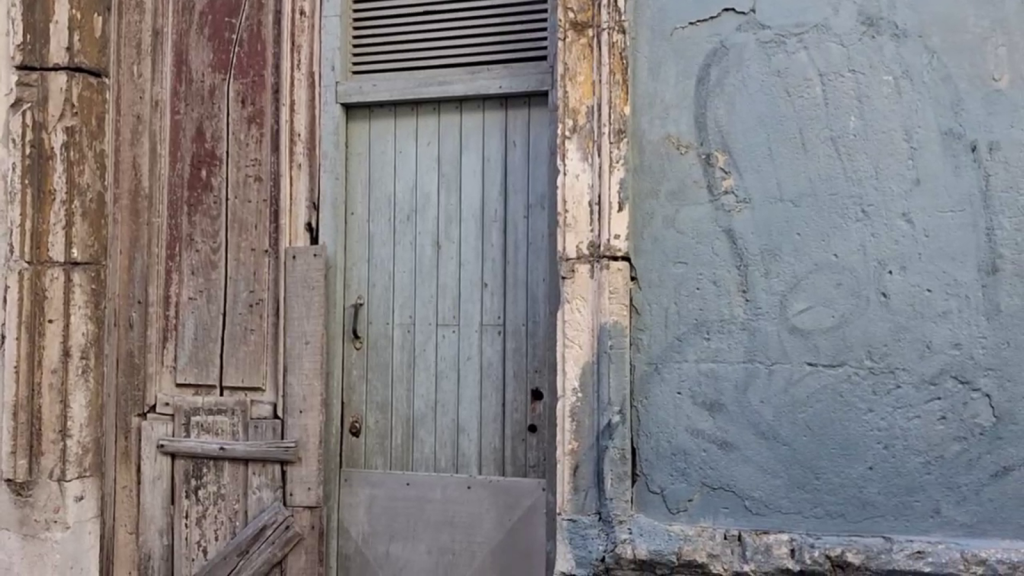
I turn onto Damas Street and arrive at number 955. The doorway is barricaded with rickety planks. Rusty beams protrude from the upper floor, which collapsed years ago. It’s the home of the artist Luis Manuel Otero Alcántara, imprisoned since July 2021. A passing neighbor winks at me, and after a few seconds, I continue on my way. A man in front of me is carrying two buckets. They haven’t had water in San Isidro for days either. A mosquito ignores the repellent I’ve applied and bites my neck.
I go home looking down, always down.
Previous Havana Chronicles:
Reina, the Stately Street Where Garbage is Sold
Searching for Light Through the Deserted Streets of Havana
The Death Throes of ‘Granma’, the Mouthpiece of a Regime Cornered by Crisis
The Anxiety of the Disconnected Cuban
One Mella, Three Mellas, Life in Cuba Is Measured in Thousands of Pesos
It Is Forbidden To Leave Home in Cuba Today Because It Is a “Counter-Revolutionary Day”
Vedado, the Heart of Havana’s Nightlife, Is Now Converted Into a Desert