The maritime intelligence agency asserts that the tanker manipulated positioning signals and entered a port on the Island at night in early March.
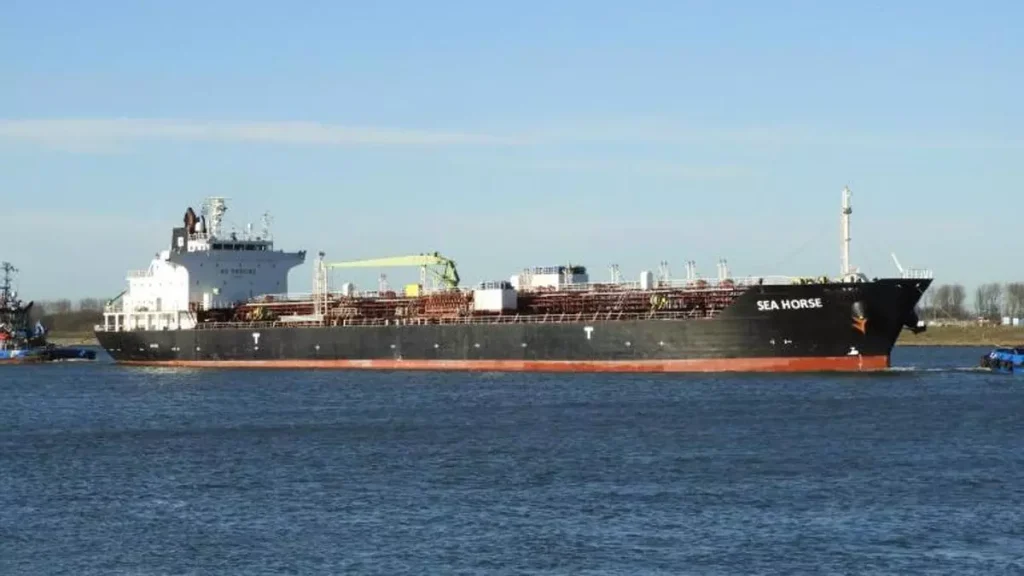
 14ymedio, March 19, 2026 – Madrid/Despite the oil blockade imposed more than two months ago by the U.S. on Cuba, there is strong evidence that the tanker Sea Horse (also Seahorse), under the Hong Kong (China) flag, managed to clandestinely reach a port on the Island and unload about 190,000 barrels of Russian diesel. The arrival took place at the beginning of this month, according to the maritime intelligence agency Windward, which detected manipulation of the Automatic Identification System (AIS), which transmits the location, identity, course, and speed of vessels.
The tanker, which is not sanctioned according to Windward, loaded diesel using the ship-to-ship method in Cyprus in early February. It then indicated it was heading to Cuba but soon altered its route and reported “Gibraltar for orders,” a nautical instruction used to indicate that it will remain in that port (belonging to the United Kingdom and located in southern Spain) awaiting final orders.
Between mid- and late February, the Sea Horse was navigating the Atlantic, stopped 1,300 nautical miles from Cuban waters, and began drifting at speeds below one knot, with the warning “not under command,” a visual signal—black balls by day and red lights at night—normally used when, due to damage or malfunction, the captain cannot properly maneuver. In practical terms, this grants what is known as the right of way and requires other vessels to avoid it. Although the purpose is to prevent accidents, in this case the signal may have been used fraudulently to proceed without difficulty.
The Sea Horse was navigating the Atlantic, stopped 1,300 nautical miles from Cuban waters, and began drifting at speeds below one knot, with the warning “not under command”
According to Windward, this is one more of the deceptive techniques the tanker has used before, including switching off transponders during the transfer of Russian oil to evade sanctions against Moscow over its war of aggression in Ukraine. According to the information, this would be the first tanker to reach Cuba since early January, when the Ocean Mariner did so with a cargo of more than 80,000 barrels of Mexican fuel, even though Cuban President Miguel Díaz-Canel said at a press conference last Friday that not a single drop of crude had entered the Island in three months.
Asked about Windward’s information, University of Texas expert Jorge Piñón told 14ymedio: “Anything is possible, but tracking services, Reuters, and Bloomberg do not indicate it.” However, they do point out, as he himself confirmed again this Tuesday to this newspaper, that the tanker is once again heading toward the Island with some 200,000 barrels of Russian diesel. “Our calculations indicate it would take approximately five days to reach the north coast of Cuba, 1,146 nautical miles away,” the specialist said, after the ship had been drifting. It is now moving “under its own power” at a speed of 9.9 knots.
Added to that vessel is the Anatoly Kolodkin, loaded with Russian oil and heading toward Cuba, according to Bloomberg and the Financial Times, which cite information from the maritime intelligence firm Kpler. The tanker carries nearly 730,000 barrels of Urals crude on board and is scheduled to arrive at the port of Matanzas at the end of March.
The tanker carries nearly 730,000 barrels of Urals crude on board and is scheduled to arrive at the port of Matanzas at the end of March
Recent data indicate that the promised Russian aid, which until now had remained only words, may materialize or may have already done so. Since the Trump Administration announced at the end of January sanctions on countries that sold or supplied oil to Cuba, no country had defied the measure, which was technically neutralized by the Supreme Court’s decision declaring illegal the basis on which the White House planned to justify them: tariffs under presidential powers that the president does not possess under current circumstances. Despite this, the president could seek ways to penalize deliveries by resorting to another rule, which has so far functioned as a deterrent mechanism.
In recent days, due to the war in Iran affecting global hydrocarbon trade following the blockade of the Strait of Hormuz and attacks by both sides on gas and oil facilities, the U.S. has temporarily lifted sanctions on Russian crude in an attempt to ease a market whose prices are rising by the minute, a decision that could ultimately benefit Cuba.
⸻
Correction: A previous version of this article mistakenly included a reference to the sale of gasoline through the Ticket application. The text was corrected to eliminate confusion between gasoline and diesel.
Translated by Regina Anavy
______________________
COLLABORATE WITH OUR WORK: The 14ymedio team is committed to practicing serious journalism that reflects Cuba’s reality in all its depth. Thank you for joining us on this long journey. We invite you to continue supporting us by becoming a member of 14ymedio now. Together we can continue transforming journalism in Cuba.