The departure of security advisers and doctors comes as the U.S. steps up its strategy to weaken the alliance between Havana and Caracas.
 14ymedio, Havana, February 21, 2026 – Cuba’s presence in Venezuela, long regarded as one of the pillars of the survival of Chavismo, is showing signs of a pullback. Security advisers and medical personnel from the Island have begun leaving the South American country amid growing pressure from Washington to dismantle the alliance between the two governments, according to an investigation published this Friday by the Reuters news agency.
The move comes at a particularly delicate moment for Caracas and Havana. According to eleven sources cited by the agency, Venezuela’s interim president, Delcy Rodríguez, has chosen to rely on Venezuelan bodyguards for her protection, marking a departure from the usual practice during the administrations of Nicolás Maduro and Hugo Chávez, who depended on elite Cuban units for their personal security.
The withdrawal does not appear to be total or definitive, but it is significant. Some Cuban advisers within the General Directorate of Military Counterintelligence (DGCIM) have been removed from their duties, according to a former Venezuelan intelligence official. In addition, in recent weeks there have been return flights to Cuba carrying health professionals and security specialists.
A source close to Venezuela’s ruling party said the departures are a direct result of orders from Delcy Rodríguez
One visible sign of this movement has been air traffic between Havana and Caracas. 14ymedio has closely tracked the routes of Cubana de Aviación’s Ilyushin Il-96-300, which has made multiple trips in recent weeks to repatriate Cuban personnel stationed in Venezuela. The operation, far from being limited to healthcare workers, mainly involves uniformed members of the Ministry of the Interior and the Revolutionary Armed Forces. The aircraft has made around a dozen trips since the capture of Nicolás Maduro and does not always return empty, suggesting a rotation or redeployment of personnel on the ground. These discreet but steady flights reinforce the hypothesis of a partial pullback under external pressure rather than a total withdrawal of Cuba’s presence in the South American country.
The exact reasons for the pullback remain the subject of conflicting accounts. A source close to the Venezuelan ruling party said the departures respond directly to orders from Rodríguez under U.S. pressure. Other sources, however, could not confirm whether this is a decision by Caracas, a voluntary move by the Cubans, or an instruction coming from Havana.
Washington has placed the Cuba–Venezuela relationship at the center of its regional strategy. Following the U.S. military operation of January 3—during which, according to the Cuban government, 32 Cuban citizens linked to security tasks were killed—President Donald Trump vowed to cut the ties between the two countries at their root.
“Cuba survived for many years thanks to Venezuela’s oil and money… but not anymore!” Trump wrote on January 11 on his Truth Social network, making clear the line of economic and political pressure.
Official media in Cuba avoid discussing the changes that have occurred in Venezuela following Maduro’s capture
For decades, the exchange was mutually beneficial: Havana sent thousands of doctors, sports trainers, and intelligence advisers, while Caracas supplied subsidized oil that was vital to the Cuban economy. That arrangement began to erode with Venezuela’s crisis, but it now faces its greatest challenge.
Since mid-December, Washington has blocked shipments of Venezuelan crude to Cuba, a move that has worsened the Island’s already severe energy crisis. This has been compounded by the executive order of January 29, in which the Trump administration threatens to impose tariffs on countries that export crude to Cuba.
A White House official cited by Reuters also said that the United States maintains a “very good relationship” with Venezuela’s new leadership and believes Rodríguez’s interests “align” with Washington’s objectives.
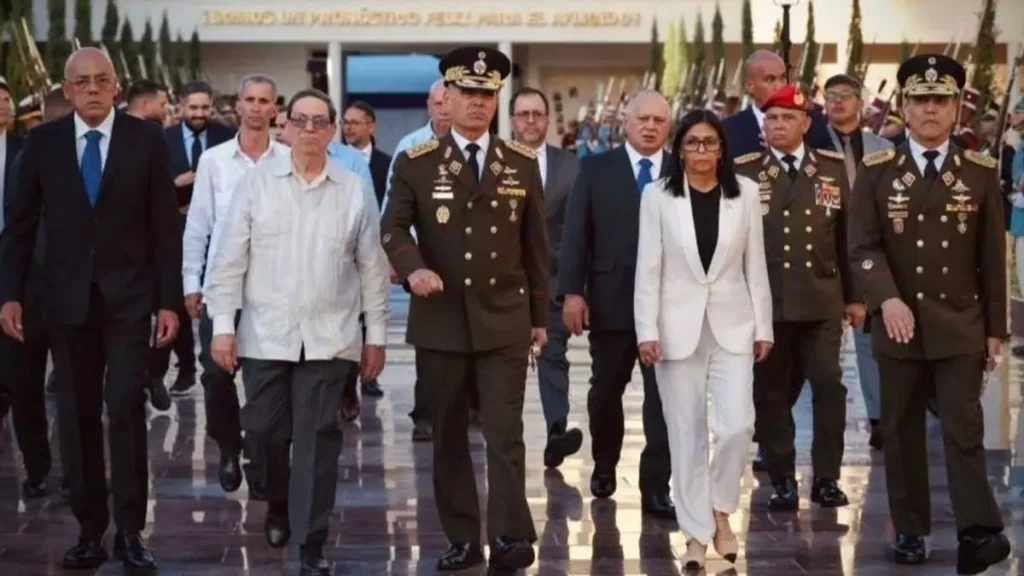
Despite signs of operational distancing, both governments have publicly insisted on the continuity of the alliance. On January 8, Rodríguez herself appeared in Caracas alongside Cuban Foreign Minister Bruno Rodríguez during an event commemorating the victims of the U.S. attack. Days later, the Venezuelan leader spoke by phone with President Miguel Díaz-Canel to reaffirm, according to the official version, the bilateral “brotherhood.”
The pullback reflects more of a tactical adjustment than a strategic rupture
In Havana, the rhetoric has also remained largely unchanged, although official media avoid addressing the changes that have taken place in Venezuela since Maduro’s capture. On the ground, however, the picture is more nuanced. A source close to the Cuban government acknowledged that while some soldiers wounded during the U.S. operation have returned to the Island, others remain active in Venezuela. The source also noted that a considerable number of doctors continue providing services.
Analysts consulted by Reuters agree that the pullback represents more of a tactical adjustment than a strategic break. Frank Mora, former U.S. ambassador to the Organization of American States, believes Rodríguez is acting cautiously. According to his assessment, she is trying to keep the Cubans “at arm’s length” until she consolidates her grip on power, without completely breaking with Havana.
Along the same lines, academic John Polga-Hecimovich stresses that the footprint of Cuban intelligence remains deeply embedded in Venezuela’s security structures. Although advisers failed to prevent Maduro’s downfall, their previous work, especially in counterintelligence, contributed decisively to the stability of Chavismo for years.
For now, the partial withdrawal raises more questions than answers. While return flights continue to multiply, U.S. sources warn that covert Cuban agents are likely to remain in Venezuela monitoring the evolution of the political landscape. What does seem clear is that the de-Cubanization of Venezuela is deepening, and the Havana–Caracas axis is going through its most fragile moment.
Translated by Regina Anavy
______________________
COLLABORATE WITH OUR WORK: The 14ymedio team is committed to practicing serious journalism that reflects Cuba’s reality in all its depth. Thank you for joining us on this long journey. We invite you to continue supporting us by becoming a member of 14ymedio now. Together we can continue transforming journalism in Cuba.