The measure will affect people who were residing in Spain before December 31, 2025
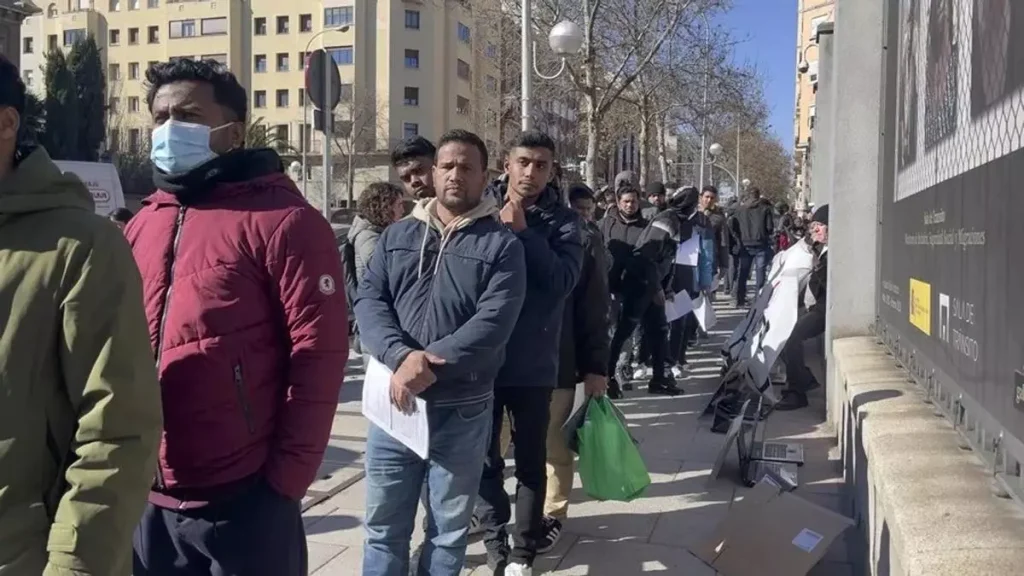
 Europa Press / EFE/ 14ymedio, Madrid, January 26, 2026 — The Government will approve this Tuesday, January 27, at the Council of Ministers, an extraordinary regularization of migrants by royal decree, following an agreement between the Spanish Socialist Workers’ Party (PSOE) and the far-left Podemos, sources from the Ministry of Inclusion, Social Security and Migration confirmed to Europa Press.
These same sources explained that this extraordinary regularization, first reported by the progressive Partido Morado [Purple Party], applies to foreigners who are already in Spain, and added that it will be carried out “with the aim of guaranteeing rights and providing legal certainty to an existing social reality.” Because it is being approved by decree, it will not need to be ratified by Congress.
The initiative revives the mandate of the Popular Legislative Initiative (ILP), backed by more than 700,000 signatures and supported in 2024 by all parliamentary groups except the conservative Vox Party (310 votes in favor and 33 against), although it remains stalled in the lower house.
Montero said that beneficiaries will have to prove at least five months of stay in Spain, for which they will need to provide proof of registration, medical reports, or money transfers
The Podemos Member of the European Parliament, Irene Montero, revealed the agreement with the PSOE on Monday during an event in Madrid focused precisely on the regularization of this group. There, she said the measure will apply to people who were residing in Spain before December 31, 2025.
In addition, Montero explained that beneficiaries will have to demonstrate at least five months of residence in Spain, for which they will need to submit proof of municipal registration, medical reports, or money transfers. Upon submitting the application, a provisional residence authorization will be granted.
Montero also said that Podemos will ensure the process is “swift and effective” and that it is necessary to guarantee the rights of these individuals in the face of “racist violence.”
The Funcas think tank (Savings Banks Foundation) estimates that about 840,000 migrants live in Spain in an irregular administrative situation, representing 17.2% of the foreign population from non-EU countries.
This estimate is based on the difference between the population actually residing in Spain according to the National Statistics Institute (INE) and foreign nationals who do have residence permits, are beneficiaries of international protection, or are in the process of obtaining it.
Funcas estimates that around 840,000 migrants live in Spain in an irregular administrative situation, representing 17.2% of the foreign population from non-EU countries.
These data, as of January 1, 2025, point to a notable and sustained increase in the number of foreigners in an irregular situation since 2017, when the estimated figure stood at around 107,000, or 4.2% of the non-EU foreign population residing in Spain.
By origin, nationals from the American continent stand out (760,000), representing 91% of total irregular immigration, especially Colombians (nearly 290,000), Peruvians (almost 110,000), and Hondurans (90,000). African (50,000), Asian (15,000), and European (14,000) nationalities trail far behind.
The report does not specify the exact number of Cubans in an irregular situation, but the thousands estimated to be in this situation will also be able to benefit from the government measure.
The data predate the latest reform of the immigration regulations, which came into force in May 2025 and introduced changes to make access to regularization through social ties (arraigo) more flexible, which “would tend, in principle, to reduce the number of irregular migrants.”
The new regulations will allow 900,000 people to be regularized over three years. However, Funcas notes that if current trends continue, even if the government’s estimates are met, the number of residents in an irregular situation would not decrease, but rather stabilize.
For Funcas’s Director of Social Studies, María Miyar, the figures once again demonstrate “the characteristics of the Spanish migration model of the last 25 years,” which “assumes that a significant proportion of immigrants go through a long period of irregularity before obtaining administrative regularization.”
The think tank highlights the “lack of planning in Spanish migration policy, without a clear strategy regarding the volume of immigrants received or their characteristics.”
While acknowledging that the new regulations “will surely contribute to the social integration of many immigrants,” they add that it “still does not entail real planning.”
To truly reduce the figures, the report points to the need for measures that improve the management of migration flows and that are framed within a broad strategy of economic growth and productivity, directing immigration toward sectors of the economy with labor shortages and qualification requirements.
Translated by Regina Anavy
____________
COLLABORATE WITH OUR WORK: The 14ymedio team is committed to practicing serious journalism that reflects Cuba’s reality in all its depth. Thank you for joining us on this long journey. We invite you to continue supporting us by becoming a member of 14ymedio now. Together we can continue transforming journalism in Cuba.