“We ourselves have doubts. The banks are collecting foreign currency only; they haven’t given us the order yet to sell”
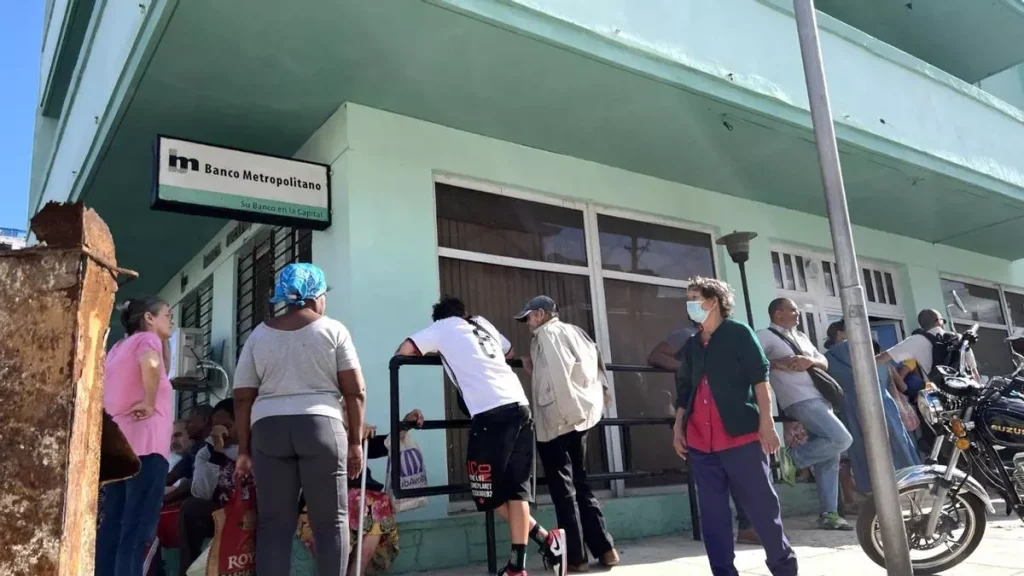
 14ymedio, Havana, Darío Hernández, December 23, 2025 — Nearly a week after the Central Bank of Cuba (BCC) announced the implementation of a floating rate for the foreign exchange market, in addition to other official exchange rates, the measure has yet to materialize for most Cubans. In Havana, the banks are not selling dollars to the population, despite the regulation being presented as a step to “organize” the exchange market and bring the official rate closer to the country’s economic reality.
In practice, the only thing that has begun to function is the purchase of foreign currency, and even that operation is surrounded by improvisation, administrative silence and confusion among bank employees themselves, as 14ymedio was able to confirm during visits to several bank branches in the Cuban capital.
“So far, I have no news that dollars are being sold to the population under the new rate; what they are doing is buying,” a Banco Metropolitano branch employee in El Vedado, who prefers to remain anonymous, explained to this newspaper on Monday. According to his account, US currency was being received that day at 401 pesos.
“If the customer hands over a large amount of dollars and the bank doesn’t have enough cash in national currency, part of the payment is made through electronic transfer. If the disbursement is made completely in cash, a 3% discount is applied as a tax,” the state worker specifies.
The new rate was announced by monetary authorities as a flexible mechanism, subject to adjustments based on supply and demand. The stated objective was to compete with the informal market and capture dollars currently circulating outside the state financial system. However, what is happening at the branches is very different from the official narrative. There are no clear protocols, and staff are working without precise instructions on how to proceed.
There are no clear protocols and staff are working without instructions
This scheme, far from conveying confidence, feeds the perception of improvisation. “This entire process of the new floating dollar exchange rate has been implemented without notice or prior preparation of the bank staff,” the worker summarizes. “We haven’t received any guidance on how to sell the dollars, whether we’ll give it to them in cash or through electronic transfer. Even yesterday we had a meeting at our bank, and the topic of selling dollars didn’t even come up.”
The uncertainty repeats itself at other branches in the capital. At the bank located on the ground floor of the Focsa building, also in El Vedado, an employee confirms that the order for now is to buy only foreign currency. “We ourselves have doubts. Now all the banks are doing is collecting, buying dollars,” she explains. Although she says that selling will happen “at some point,” she recognizes that there still isn’t an official instruction allowing them to offer dollars to the public.
The worker also confirms that the rate of 401 pesos is already being used in other financial operations. “Those who have MLC [freely convertible currency] cards, now when you do a transfer from Transfermóvil to national currency, the exchange rate used is that one, and you gain cash that way.” If this detail is confirmed, then it would be a signal that the BCC is trying to consolidate the freely convertible currency again, as seems to be indicated by the rapid rise of that virtual financial instrument on the informal market exchange board published daily by the site El Toque. At the end of October; a dollar was worth barely 200 pesos and is now at 350.
The design of the sales mechanism, when finally activated, also raises questions. According to banking sources, MSMEs (micro, small and medium-sized enterprises) will receive dollars exclusively through electronic transfers, not in cash, which is in line with the chronic shortage of bills in state coffers. For individual customers, a combination of cash and transfers is expected, “when they approve it,” clarifies the Focsa employee. For now, the outlook is an asymmetric scheme: the bank buys dollars from the population but doesn’t sell them.
The BCC announced a new banking channel for the non-state sector to purchase foreign currency in the official market. “Requests will be made from commercial banks and through the fiscal account, without handling cash,” the brief informative note clarifies. “The limit will be up to 50% of the average gross income of the fiscal account in the last quarter,” the text adds.

Regarding individuals, this note clarifies that the limit of 100 dollars per person will continue and that the cumbersome and ineffective system of turns through the Ticket app at the 41 sales offices will be maintained.
Outside the Focsa bank branch on Monday, however, the urgent concerns were different. The long line to collect pensions or attempt to withdraw cash from ATMs monopolized customers’ anxiety. Each time an employee poked their head out the main door, a shower of questions rained down on them. Doubts ranged from the establishment’s operating hours during the upcoming holidays to questions about when they will start selling dollars.
Informal currency exchangers, meanwhile, seem to be starting to react after days of paralysis and uncertainty following the official announcement. “The guy who buys dollars in my neighborhood went a week without accepting them but has started again and has set them at 420 pesos,” a young resident of the Guanabacoa municipality explains to this newspaper. In private businesses, it is common for employees to accept US currency at the informal exchange rate and even to purchase it.
El Toque reports that the dollar this Tuesday is at 440 pesos on the informal market, where the greenback continues to circulate with greater agility and without taxes or cumbersome procedures. For many Cubans, handing over their foreign currency to the bank and having to register personal data with no certainty of being able to buy it back doesn’t seem like an attractive option at the moment.
“I had 100 dollars saved for Christmas and I preferred to change them with an individual who has a cafeteria on my block,” recounts a neighbor from Cotorro. “He gave me 425 pesos for them and I came out better than I would have with the bank and didn’t have to show my ID card,” she adds. However, she will avoid selling the remaining US currency she has saved “until things settle down.”
Translated by Regina Anavy
____________
COLLABORATE WITH OUR WORK: The 14ymedio team is committed to practicing serious journalism that reflects Cuba’s reality in all its depth. Thank you for joining us on this long journey. We invite you to continue supporting us by becoming a member of 14ymedio now. Together we can continue transforming journalism in Cuba.