The opponent is accompanied by his mother, Yindra Elizastigui, and his seven-year-old son
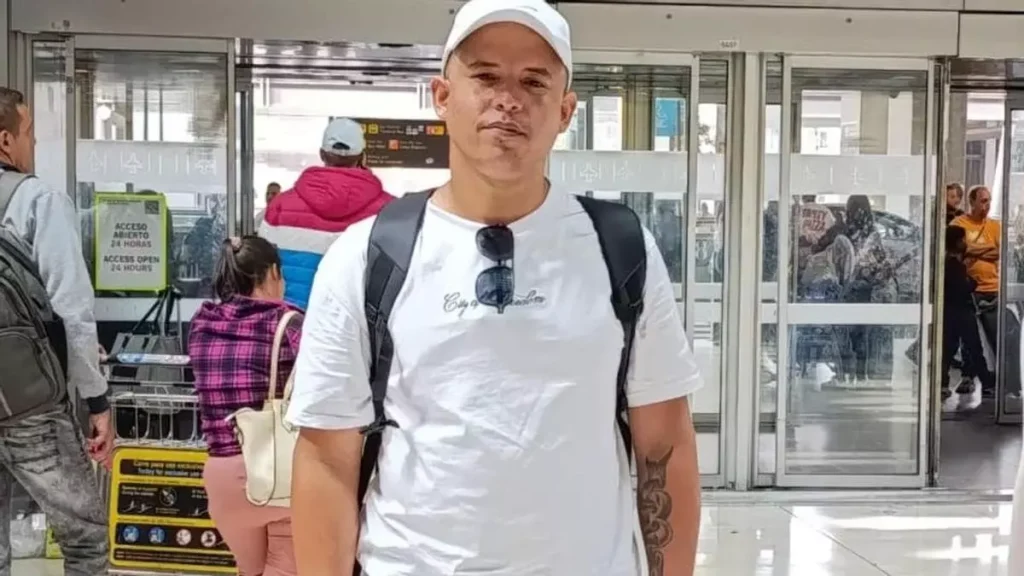
 14ymedio, Madrid, October 13, 2025 — Luis Robles Elizastigui, the “the young man with the placard,” arrived in Madrid this Monday from Cuba, along with his mother, Yindra Elizastigui, and his seven-year-old son. Excited and tired, they did not want to make any statement on arrival at the Adolfo Suarez Airport in Madrid, which was witnessed by 14ymedio.
The 32-year-old from Havana, considered a prisoner of conscience by Amnesty International, was one of those released last January during the mass releases of prisoners as part of an agreement with the Biden government. At the time, he was still under house arrest — as he was last June — as part of his sentence of five years in prison for holding a poster calling for the release of rapper Denis Solís on the central boulevard of San Rafael in Havana on December 4, 2020.
Arrested that same day, the images of his solitary demonstration spread on social networks and were immortalized two months later in the Patria y Vida video clip. They were, at the same time, the only incriminating evidence presented by the Prosecutor’s Office in the trial, held almost a year later in Marianao, in which Robles was tried for resistance and enemy propaganda, despite the fact that in the video it was observed that he did not fight with the officers who arrested him, nor was there any allusion to an enemy on his poster. The people around him tried to defend him from the police.
The banner said, “Freedom, no more repression, #FreeDenis,” in reference to the rapper sentenced to eight months in prison in a summary trial, who would end up being banished to Serbia.
The three judges and prosecutor involved were sanctioned last May by the US for their “crucial role” in the arbitrary detention
According to the judgment, to which 14ymedio had access, it was “proved” in the trial that Robles “responded to a call” by the Cuban influencer “Alexander Otaola to speak out” against the arrest of Solís, “the police authorities and the leaders of the State and the government,” to carry out any act aimed at destabilizing the internal order and to demonstrate publicly in the streets against the Cuban economic and social system.”
The phrase on the sign that Robles was carrying “opposed the decisions of the authorities” and determined his arrest, which was justified by the Provincial Court of Havana, where the activist was prosecuted.
The sentence was dated March 28, 2022, almost four months after the trial, and the three judges and prosecutor who participated were sanctioned last May by the US for their “crucial role” in the arbitrary detention of Robles, an action that Washington said was a “grave violation of his human rights.”
Since then, the four officials – Gladys María Padrón Canals, María Elena Fornari Conde, Juan Sosa Orama and Yanaisa Matos Legrá – and their families have been banned from entering US territory.

While he was imprisoned in the Combinado del Este maximum security prison, the regime went after Robles’ family and arrested one of his brothers, Lester Fernández, while he was building a boat. He was also fined 7,000 pesos for “illegal exit from the country,” although there was no proof of it, as his mother has reported since they submitted the facts in early 2023.
Yindra Elizastigui, for her part, has been one of the most combative mothers for the cause of political prisoners, not just her son. Throughout his years in prison, she never tired of denouncing the ill-treatment Robles received. “We must continue to defend them, because our children and our families are innocent. What they did, they did for a right that all human beings want,” she declared in a live broadcast in May last year when her son was once again denied the conditional release to which he was entitled.
Graduated in Informatics, we started to know more about Luis Robles thanks to his brother, Landy Fernández Elizastigui, who became one of the channels of communication of the “young man with the placard” with the outside. In an interview with 14ymedio, Fernández said that his brother has always “thought differently about the regime.”
Indeed, three days before going out on the streets to demonstrate peacefully, Robles recorded a video that was published much later where he talked about his thoughts, desires and also the reasons that led him to be a protester.
“We wish from the heart for a change, a change of system, a change of country, because really communism has turned this country into a living hell”
“We sincerely wish for a change, a change of system, a change of country, because really communism has turned this country into a living hell, a hell where it is practically impossible to breathe, not only air, but also peace and tranquility,” he stated.
At another time, he said that “freedom is the greatest thing you can have in life, and these shameless communists since they arrived have cut off all kinds of freedoms, freedom to a free religion, freedom to a free ideology, freedom to choose who you like, not who they impose on you.” And he continued: “They have taken away even the freedom to think, they want to control even what we think.”
In March 2022, the 29-year-old published a letter reiterating his struggle and goal: “freedom for the people of Cuba.” In the missive, Robles went back to the reasons that brought him to the peaceful protest that led to prison.
“I decided to break my silence because I was tired of seeing my country destroyed and the government doing nothing to fix it,” he explained, “because I think that Cuba’s greatest enemy is not outside but sitting in the seat of the President.”
Translated by Regina Anavy
____________
COLLABORATE WITH OUR WORK: The 14ymedio team is committed to practicing serious journalism that reflects Cuba’s reality in all its depth. Thank you for joining us on this long journey. We invite you to continue supporting us by becoming a member of 14ymedio now. Together we can continue transforming journalism in Cuba.