
With the Crisis, the ‘Camels’ Return in Cuba, As in the Worst Time of the Special Period

Cuban transport revives the camello. [14ymedio]
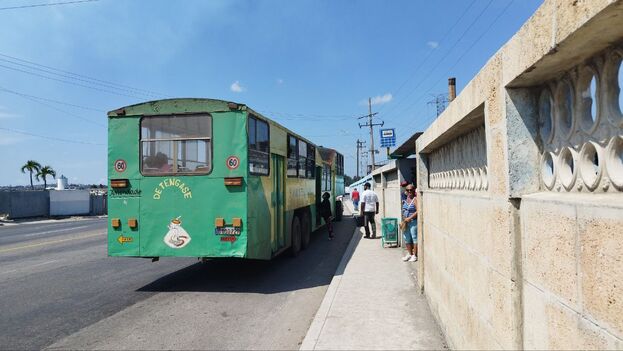
14ymedio bigger14ymedio, Juan Diego Rodríguez, Havana, 28 April 2023 — Last Wednesday, a 14ymedio reporter sent a photo that he had just captured on Avenida del Puerto, in Havana: a camello [camel] was picking up passengers on a route that took them to La Palma, a neighborhood on the periphery. It was further proof that the fuel shortage was creating a transport crisis similar to the one experienced in the 90s, during the Special Period, which began even before the end of the Soviet subsidy.

In 1988, the Cuban engineer Jorge Hernández Fonseca and his colleagues from the National Office of Industrial Design proposed to the authorities an idea to end the transport crisis in Havana. The vehicle, locally manufactured, would have the capacity to carry more than 300 people on each trip. A few years later, the “invention” had become the symbol of an entire time of survival, and there was no bus stop at which its arrival was not expected, often in desperation.

“The idea was for the Island to have a kind of ’metro’ on the streets,” says 14ymedio reporter Hernández Fonseca, exiled in Miami. The “inventor of the camel” describes as “cyclical” the collapse of public transport in the capital and in the main cities of the Island since the triumph of the Revolution. The return of the “metrobus” that never was, constructed from two or three buses assembled with a trailer on an 18-wheeled chassis with two “humps” in the ceiling, is no surprise.

“I think it is the most sensible thing to quickly alleviate the crisis,” says the engineer, although he doubts that the country is in a position to manufacture new buses with the characteristics that the camels had. Those that circulated during the Special Period were made by “the cargo transport companies and the Army.” In addition, he says, it had the ability to save fuel due to the large number of passengers it could pick up on a single trip. continue reading

Hernández Fonseca, who has traveled through several capitals of the world, understood that in the Cuba of the 90s, after the fall of the Soviet Union, there was no way to sustain an underground subway network. A bus with certain characteristics of the subway was the only option. “Everyone who has used a subway knows that mass transport is prioritized over comfort. We must remember the context in which the first metrobuses arose: the Special Period.”

The fuel crisis that the Island is now experiencing, he reflects, is a “repetition” of that time. Many Cubans, however, thought they had exceeded the time when camels were the only option to get to the work center or move around the city. Today, the few buses that circulare in Havana — “leased” according to their signs — bring with them the bad taste of the economic debacle of the 90s.

Criticism of the ’camel’ is not only aimed at the bad memories it brings to most Cubans by associating it with the crisis but also at how hot it is inside, given the many passengers it transports and its small windows. The shocks it causes in the homes located on the avenues where it circulates also adds to its defects.

“Cubans have more criticisms than compliments about the camello,” recognizes Hernández Fonseca, who claims to be no stranger to the discomfort of the vehicle, but it must be understood that “there was no other alternative” at that time, he says. As the situation is, he does not consider it a thing of the past nor does he see it as part of a future Cuban transport museum.

Translated by Regina Anavy

____________

COLLABORATE WITH OUR WORKThe 14ymedio team is committed to practicing serious journalism that reflects Cuba’s reality in all its depth. Thank you for joining us on this long journey. We invite you to continue supporting us by becoming a member of 14ymedio now. Together we can continue transforming journalism in Cuba.
The Message of the Cuban Bishops Avoids Alluding to the Negotiation on Political Prisoners

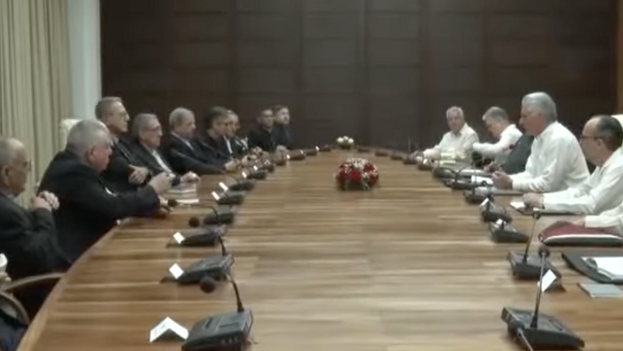
The Catholic bishops in their meeting with Miguel Díaz-Canel and the hierarchy of the Communist Party of Cuba, last Wednesday in Havana. (Screen capture)

14ymedio bigger14ymedio, Madrid, 28 April 2023 — The Conference of Catholic Bishops of Cuba (COCC) issued an official statement this Friday about the meeting they held two days ago with President Miguel Díaz-Canel and other senior officials of the country.

In it, they did not allude to something that Ariel Suárez, secretary of the Episcopal Conference, had acknowledged this Thursday to the Reuters agency: that the parties addressed the issue of the political prisoners arrested for the demonstrations of July 11, 2021.

Instead, the text affirms that the bishops “did not discuss specific positions of the Church, but shared with all respect, sincerity and clarity their concerns and assessments about the current moment in which we live.”

In addition, they appreciate “the possibility of the exchange, for the seriousness in which it was developed” and “the opportunity to be heard,” and they value “the importance and convenience of this experience, also for the future.”

It was an occasion, they conclude, “for the bishops to renew to the authorities their commitment to the Cuban people and to everything that favors a more serene climate of peace, harmony, respect for all and hope.” continue reading

Asked about the role of the Catholic Church in mediation with the regime, the Cuban priest Alberto Reyes, in an interview with 14ymedio, opined that the institution has its own limits, and that, despite its social impact and charitable works, “it is not a charitable organization or a political party.”

On the occasion of Reyes’ visit to Brussels, a group of European delegates condemned in a letter “the increase in citizen repression, the lack of freedom of expression and the absence of signs of openness and democracy” on the Island.

The letter, released this Friday by the Cuban Observatory of Human Rights and signed by Leopoldo López Gil, Javier Nart, Antonio López-Istúriz, Gabriel Mato, Enikö Györi, Soraya Rodríguez Ramos and Jordi Cañas, expresses its concern about “the unacceptable situation of political prisoners in Cuba, imprisoned for exercising their legitimate right to demand democratic changes on the Island.”

In addition, they refer to the “marked deterioration of citizen life in Cuba,” highlighted by “the recurrent lack of medicines, the growth of violence and the insecurity due to the precariousness suffered by its population.”

This, they continue, “has triggered critical levels of emigration, especially of the young population, which is forced to leave in the absence of a future.”

In accordance with the Political Dialogue and Cooperation Agreement, in force between Cuba and the European Union, they call for the holding of “free, transparent and guaranteed elections, which serve for the country to return to the democracy that its citizens so long for.”

On Wednesday, 50 relatives of political prisoners on the Island sent a letter to the European Parliament in which they exposed the precarious situation of the detainees after the mass protests of July 11, 2021 [11J] in Cuba.

The signatories noted in their letter that, in September of that same year, the European Parliament approved resolution P9-TA (2021) 0389, which condemned the “government repression” that was being reported from numerous cities in Cuba. Relatives describe this document as “one of the most forceful texts in favor of the freedom of the Cuban people.”

They also noted the most recent attempt at mediation for the release of the prisoners, during the visit of Cardinal Beniamino Stella, special envoy of Pope Francis and former ambassador of the Vatican during the Special Period. Stella, supported by the pontiff, had requested “an amnesty or some form of clemency” for political prisoners. The members of the Cuban Episcopal Conference also joined the demand, without a concrete response from the Government.

Although Stella’s statements suggested that there had been a conversation at the highest level about those imprisoned, Miguel Díaz-Canel’s public reaction was to affirm that he would try to find “the solution to the expectations of both parties.” But the negotiation, in which several countries, such as Spain, claimed to be willing to offer asylum to the interested parties, again came to nothing.

Translated by Regina Anavy

____________

COLLABORATE WITH OUR WORKThe 14ymedio team is committed to practicing serious journalism that reflects Cuba’s reality in all its depth. Thank you for joining us on this long journey. We invite you to continue supporting us by becoming a member of 14ymedio now. Together we can continue transforming journalism in Cuba.

About 15,000 Cubans Have Arrived in the United States With Humanitarian ‘Parole’

The ’parole’ processes are based on sponsors for Cuba, Haiti, Nicaragua and Venezuela will remain in force after May 11. (Telemundo/Screen capture/YouTube)

14ymedio bigger14ymedio, Havana, 28 April 2023 — A total of 15,000 Cubans arrived in the United States as of March through the humanitarian parole program launched in January by Joe Biden’s government. In the first quarter, “18,000 Haitians, 7,500 Nicaraguans and 32,000 Venezuelans were admitted,” as reported at a press conference by the acting undersecretary of the Department of Homeland Security, Blas Nuñez-Neto.

To date, more than 55,000 Cubans, Nicaraguans and Haitians have received authorization to travel to the United States under this program, in addition to 40,000 Venezuelans.

The US official recalled that “the parole processes based on sponsors for Cuba, Haiti, Nicaragua and Venezuela that were announced in January will remain in force after May 11,” when the current Title 42 is suspended and the old article 8 is reactivated to deport people who arrive in an irregular status to their countries. continue reading

Arrival in the United States of a Cuban benefiting from humanitarian parole. (Screenshot)

Nuñez-Neto insisted that the US border is not open and that from May 11 the repatriation of migrants who enter the United States will be “accelerating.”  Persons expelled “will not be able to enter the country for five years, in addition to being prosecuted.”

Among the measures to establish order in legal migration and reduce illegal migration, Nuñez-Neto specified that the appointments available in the CBP One application will be increased.

At the same conference, the Deputy Undersecretary of State, Marta Youth, of the Office of Population, Refugees and Migration of the State Department, reiterated the creation of centers to manage migrant applications in Colombia and Guatemala, where applicants will be able to access some legal migration routes, such as obtaining refugee status, family reunification programs and work permits.

In these centers, now-existing facilities of the UN Refugee Agency and the International Organization for Migration, evaluated migrants will be able to benefit from refugee programs and humanitarian permits for families and to work in the United States. Spain and Canada have also agreed to receive people who are sent from these facilities.

On Thursday, the Secretary of State, Antony Blinken, and the Secretary of National Security, Alejandro Mayorkas, announced the extension of the parole for family reunification to nationals of El Salvador, Honduras, Guatemala and Colombia.

The US Coast Guard continues to return Cubans to the Island; this Friday it was a group of 82 rafters. (Twitter/@USCGSoutheast)

This Friday, the U.S. Coast Guard returned 82 migrants from the Island on the ship Paul Clark. Captain Ben Golightly, of District Seven, recalled that Blinken made it known that Cubans and Haitians who are detained on the high seas after April 27 will not have the right to humanitarian parole and will be returned to their country of origin.

The agency stressed the return by sea or air for Cubans. This week the deportations of migrants from the Island resumed on a flight from Miami. The number of weekly flights will double or triple for some countries,” according to a statement.

Last Sunday, the US Coast Guard transferred 20 Cubans to the Bahamas on the ship Skipjack, who had been rescued on Tuesday. The agency reported that since October of last year, the attempts of 6,449 rafters to reach Florida has been thwarted.

Translated by Regina Anavy

____________

COLLABORATE WITH OUR WORKThe 14ymedio team is committed to practicing serious journalism that reflects Cuba’s reality in all its depth. Thank you for joining us on this long journey. We invite you to continue supporting us by becoming a member of 14ymedio now. Together we can continue transforming journalism in Cuba.

Cuba’s Comptroller’s Office: From Administrative Control to Popular Control

The Controller General of the Republic, Gladys Bejerano Portela. (Networks)

14ymedio bigger 14ymedio, Elías Amor Bravo, Economist, 27 April 2023 — Cuba president Díaz-Canel’s intense agenda didn’t prevent him from holding a review meeting with controllers and auditors, and in particular with Señora Gladys Bejarano, once a star of the firmament of the Cuban communist economy, and now perhaps, at her lowest hour. Sra. Bejarano is the head of the Office of the Comptroller General of the Republic and the National Audit System, the main instrument of the regime in the “fight against corruption” of the many that exist.

At the meeting, Díaz-Canel highlighted “the accompaniment and support they have given to the direction of the country in all the tasks that have been proposed” and thanked “the effort, dedication, responsibility and commitment; proposing new things, how to get ahead, how to find solutions to our problems” to the managers, specialists and young people of that organization and to the audit areas of ministries, national entities, companies, local bodies of the People’s Power and other branches that participated in the event.

For Díaz-Canel it is important that the Comptroller’s Office seek for each measure approved by the regime “an interpretation of how to control the implementation of those measures so that they take effect.” But shouldn’t this task be carried out by the one who proposes the measure, that is, the government? Or is it that the basic principles of good governance are ignored by the leaders of the regime? It is not strange that, measure after measure, they all fail. This is a good example.

Next, Mrs. Bejerano gave a report on the challenges and projections for the performance of the entity she presides over in this exercise, presenting a mixed bag, very much in her style. continue reading

First of all, she wants to stop the loss of staff in the system. Controllers are leaving for the United States, Europe and Latin America. She knows that their experience and qualifications can help them get work as auditors in consultancies where they can earn six figures a year and not suffer the deprivations of communism. No wonder Mrs. Bejarano complains of a diminishing workforce.

Secondly, she called for the promotion of a culture of prevention and control in administrations and increased rigor in confronting manifestations of indiscipline, illegality and corruption in the field of administrative management. She offered to be at the head of the repressive mobs that communists like so much. It seems the Comptroller’s Office should exist for something else.

Third, she asked to update and optimize the self-control routes of the administrations and reduce the aspects that have to be checked. That is, work less for your organization, and if possible, look the other way if problems appear that can create some difficulty for the hierarchy. No. That’s not how you should play.

Fourth, she mentioned the realization of the next National Check of Internal Control, which evaluates the economic results; the quality of prevention and control actions; and the increase in speed in the processing and response to complaints and requests of the population, among other objectives. The truth is that little is known about those annual checks. It would not be a bad thing if the results of the work were disclosed.

Díaz-Canel, very much in his role, said he met young people in all the provinces willing to work in the Comptroller’s Office. In fact the UJC [Young Communist League] was present at the event and once again extended itself in its successful “innovative capacity, from the concept of creative resistance” to apply it to the daily task of the auditors. Díaz-Canel knows little about audit work.

At the close of the meeting, Díaz-Canel pointed out the high ideological training of those who make up the Office of the Comptroller General of the Republic and the National Audit System. Maybe that’s why they have difficulty retaining professionals who are fed up with so much ideology. He spoke about the negative consequences of the ’blockade’, which in his opinion has generated a context conducive to the increase of social indiscipline, illegalities, crime and corruption.

And he added, “in the face of imperialist logic, let’s impose socialist logic” supported by creative resistance, the completion of tasks and making it happen by the participation and dialogue of the workers. When it seemed that he was saying goodbye, he resorted, as it could not be otherwise, to the subject of his doctoral thesis, the paradigm of government based on science and innovation, social communication, computerization and digital transformation, which he asked to be applied to the activity of the Comptroller’s Office. And all this, without forgetting the “battle against corruption, against simulation, against shamelessness, and against double standards,” putting “socialist morality and honest and creative work first.”

A radical speech, of angry positions, far from reality and which  shows the enormous weaknesses of Díaz-Canel and the model he tries to defend at any price. The obsession with confronting corruption is greater than the corruption itself that has been installed in society, which, as we have highlighted in this blog, has a lot to do with the apparatus of administrative and legal rules of the Cuban communist system. Now Díaz-Canel not only wants to apply it to the Comptroller’s Office but also to popular control, and thus he announced that “people are needed to control and make the processes more transparent.” Hold on, curves are coming.

Translated by Regina Anavy

____________

COLLABORATE WITH OUR WORKThe 14ymedio team is committed to practicing serious journalism that reflects Cuba’s reality in all its depth. Thank you for joining us on this long journey. We invite you to continue supporting us by becoming a member of 14ymedio now. Together we can continue transforming journalism in Cuba.
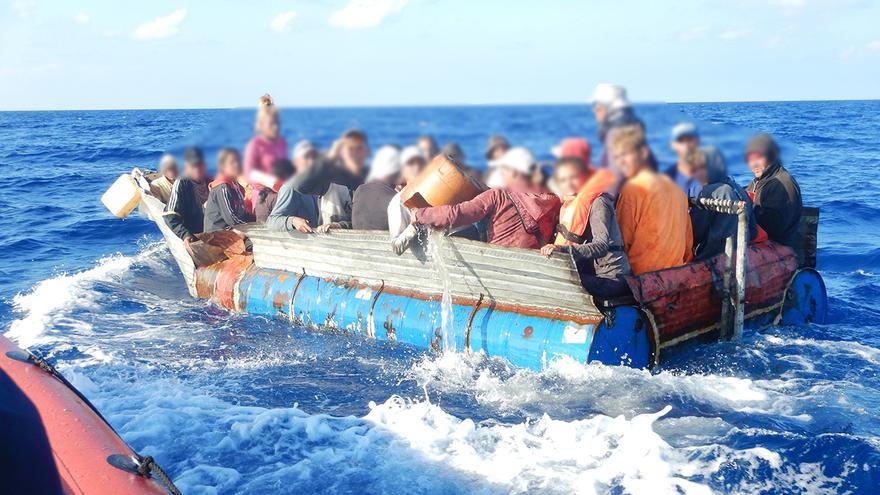
As of May, Cubans Older than 13 Won’t Get Chicken on the Ration Book

“The idea that at the beginning of the month we will have everything in the ration stores for the moment is not sustainable,” say the managers. (14ymedio)

14ymedio bigger14ymedio, Havana, 29 April 2023 — Cubans over the age of 13 will no longer receive standard chicken meat, but rather picadillo and mortadella. The news, slipped into a report on the difficulties in supplying the basic family basket, adds that only the chicken “in the distribution” will be for minors 13 and under age and those who have a “medical diet.”

With the drop in imports of chicken to the island from the United States, and the increase in the price of the product in the international market, the direct impact on consumption could be seen coming since February, when the Cuban economist Pedro Monreal announced the the lowest import volume in the last five months.

After lamenting the serious “affects with fuel,” a situation that is already reaching critical levels at the cusp of summer, the general director of Merchandise Sales of the Ministry of Domestic Trade, Francisco Silva, explained that the sale of increasingly scarce rationed goods would start “partially” from this Saturday.

Food and supplies corresponding to May, said the manager, have been given priority in the processes of “port extraction and distribution.” Among the missing products in April, whose delivery the ministry expects to “complete” soon, are beans, peas and oil. The wait will be slightly longer for coffee, which will arrive at the bodegas [ration stores] in the first days of May, announced Silva, who made it clear that, for now, it is barely being produced, just like fruit compote.

There will be no change in prices, he promised, which will continue to be those approved by the organizers of the Ordering Task. Some vulnerable families in the country will receive a free food module, a measure that will be extended to all consumer centers in Holguín and Guantánamo.

In this last province in particular, one of the poorest in the country, the official press commented with concern on the growing shortage. An article published this Saturday in the newspaper Venceremos noted that the basic food basket should be a “first order task for the country’s leadership,” since it constitutes the only source of food for many families in the eastern region. continue reading

However, the article notes, the result was the absence of rice, sugar, oil, grains, coffee, salt, and other inputs that take time to arrive, if at all, to “the most distant bodegas” on the Island.” From 2022 to 2023 the arrival of these products has been very unstable,” it summarizes.

Asked about these problems by the Communist Party organ in Guantánamo, the national commercial director of the Wholesale Food Products Company, Ángel de la Cruz Vaquero, pointed out that there were other culprits for the delay: the suppliers and transporters, in addition, of course, the US ’blockade’ and even the ’lags’ caused by the coronavirus pandemic.  

The case of Guantánamo, explained the national director, is particularly alarming, because “when the cargo arrives at the port of Santiago de Cuba, most of the eastern provinces are there, ready to collect their quotas,” while Guantánamo arrives late and after a lot of ” lost time.”

In the province itself, the “technological obsolescence of industries” is another point against local supply. Sugar production, the official explained, “is going through one of its worst moments, more cane is needed and there isn’t any.” The alternatives are to bring raw sugar from Las Tunas and Camagüey, but those provinces already have their own problems.

The most serious issue continues to be transportation, Vaquero stressed. In the midst of the fuel debacle and with the country almost paralyzed, the responsibility for transporting the available products falls into a diffuse limit: Is it the fault of the provincial Directorate of Transportation, or of the national managers, he asks himself.

Vaquero explained that the supplies are transported to different points on the island by sea, by train or by road, each one with “advantages and disadvantages.” The maritime route uses a well-worn floating generator, with a capacity of 300 tons of cargo, which must make a technical stopover in the vicinity of the Guantánamo Naval Base, where the US authorities must grant permission to enter the provincial port. Other times, maritime transport is hampered by weather conditions, which put “tons of expensively imported food” at risk.

As for the train, with “very damaged” wagons with a capacity of 60 tons, it often happens that the locomotive is missing because the province simply does not have one. In addition, the goods usually arrive battered by the journey and the “rubbing against the sides” of the wagon.

The difficulties of the first two routes mean that road transport is the most frequent and, since the crisis began, also the most affected. Getting a shipment of oil up to the most isolated areas of the Sierra – such as Baracoa, Maisí, Yateras and El Salvador – is almost impossible, since there is no fuel or trucks in good condition to make the trip.

Guantánamo has not been able to avoid the “lag” since June 2022 and the consequence has been the increasingly serious shortages in the state market. Vaquero does not share the voluntarism with which Cubadebate described the situation of the basic basket: “The idea that at the beginning of the month we will have everything in the warehouse for the moment is not sustainable,” he concluded.

*Translator’s note: The “Ordering Task” [Tarea Ordenamiento] is a collection of measures that include eliminating the Cuban Convertible Peso (CUC), leaving the Cuban peso as the only national currency, raising prices, raising salaries (but not as much as prices), opening stores that take payment only in hard currency which must be in the form of specially issued pre-paid debit cards, and a broad range of other measures targeted to different elements of the Cuban economy. 

____________

COLLABORATE WITH OUR WORKThe 14ymedio team is committed to practicing serious journalism that reflects Cuba’s reality in all its depth. Thank you for joining us on this long journey. We invite you to continue supporting us by becoming a member of 14ymedio now. Together we can continue transforming journalism in Cuba.
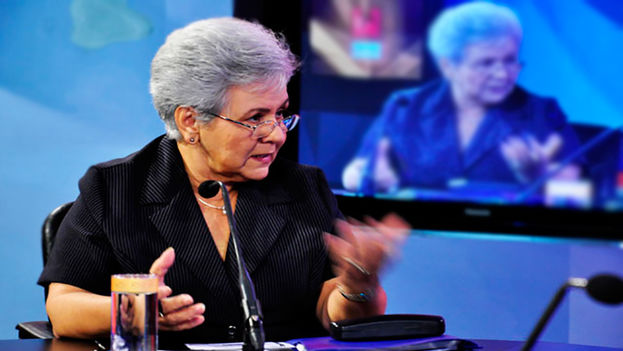
Pavel Giroud Highlights ‘The Pain of Cubans’ Upon Receiving the Platinum Award for the Documentary ‘The Padilla Case’

Cuban director Pavel Giroud received the Platinum Award for the documentary El Caso Padilla [The Padilla Case]. (Facebook)
14ymedio bigger14ymedio/EFE, Havana, 23 April 2023 — Director Pavel Giroud highlighted “the pain of Cubans” upon receiving the award for best documentary film for El caso Padilla, at the Platinum Awards of Ibero-American Cinema, held this Saturday at the Ifema Madrid Palace.

“I want to thank you in the name of we Cubans who are fed up. Our country is a theme park for an ideology and a utopia, and the pain of Cubans does not have the same strength as the pain suffered by other countries,” Giroud said when collecting the prize.

El caso Padilla uses unpublished images of the self-criticism of the poet Heberto Padilla before the Union of Cuban Writers. He was arrested in 1971 by State Security and accused some who were present, including his own wife, of being counterrevolutionaries.

The Platinum Awards, organized by Egeda and the Ibero-American audiovisual federation Fipca, were presented at a gala held at the Municipal Palace of Ifema Madrid, with more than 1,800 guests and 200 accredited journalists.

The favorite of the gala was Argentina 1985, which won five awards, including best film, closely followed by the Spanish As bestas [The Beasts], which received four. continue reading

In a gala marked by the demands of historical memory, the celebration of the Hispanic and music, Santiago Mitre’s film about the historic trial of the leadership of the Argentine military dictatorship also won the award for best actor for Ricardo Darín and those for best screenplay, art direction and education in values.

The Spanish As bestas, a rural thriller that reflects on violence, won the awards for best director for Rodrigo Sorogoyen, best supporting actor, for Luis Zahera, best editing and best sound.

In Spain, the awards for best leading actress, Laia Costa, and best supporting actress, Susi Sánchez, were given for their work in Cinco lobitos [Lullaby], the debut film by Alauda Ruiz de Azúa that is about motherhood.

In the series section, the great winner was Noticia de un secuestro [News of a Kidnapping], an adaptation of the book of the same name by Gabriel García Márquez. Meanwhile, the award for the best Ibero-American comedy is shared between Spain and Argentina, since it was for Competencia oficial [Official Competition], a satire on the egos in the world of cinema directed by Mariano Cohn and Gastón Dupra, starring Penélope Cruz, Antonio Banderas and Oscar Martínez.

The Chilean 1976, a thriller drama set in the darkest years of that country’s dictatorship and directed by actress Manuela Martelli, won as the best debut film, and the Bolivian Utama [Our Home] by Alejandro Loayza, won in best photography and best music.

The Platinum for the best animated film went to Mexico, for Águila y Jaguar, los guerreros legendarios [Águila and Jaguar, the Legendary Warriors], a post-apocalyptic story directed by Mike R. Ortiz. In the series section, the great winner was Noticia de un secuestro [News of a Kidnapping], an adaptation of the book of the same name by Gabriel García Márquez, which won four awards: best series, best creator, best lead actress (Cristina Umaña) and best supporting actress (Majida Issa).

Translated by Regina Anavy

____________

COLLABORATE WITH OUR WORKThe 14ymedio team is committed to practicing serious journalism that reflects Cuba’s reality in all its depth. Thank you for joining us on this long journey. We invite you to continue supporting us by becoming a member of 14ymedio now. Together we can continue transforming journalism in Cuba.
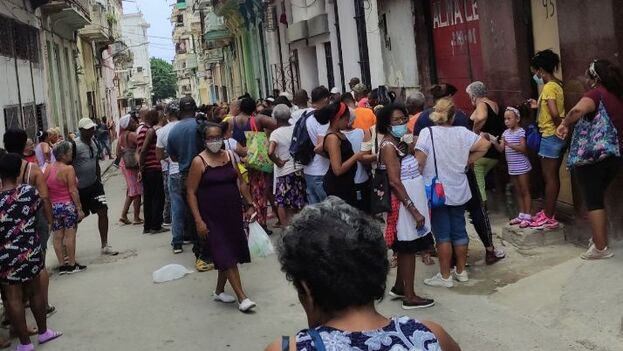
Tourism in Cuba is Still Depressed and is Saved Thanks to Canadians

The forecasts of receiving 3.5 million tourists this year are in jeopardy, after a very poor first quarter. (14ymedio)

14ymedio bigger14ymedio, Madrid, April 25, 2023 — At the gates of the Cuban Tourism Fair (FitCuba), which will start on May 1 with the presence, among others, of about 400 travel agents at a convention organized by the Spanish DIT Gestión, the data of the sector reflect a very deficient first quarter. As of March, 926,732 travelers had arrived on the Island, of which 752,459 were tourists, 48.5% less than in March 2019, the last normal first quarter before the pandemic, when the figure was 1,460,408 foreigners.

The data have not been adequately compiled this April due to the work of updating the page of the National Office of Statistics and Information (ONEI), which prevents normal access to this month’s reports. However, the Cuban Minister of Tourism, Juan Carlos García Granda, provided an approximate figure in a meeting with the authorities of the branch, and this morning the report was partially visible on the ONEI website.

In total, 263,470 international visitors arrived in Cuba in March, a better figure than in January (249,255) and February (239,734), which are traditionally months of greatest influx. However, although the official note highlights that this growth represents 239.1% compared to the same period in 2022, the Island is not making a comeback, far from it compared to the years preceding the outbreak of COVID-19.

In the first quarter of 2018, 1,383,895 tourists traveled to Cuba and in 2017, 1,469,919 did so, almost double the number (45.5% and 48.8% respectively) of this year. These data consolidate the idea that the goal of 3.5 million tourists for 2023 may again be difficult to achieve. continue reading

Last February, the Cuban economist Pedro Monreal made an estimate of the number of foreign visitors that the Island should have received in the first two months of the year for the projection to be consistent, and placed it at 717,500, calculating that, usually, at that point it is necessary to have reached 20% of the total. At that time, the deficit was already 228,511.

“The next data for the month of March must be decisive to confirm a possible trend because the first quarter has usually been the most important, concentrating approximately a third of the annual visitors (average of 32% in 2017-2019),” the expert added. That amount should, according to these calculations, be 1,120,000 tourists, 367,541 more than those who have actually arrived.

Image

Official tourism statistics in Cuba indicate that it could be problematic to reach the goal of 3.5 million tourists in 2023. The accumulated amount for the first two months falls short by 228,000 visitors compared to the level that should be compatible with the goal  — Pedro Monreal (@pmmonreal) March 24, 2023

By nationality, there’s nothing unexpected. Canadians are still in first place and are more than half of the total number of international travelers received so far this year, with 387,071. Behind is the Cuban community abroad, with 83,670, and the United States, with 41,152.

Russia repeats third place, with 32,224, although it still does not reach the figure it had last year (36,677), when the consequences of the invasion of Ukraine had not yet affected tourism in a sudden way. We will have to wait until April for the balance to be positive, since by that date in 2022 there were no flights left between the Island and its Eurasian partner, which in previous years was the market with the highest growth.

The Europeans – Germany (22,700), France (19,478), England (18,301), Spain (16,993) and Italy (16,048) – also do not recover the numbers they had in the past, although they still represent a good share of the Cuban market in a ranking that ends with Mexico, at 10,610. The large group formed by other countries now contributes 104,212 travelers, whose origins are unknown.

In this context, the ruling party persists in last year’s error and continues to present the data in an optimistic way, insisting that there is a recovery that only occurs if the data is compared with the collapse that occurred during the pandemic.

The majority of countries in which tourism is one of the great engines of the economy have recovered and even surpassed the pre-pandemic figures, as is the case of Spain, which closed with a growth of 8.3% compared to 2019, and this year is expected to be even greater; or, a direct competitor, the Dominican Republic, which in the first quarter of 2023 has received 2,076,171 tourists, compared to 1,876,144 in the same period in 2019.

Juan Carlos García Granda warned last March that “it would be a mistake to continue with the working methods and systems of previous years, because adverse conditions for Cuba and a global crisis persist.” However, nothing seems to change in the leaders’ plans.

FITCuba 2023 will try to sell “the security of the country and the friendly nature of Cubans,” as has transpired in the press releases of the event, at a time when the shortage and the aggravated crisis, both of supplies and food, are causing an increase in vandalism and crime, and when hopelessness and sadness are reflected more than ever, since the years of the Special Period, on the faces of Cubans.

Despite this, activities of gastronomic excellence and cocktails are prepared within the framework of the event, including a private sector competition. The participation of thousands of people from dozens of countries is expected, as well as hotel chains, airlines, tour operators and travel agencies.

In addition, in the last few hours the Spanish wholesaler Cinco Estrellas Club, in coordination with the Blue Diamond Resorts and Meliá Hotels International chains, announced the launch of Cuba as a new destination within its summer programming, with seven programs and circuits that can already be booked, while Tui, based in Madrid, activated this Monday an active promotion until May 7 that includes a 7% discount for more than 2,300 departures to the Island until October.

Translated by Regina Anavy

____________

COLLABORATE WITH OUR WORKThe 14ymedio team is committed to practicing serious journalism that reflects Cuba’s reality in all its depth. Thank you for joining us on this long journey. We invite you to continue supporting us by becoming a member of 14ymedio now. Together we can continue transforming journalism in Cuba.

The US Authorizes the Sale of Cars, Trucks and Tractors to Private Enterprises in Cuba

According to Aparicio’s example, “a $20,000 car should have $6,000 of taxes and $10,000 for logistics and documentation added to the price.” (Univision/Captura)

14ymedio bigger14ymedio, Madrid, 27 April 2023 — The company Apacargo Express, based in Miami, has obtained a license to export new and used cars, trucks, trailers, tractors and agricultural equipment to Cuba, according to Univision 23 journalist Mario Vallejo.

The authorization, 10 million dollars, was approved by the Office of Foreign Assets Control (OFAC) of the US Treasury Department as an exemption from the embargo. As a condition, the sale must be to private entrepreneurs and, in no case, to the State.

“At the moment it is aimed at small and medium-sized companies [SMEs] so that they can import cars for their use,” Eduardo Aparicio, owner of the authorized business, told the reporter.

He explained that there is a high demand, and the first step is to ask the importing company for a budget to know what the final value of the operation will be. Aparicio said that Cuban customs does not charge many taxes, but it is expensive to pay the importing company, which is asking for around 30% of the value of the vehicle invoice.

Based on other experiences such as those of cargo companies, he said it is “quite manageable.” According to Aparicio’s example, “6,000 dollars of taxes and about 10,000 dollars for logistics and documentation should be added to a $20,000 car.” continue reading

“It’s obvious that the embargo exists, but if we have flexibility from the Department of Commerce to do these deals with Cuba, I think it’s the way to do something different that may lie ahead in the near future,” he said.

Aparicio has spent years obtaining licenses from OFAC to do business in Cuba. According to the website of the company, founded in 2015, it offers consulting services, legal and economic advice, planning and monitoring of business trips, air tickets, hotels, internal transport, translation and development of business plans.

Last October, the U.S. Office of Industry and Security approved an exclusive license in favor of the Premier Automotive Export distributor, based in Columbia, Maryland, for the export of motorcycles and electric skateboards, news that was as celebrated as it was criticized by Cubans on and off the Island.

On this occasion, the initial reactions have been mostly mockery. At a time of fuel shortage, with vehicles lining up for days to try to refuel at gas stations, the acquisition of a car is not among the priorities of many Cubans. “But how are they going to work if there is no oil, gasoline or water there?” one user reproached. Others reacted with humor: “Let them get a Tesla because how are they going to find gas?”

There was also no shortage of several commentators who demanded food shipments rather than vehicles and those who distrust that, despite the restrictions, the Miami cars will not finally end up in the hands of the regime: “They are sent to the self-employed and then the State confiscates them and passes them into the hands of the Government.”

Translated by Regina Anavy

____________

COLLABORATE WITH OUR WORKThe 14ymedio team is committed to practicing serious journalism that reflects Cuba’s reality in all its depth. Thank you for joining us on this long journey. We invite you to continue supporting us by becoming a member of 14ymedio now. Together we can continue transforming journalism in Cuba.
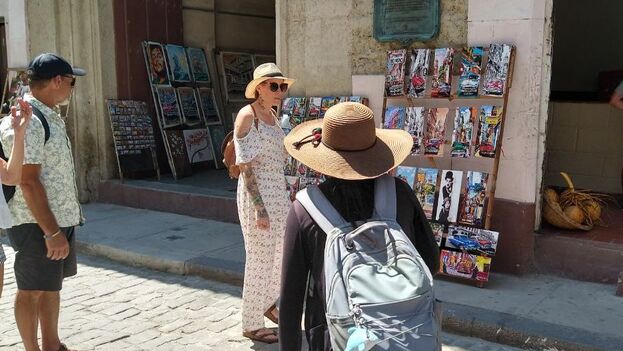
Jorge Fernandez Era Breaks with ‘La Joven Cuba’ After it Rejected an Article Described as ‘Satire’

Jorge Fernández Era stopped collaborating with La Joven Cuba on Sunday. (Facebook)

14ymedio bigger14ymedio, Havana, April 24, 2023–Cuban writer and journalist Jorge Fernández Era abandoned his collaboration with La Joven Cuba, a digital magazine where he had been publishing since February 2021, after its director, Harold Cárdenas Lema, rejected his Sunday column because he did not adjust to the media outlet’s editorial line.

The article quipped that Puentes de Amor [Bridges of love], an American pro-Castroite organization, and Cuban State Security, which those responsible for the publication considered the use of “discrediting projects and institutions for which we prefer to conduct political analyses, rather than approach them as satire.”

Fernández Era refused to modify one paragraph in the column, as Cárdenas Lema proposed, and claimed satire is a legitimate method before anouncing his departure from the media outlet. “The solution, according to Harold, is to rewrite the article, with the goal of eliminating references to Villa Marista [a prison] and Puentes de Amor. I expressed that I do not accept changing a single comma in Contrato.

“Since the decision to not publish the entire text stands, I resigned as of yesterday as a collaborator at La Joven Cuba,” he announced yesterday in a Facebook post.

The writer appreciates, despite everything, the support he received from Cárdenas Lema and his patience since he began collaborating with the media outlet. “To date, I must say, I defend my writings tooth and nail, even though my thinking, humor and bite have never conceded to the all-encompassing powers at whom they are aimed,” he adds. continue reading

Fernández Era accompanied his announcement with the original column that he was unable to publish in the magazine and shared the reasons for his allusions. The writer points out that he considers Puentes de Amor a “laudable and necessary” organization which recently commited a “despicable” act.

What the journalist reproaches are the photographs of Carlos Lazo and other members of Puentes de Amor, for official press progapanda, with Ernudis Echeverría — a young emigré whom the organization helped return to Cuba after he suffered an accident that left him severely injured. “A human gesture had he not taken advantage of the opportunity for self-promotion and to take the most horrendous photos I’ve ever seen, one of them a selfie inside the plane as if he were in front of the Bridge of Sighs.”

The other institution is State Security of which he says, “it is not necessary to discredit, it does it itself.” The journalist was arrested on April 6th and interrogated for several hours at the police station in Aguilera after publishing a column in which he ridiculed the nomination of octagenarian candidates to Cuba’s parliament, in addition to an interview he gave to producer Ian Padrón.

The agents intercepted Fernández Era while he was walking with his wife and a friend and, after reviewing his documentation, took him to the police station where they accused him of “refusing assistance and disobedience” and they demanded he pay the 3,000 peso fine for not attending previous citations to appear, but the writer refused due to irregularities in the charging document, which were also “in violation of the Criminal Procedures Law, and also the National Symbols and Military Secrets laws.”

These events are considered by the director of La Joven Cuba as “a disagreement of a personal nature” and are a departure from, in Fernández Era’s opinion, the declaration the media outlet made when, after his arrest, they urged “Cuban authorities to respect freedom of expression and political guarantees of all citizens,” and demanded his immediate release. The journalist states that with the column he intended to provide his version in a humorous way, since Cárdenas Lema had offered him the space to explain himself. However, he refused to publish the article as it was.

“Following my arbitrary detention on Thursday April 6, a chain of events has occurred that confirm a consistent line of action by the repressive organs. La Joven Cuba, with its silence, is also covering up. Believe me, I have not told — I will do so in due time — all  the baseness with which the “heroic” organs of Minint [the Ministry of the Interior] have come down on me,” warned the author.

The writer’s exit follows that of members of La Joven Cuba’s editorial board: web editor José Manuel González Rubines and coordinator Alina Bárbara López Hernández. The latter was “cowardly harassed by three agents,” according to claims made by Fernández Era, of State Security when she clamored for his release in a park in Matanzas.

It was not the first time López Hernández had problems with State Security, which had already summoned her in October for an interrogation to which the professor legally refused to attend. The Prosecutor accepted her claim and annuled the summons at the time. The first time Fernández Era was called to an interrogation was in January of this year for the content of his publications; authorities did not hesitate to warn him not to attempt to file a complaint like his colleague because “Matanzas is not Havana.”

Translated by: Silvia Suárez

____________

COLLABORATE WITH OUR WORKThe 14ymedio team is committed to practicing serious journalism that reflects Cuba’s reality in all its depth. Thank you for joining us on this long journey. We invite you to continue supporting us by becoming a member of 14ymedio now. Together we can continue transforming journalism in Cuba.

The Livestock Stolen in 2022 in Cuba Is Equivalent to 22 Million Pounds of Meat

Cuban producers begin to see a decrease in the quality of livestock. (14ymedio)

14ymedio bigger14ymedio, Madrid, 24 April 2023 — The numerous cases of theft and slaughter of livestock that producers in Cuba have been reporting for months and that the official press of the provinces reviews in the balance sheets of the sector finally have national figures that demonstrate the seriousness of the problem. In the last year the figure was almost 2.5 times higher than in 2021, with Villa Clara, Holguín and Matanzas in the lead.

Throughout the Island in 2022, there were 82,445 cases of theft and slaughter, of which 45,315 corresponded to cattle and 37,130 to horses. The increase is considerable compared to the numbers from the previous year, with the loss of 33,690 animals: 17,144 cattle and 16,546 horses.

By provinces, Villa Clara leads the sad ranking, with 12,243 cases compared to 4,079 the previous year, three times as many. In addition, five of the ten most affected municipalities on the Island belong to that province. In second place is Holguín, with 9,825 lost last year, doubling the figure of 2021, with 4,655. Last on the podium is Matanzas, which also makes a considerable leap from 2,926 to 8,159 losses.

“That represents 16,000 tons of meat, which in turn is 5,000 tons of boneless meat. This is equivalent to two pounds of meat lost only by theft and slaughter” for each of the 11 million Cubans, Adrián Gutiérrez Velázquez, director of livestock of the Ministry of Agriculture, told the official newspaper, which on Monday published the first part of a special dedicated to this evil that affects first producers and finally Cuban consumers, who can barely access this type of protein due to the scarcity in the markets and, consequently, its high price when it is found, mostly “under the table.” continue reading

In the text, the director of a state livestock company in Cienfuegos, Denis Sixto Rodríguez, warns of the dizzying increase in robberies. “In the company you had five to seven thefts and slaughters in a year. Since the end of last year, the numbers have been increasing. In November, there were 29; in December, 27; and in January and February, 40 animals each month,” he says.

In his opinion, it is not only the price of the sale that is lost, but the investment of at least three years of work involved in raising  livestock. The province of Cienfuegos went from 3,017 cases of theft and slaughter in 2021 to 7,082 in 2022, and it is the fourth most affected in the country.

Another characteristic case is that of Pinar del Río — which goes from 1,458 crimes of this type to 4,282. There, the animals traditionally grow better in the pastures, grazing freely. “Here you have to go out on the highway if you want to take meat to Havana,” adds Sixto Rodríguez. But the increase in crime is forcing us to change the custom and put the animals inside, or we are forced to stand guard. “This is very complicated; it is not humanly possible to stay up all night and then leave at 4 or 5 in the morning to go to work.” If they decide, on the contrary, to lock up the animals, the quality worsens, deaths occur and production drops, since livestock are not accustomed to that kind of life.

In addition, cases of aggression or simply the fear of them cause casualties in an already complicated sector. “Some policemen arrested a thief with sacks of meat, and when he was cornered he threatened them with a machete. If the officers hadn’t taken off, they wouldn’t have been able to tell the story,” he adds. Another of those consulted for the report states that “the police are not giving this issue all the attention that it deserves,” a situation that forces the ranchers into “night patrol.”

Gutiérrez Velázquez warns of the implications of the current situation. It is not a short-term problem, in the opinion of the director of the Ministry, and it will have consequences on future livestock because it affects the quality of life of the cattle and, therefore, the taste of the meat. “It’s like we have them in a concentration camp,” he says — and the drought is the last straw. “The animals that are shut in from three or four in the afternoon until the next day deteriorate. They killed 50,000 of our three million livestock, but the great concern is the issue of having to lock them up,” he insists.

The case of horses is also worrying. The Cubadebate report recounts the case of Humberto Hernández Malagón, who has fruit trees and cows and needed his mare to move the merchandise. “I used to leave her tied up under a bush, in the field. One of my children went for a walk and everything was fine, but when I went to look for her she was gone. Although we followed the trail, we didn’t find anything, not even bones,” he says.

The rancher invested more than 20,000 pesos ($833) in buying posts and wiring to fence his land, which the thieves trampled on with impunity. A little later they stole a team of oxen from a neighbor. “It was money that I lost, because every week they were robbing me two and three times to get the animals,” he adds. Now he has built ditches over three feet deep, but the fear does not go away.

“If they take away my oxen, I will retire,” says another farmer, who remembers only one time, in the 80s, “as bad as this. They come and blatantly steal them from you, to your face. They took a cow from the field and I couldn’t find any trace. I called the police and they never showed up. I went to the station to look for the tag they give you to be able to take the animal off the livestock registry and it was a total mess.  I went four times, and the deadline almost expired and then you even have to pay a fine if that happens.”

Translated by Regina Anavy

____________

COLLABORATE WITH OUR WORKThe 14ymedio team is committed to practicing serious journalism that reflects Cuba’s reality in all its depth. Thank you for joining us on this long journey. We invite you to continue supporting us by becoming a member of 14ymedio now. Together we can continue transforming journalism in Cuba.
In March, the Price of Rice in Cuba Skyrocketed by 23.1 Percent Despite Donations From Vietnam

It is almost impossible to buy rice without spending the night in the doorways of the points of sale to get a number in the line. (Escambray)

14ymedio bigger14ymedio, Madrid, 26 April 2023 — The rise in prices accelerated in March in Cuba, where eating and drinking is already almost 11% more expensive than when the year began. With an increase of 4.5% in the third month of the year alone, acquiring food and non-alcoholic beverages costs 75% more than in March 2022.

The overall Consumer Price Index (CPI) increased by 3.2% in March, compared to 2.6% in February and 2.32% in January; the increase not only does not stop but increases at a faster rate. According to the data published by the National Office of Statistics and Information (Onei) relating to the third month of the year – and just as the fourth is about to end — the data show an increase of 8.4% in 2023, which is 46.4% higher than a year ago.

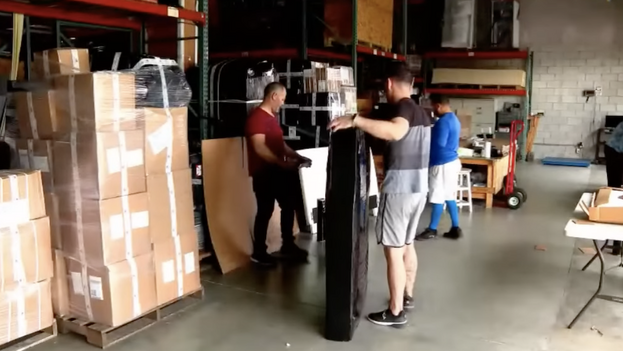
The continuous rise in the price of rice, a staple in the Cuban diet, is alarming. It increased in March by 23.1%, three times more than in February, when it already cost 7% more than in January, despite donations from Vietnam. The shortage has shot the price up to 200 pesos ($8) per pound in the informal market, very close to the price recorded for a pound of pork.

At the beginning of March, the Government had only 2,090 tons of rice for the standard basket, when 36,000 tons are needed. The 2022 harvest remained at 120,000 tons, far from the 700,000 necessary for national consumption for a year, and the situation will not improve this year, since only 168,032 of the planned 345,948 acres were planted. continue reading

The price of white cheese also keeps increasing, and after being the most expensive food in February with 13.3%, in March it rose again by 15.1%.

Liquid milk, increasingly scarce on the Island even in Sancti Spíritus where powdered milk is hardly ever consumed, rose by 8% in March. Poultry (5.1%) and pork (1.28%) close the list of foods that are most difficult to buy, while tomatos and peppers are again in the classification of products that decrease in price, with -17.9% and -15.4% respectively.

Food consumed outside the home, included in restaurants and hotels, once again contributes to the unstoppable rise of food prices. That group is the one that has risen the most so far this year, with 13.3%, adding 3.4% in March. Compared to last year, the increase reaches 63.6%.

Within this category, lunch and dinner have the biggest rise with 4.3%, followed by snacks (3.4%), prepared takeaway foods (3.1%) and breakfast (2.6%). It closes with soft drinks, which rose by 2.4%.

Again, transport, despite its poor service, was the third group of products and services that became most expensive (3%), and the fuel crisis had not yet begun. The price increase so far this year is 6.8%, and the year-on-year variation amounts to 18.26%. The largest increases occur in the inner city, with 11.3% for trucks and vans and 11.4% for taxis. In the case of urban transport, colectivos, “collective” taxis, rose by 4.4% and taxis by 8%. The group closes with busses, which also went up in price, although only by 0.5%.

Education, which usually has more discreet growth, rose significantly this month by 3% and accumulates a rise of 5.3% in 2023, almost 20% compared to March 2022. There were also  price increases for various goods and services (1.57%); housing services (1.1%); recreation and culture; clothing and footwear; and health and communications, all of them below 1%.

It is no wonder that the only thing that drops in price in Cuba is the group of alcoholic beverages and tobacco, although even here the fall is more moderate. After decreasing by 4% this month, prices stand at -14.6% so far this year and -6.8% compared to March 2022. The decline for this group, the only one that has prevented inflation from being even greater, is fundamentally due to strong tobacco, which decreases again in March, although this time only by 5.38%, compared to the price drops of January and February, which were around 8% on average.

The official figures confirm a reality installed on the Island since the entry into force of the Ordering Task,* which despite being designed as a set of measures to last for at least a decade has left a bleak panorama in the day-to-day life of the population without the authorities taking real measures to tackle it. In addition, the situation can only get worse with the lack of fuel in April, a deficit that will affect the production and transport of food, making everything worse.

The Onei data help to follow the evolution of prices, but it is essential to take into account the independent figures that include the informal market as much as possible. The American economist Steve Hanke placed annual inflation in Cuba at 80% at the end of March.  Preliminary data for April reduced it to 62%, which locates  the Island in 13th place in the ranking for inflation.

In addition, the Cuban peso has depreciated, according to his calculations, by 61% against the dollar, and this puts Cuba in fourth place, behind Zimbabwe, Venezuela and Lebanon.

*Translator’s note: The so-called Ordering Task [Tarea Ordenamiento] is a collection of measures that include eliminating the Cuban Convertible Peso (CUC), leaving the Cuban peso as the only national currency, raising prices, raising salaries (but not as much as prices), opening stores that take payment only in hard currency, which must be in the form of specially issued pre-paid debit cards, and a broad range of other measures targeted to different elements of the Cuban economy.

Translated by Regina Anavy

____________

COLLABORATE WITH OUR WORKThe 14ymedio team is committed to practicing serious journalism that reflects Cuba’s reality in all its depth. Thank you for joining us on this long journey. We invite you to continue supporting us by becoming a member of 14ymedio now. Together we can continue transforming journalism in Cuba.
After Two Years, the United States Resumes Repatriation Flights to the Island With the Transfer of 150 Cubans

Mario J. Pentón, of América TeVe, confirmed the arrival of Cubans deported by the United States to Havana. (Mario J. Pentón)

14ymedio bigger14ymedio, Havana, 24 April 2023 — A group of about 150 Cubans was repatriated to the Island this Monday on a flight that took off from Miami International Airport, in the first return of this type, by air from the United States, in two years. According to Univision 23 journalist Mario Vallejo, these people were held at the Krome Processing Center in charge of the Immigration and Customs Control Service.

“At least four buses left Krome for the airport,” he said through a video uploaded to his social networks. “By 8 in the morning they were on the airplane.”

Vallejo said that some relatives of these Cubans confirmed from the Island that they were visited by staff of the Ministry of the Interior to ask them “if they could receive” the returnees and that this process would take place in the next few hours; however this “was today,” the journalist said.

Meanwhile, reporter Mario J. Pentón of América Tevé, confirmed that the group of migrants arrived in Havana, but that they have not been able to move to their respective destinations, due to the fuel crisis that affects the entire Island. “Apparently they don’t have gasoline to transport those from the provinces” and the habaneros “are expected to be released in the next few hours.” He reiterated that neither the Cuban regime nor the US government has said anything. continue reading

Last Saturday, relatives of several Cubans detained in South Florida demonstrated in Miami to demand the release of those who entered through the U.S. southern border or by sea and lost their “credible fear” interviews.

The immigration lawyer, Miguel Inda Romero, told Univision 23 that they had as an alternative “what is called a deportation strike, since some of them have relatives who are residents or citizens who could make petitions for them, or simply be released under supervision as there are more than forty thousand Cubans.”

In November of last year, the Cuban government accepted the return by air of migrants who had not entered US territory, unlike those of this group.

The return by air was adopted by the Barack Obama Administration in 2017 as a limited tool to curb the number of Cubans crossing the border, but it was suspended during the coronavirus pandemic until this Monday when about 150 Cubans were repatriated.

This Sunday, the US Coast Guard transferred 20 Cubans who were rescued on Tuesday to the Bahamas on the ship Skipjack. The agency reported that since October of last year, the attempt of 6,449 rafters to reach Florida has been thwarted.

Since Friday, the Border Patrol has kept 26 Cubans in custody, including six children, who managed to disembark on Cayo Marquesas. According to Lieutenant-in-Chief Walter Slosar, they arrived on a homemade raft.

At the beginning of 2023, the US government implemented a policy to receive 30,000 monthly migrants from Venezuela, Haiti, Cuba and Nicaragua.

In parallel, it will immediately expel to Mexico the undocumented from those countries who try to cross the southern border to its territory irregularly.

Mexico, for its part, agreed to admit 30,000 migrants a month who are expelled from U.S. territory.

Translated by Regina Anavy

____________

COLLABORATE WITH OUR WORKThe 14ymedio team is committed to practicing serious journalism that reflects Cuba’s reality in all its depth. Thank you for joining us on this long journey. We invite you to continue supporting us by becoming a member of 14ymedio now. Together we can continue transforming journalism in Cuba.
Cuban Regime Retaliates Against the Incarcerated Son of Writer Jorge Fernandez Era

Jorge Fernández Era with his son Eduardo Luis. (Facebook)

14ymedio bigger14ymedio, Madrid, 25 April 2023–Just two days after announcing his departure from La Joven Cuba magazine, the director of which demanded he modify an opinion column where he quipped about State Security, writer and journalist Jorge Fernández Era accused the regime of retaliating against his son. Twenty-two-year-old Eduardo Luis Fernández, is serving a sentence for robbery with violence perpetrated in March 2021 and enjoyed some prison benefits for his good behavior, until authorities began using his situation to pressure his father.

In an extensive Facebook post on Tuesday, Fernández Era wrote about how his son ended up sentenced to ten years in prison for a robbery in which his partner wielded a sharp weapon. For those events he ended up in the Western Prison for Minors in Guatao, where he was held until 2022 when he turned 21. Already, while he was under investigation, the journalist wrote, he witnessed strange attempts to separate them, including separating him from the visitation group.

In prison, Eduardo Luis — whom he affectionately calls Eduardito — began to work as a barber for the prisoners and guards, a trade he learned thanks to a course arranged by his father. When he turned 21, he had a brief time in the 1580 penitentiary in San Miguel del Padrón and was later transferred to the Toledo 2 internment camp, near the Universidad Tecnológica de La Habana José Antonio Echeverría (Cujae), where he is currently held.

His behavior earned him four passes to date, most recently last weekend, when he told his father what happened on April 12th and gave the author consent to denounce it.

“In March, an official who ’got along well with my son’ proposed that he move to the El Chico prison — which is nearby and higher security — where he’d be ’more relaxed’. My son responded that it wouldn’t suit him, there are few prisoners there and he’d have less work. Days later one of his friends approached him and suggested they transfer together to that jail,” he explained.

A few days later, the head of Toledo 2 called a close relative to let him know that they had decided to transfer Eduardo to El Chico to “protect him from his father’s influence”, a change which would include six months without passes or visitations. However, said the official, they were available to intercede on behalf of the young man. “We will make a request to the Ministry of the Interior that his transfer be postponed to allow for his father to account for the offensive social media posts against the government and the Revolution,” he said. continue reading

Although the relative, whose identity the writer does not want to reveal, alleges that those messages were not related to the young man, the female official urged the him to be on alert, while insisting that she would do “the impossible” to keep Eduardo Luis at Toledo 2 until he was either out on parole or served his sentence.

The artist emphatically rejects making his son pay for crimes he did not commit, as well as using ministry officials for “such low methods of human degradation” with the sole aim of silencing him. “What occurred with Eduardito violates the most fundamental human rights and the Constitution of the Republic,” he reproached.

Fernández Era took the opportunity to request that the Government of Spain and its embassy in Havana intercede and approve a visa for him to present in Madrid several books he edited, a visa he had requested before his problems with State Security, which now prevents him from leaving the country, began. “We will see if they dare, once again, to forcibly exile a Cuban by birthright, or to prevent me from returning to my country,” he added.

He also asks the international community, including the United Nations, Amnesty International, churches of different faiths, and democratic governments worldwide, with a special request to the international left, to intercede on behalf of his son. “I demand, from the only pages I am allowed, my son’s immediate release and to allow him to abandon the country. Here, his physical and psychological wellbeing are at risk,” he states.

The journalist, who holds the highest authorities of the State responsible for anything that might happen to his son, cited the words of Fidel Castro himself to accuse the regime of implementing “a policy that has nothing to do with the principles of the revolution.” Furthermore, he reproaches them for practicing a socialism that “gets on with attrocities like this, typical of entrenched fascism, in the soul of the nation.”

Fernández Era announced that if his requests are not addressed, on Saturday between 12 pm and 1 pm he will position himself at the monument to José Martí in Havana’s Central Park in peaceful protest against the harassment endured by so many like his son. “I will repeat it week after week, at the same time. I have nothing left to lose,” claimed the writer, who ended the post with a phrase in all caps, “DO NOT TOUCH MY SON!”

Translated by: Silvia Suárez

____________

COLLABORATE WITH OUR WORKThe 14ymedio team is committed to practicing serious journalism that reflects Cuba’s reality in all its depth. Thank you for joining us on this long journey. We invite you to continue supporting us by becoming a member of 14ymedio now. Together we can continue transforming journalism in Cuba.
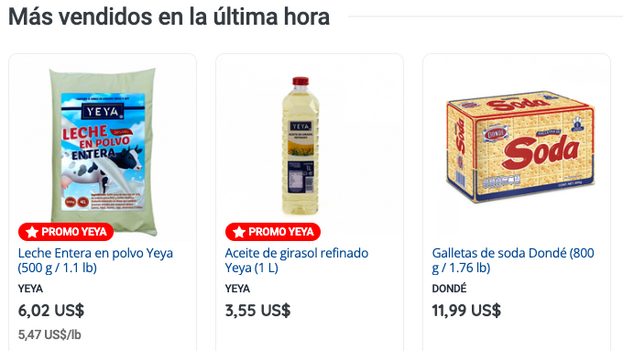
The Cuban With Dollars Also Eats Badly: Picadillo, Sausages and Mayonnaise Bought From the Outside

Among the first five products of the “Most sold in the last hour” are foods that are very incompatible with a balanced diet. (Screen capture)

14ymedio bigger14ymedio, Natalia López Moya, Havana, 25 April 2023 — The online sales pages for relatives abroad to buy for their relatives in Cuba have not only proliferated like fungi after the rain but reveal the disorder in the island’s diet.

Among the first five products of the “best sellers” on some sites, such as Supermarket 23, Yuppy Market, Alawao and Nercado, the following are repeated: condensed milk, powdered milk (with and without sugar), ground chicken, sausages, and mayonnaise and crackers (a frequent snack for many Cubans). These foods are not very compatible with a balanced diet.

Among the most requested products are also those that can be divided and stretched for several meals. The list is led by chicken or pork sausages, hamburgers and the ground turkey that is used in many homes to make croquettes, along with the instant soft drinks that constitute the main snack that students take to primary schools

While pieces of beef or pork are less in demand, boxes of frozen chicken quarters, entrails and cheap sausages are gone only hours after appearing for sale on those online portals. Vegetable oil is also frequently exhausted, and the supply of fruits, vegetables or greens is small and often sold in cut or frozen format.

Imported goods win, widely, over what is produced on the Island. It is easier to find in those digital markets a can of tuna from Europe than a fresh fish taken from the seas around Cuba. Cheeses, Gouda or cheddar style, also surpass several times the few nationally made dairy products that are marketed. continue reading

All this proves that the problem of malnutrition in Cuba is not only due to the increasingly alarming rates of poverty. When the food and toiletry shops were dollarized almost three years ago, it seemed that, at least those who received remittances from relatives abroad were going to be able to have varied food. This, despite assuming a new social division, very soon turned into a widespread complaint and even one of the reasons for the mass protests of July 11, 2021 (many demonstrations were over the closure of stores in MLC, freely convertible currency).

Just at the beginning of April, the UN World Food Program released a report saying that “the diet of the average Cuban household is poor in micronutrients and not sufficiently healthy or diverse due to the limited and unstable availability of nutritious food, socioeconomic factors and bad eating habits.”

The document, which denounces the responsibility for the Government’s economic decisions such as the so-called Ordering Task* emphasized that the situation was worse for the Cuban who did not receive remittances. However, sales websites for buying from abroad confirm that, as with happiness, money does not guarantee a good diet either.

Roast meat, lobster and shrimp, which have disappeared from the vast majority of Cuban tables, seem to come out of a fantasy novel today, but access to foreign currency does not even make Cubans lean towards the varied foods and fruits that the Island always provides: avocado, sweet potato, yucca, malanga, okra, bananas, mamey, pineapple, mango or any type of citrus: more eloquent evidence of the failure of a system that has lasted for 64 years.

*Translator’s note: Tarea Ordenamiento — The ’Ordering Task’ is a collection of measures that include eliminating the Cuban Convertible Peso (CUC), leaving the Cuban peso as the only national currency, raising prices, raising salaries (but not as much as prices), opening stores that take payment only in hard currency, which must be in the form of specially issued pre-paid debit cards, and a broad range of other measures targeted to different elements of the Cuban economy.  Translated by Regina Anavy

____________

COLLABORATE WITH OUR WORKThe 14ymedio team is committed to practicing serious journalism that reflects Cuba’s reality in all its depth. Thank you for joining us on this long journey. We invite you to continue supporting us by becoming a member of 14ymedio now. Together we can continue transforming journalism in Cuba.
Three Cuban Rowers ‘Desert’ After Participating in a Qualifying Event for the Pan American Games in Chile

The rowers Maykol Álvarez, Yoelvis Hernández and Osvaldo Pérez abandoned the Cuban team after their participation in the qualifier on the way to the Pan American Games in Santiago de Chile. (Collage)

14ymedio bigger14ymedio, Havana, 25 April 2023 — The rowers Maykol Julio Álvarez, Yoelvis Javier Hernández and Osvaldo Pérez left the Cuban team participating in the qualifying tournament for the Pan American Games in Santiago de Chile 2023 that ended on April 19. According to photographer Yuniet Ávila, the desertions occurred in Chile and Mexico.

The habanero Álvarez deserted in Chile after winning, together with Carlos Ajete, Yoelvis Hernández and Reidy Cardona, the silver medal in the category four pair (4X), guaranteeing his ticket to the Pan American Games that will be held from October 20 to November 5.

Hernández, a native of Sancti Spíritus, and Cardona, of Cienfuegos, took advantage of the stopover in Mexico to escape. “These are the first abandonments from rowing team this year,” the photographer stressed on his social networks.

Cuba sent a delegation with 15 oarsmen to Santiago for the qualifying contest. The president of the Cuban Rowing Federation, Ángel Luis García, pointed out to the official media Jit the “enthusiasm” of the athletes for competing on the same track that will host the Santiago 2023 celebration at the end of the year. continue reading

The oarsmen who escaped were coming from a training on the aquatic track of the Hanabanilla dam, in the La Coronela reservoir. The Cuban managers have not offered a position.

The departures of Álvarez, Hernández and Pérez represent a hard blow for the Cuban rowing team, which last year recorded six defections. In November, Jorge Patterson and Yudisleidys Rodríguez fled after one of the training sessions on the Virgilio Uribe Olympic court, in Mexico City.

Before the escapes of Patterson and Rodríguez, Ernier Tamayo, Alexei Carballosa and Nayala Torres had fled. They were preparing in Mexico City for the Central American and Caribbean Championship that began on November 23 in El Salvador.

The first of those six desertions was one in Mexico by Boris Luis Guerra, who won silver with his partner Adrián Oquendo at the 2019 Pan American Games in Lima.

Translated by Regina Anavy

____________

COLLABORATE WITH OUR WORKThe 14ymedio team is committed to practicing serious journalism that reflects Cuba’s reality in all its depth. Thank you for joining us on this long journey. We invite you to continue supporting us by becoming a member of 14ymedio now. Together we can continue transforming journalism in Cuba.