The Cuban Customs Office Confiscates Parcels Addressed To Dissidents / Laritza Diversent

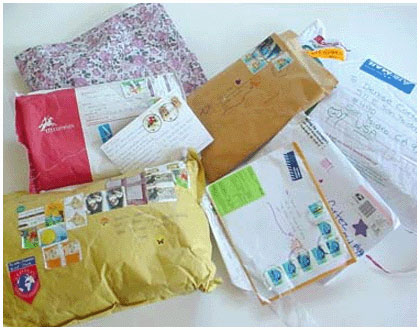
In recent times the postal parcels from overseas sent to Cubans who publicly express disagreement with the government are being confiscated. The Post Customs, an entity belonging to the General Customs of the Republic has been using the seizures of shipments originating from foreign countries as a filter applied to the dissidents.

My own case can serve as an example. In less than two months they confiscated two parcels sent to me from the United States. I was notified of the most recent of these on August 13th by means of Confiscation Order No. 1209 from the 29th of July and a document of Retention and Notification, both signed by Danny Samanda Rivero, a Customs Control inspector.

If this happens once, it could be a coincidence. The second time it could be seen as an act of cruelty. But if the same thing also occurs to other persons sharing your political views then it is a case of state policy. A subtle way to punish those who dare question the system.

Undoubtedly, the administrative measure has a political background. The list of the affected ones includes Yoani Sánchez, Silvio Benítez, Dania Virgen García, Ubaldo Manuel León, Yusnaimy Jorge, Aini Martín, Vladimir Alejo y Julio Beltrán Iglesias, among other opponents of the regime.

According to inspector Samanda Rivero, the content of the package addressed to me “put the general national interest at risk.” He ordered the confiscation invoking Resolution No. 5-96 of the Head of the General Customs of the Republic. The first confiscation on June 8th was effected by Confiscation Order No. 978. Raimundo Pérez García, a Customs Control inspector, seized the parcel using the same argument.

The Resolution No. 5 of the General Customs, effective since 1996, allows the application within the country of the Convention for the suppression of the circulation of, and traffic in, obscene publications. Furthermore it bans the sending of “any object with content considered to be contrary to the morality, the proper conduct or the general interest of the nation.” Moreover, it stipulates that the confiscated goods are to be turned over to the Interior Ministry.

In both confiscation orders enforced against me the inspectors Pérez García and Samada Rivero failed to explain how those imported items “affect the general interest of the nation.” The two confiscated packages contained something like: an MP3 player, a photo camera, pencils, ballpoint pens, pencil sharpeners, notebooks, wax crayons, balloons, toilet soap, disposable razors, deodorants, plasters, toothbrush and toothpaste. All of these are products sold in state and convertible peso shops on the Island.

At the end of July I lodged an appeal before the Head of the Posts Customs requesting the first confiscation order be overturned. Dated August 17th I was notified of the Appeal Resolution No. 231 of 2010 that dismissed my claim.

The official, Raúl Gómez Badía, the highest authority of the institution deemed the measure imposed by inspector Pérez García appropriate. After having exhausted all available administrative remedies my next step will be to assert my rights before the courts.

Although the “new customs offensive” may have another objective. To destroy the hesitant attempts to reestablish the communications between Cuba and the United States. The confiscated goods were sent to me from the northern country by the Universal Postal Service agency of the Office of International Exchange.

On September 17th 2009, Cuban and United States representatives initiated talks in Havana that envisioned the resumption of direct postal services between both countries. At the end of the meeting that took place under much secrecy the Cuban delegation issued a statement.

It´s worth making it clear that the majority of Cubans don´t think highly of the customs services, above all of those at the airports. A proof of this is the video Abuse at the Cuban Customs by the acclaimed composer and singer Cándido Fabré.

Laritza Diversent

Translated by: undef@rocketmail.com

August 31, 2010
The United States: A Necessary Enemy / Iván García


Fidel Castro loves to make references to the numerous economic, paramilitary, and political aggressions of the 11 administrations that have been through the White House throughout these 51 years the strong-man of Cuba has been in power.

The United States is far from being the ideal neighbor. In the first 40 years of the revolution, it unleashed a ferocious campaign of assaults on Castro. It was an all out fight with all the ingredients. Dirty war, economic pressure, and anti-government propaganda.

But Castro is no saint either. Strengthened by more then 20 million rubles that Moscow granted him, he served as the Russian’s aircraft carrier in the Caribbean. In October of 1962, he made the unfortunate decision of accepting 42 intermediate- and medium-range nuclear missiles equipped with nuclear warheads, strategic bomber aircraft, and 43,000 Russian soldiers on Cuban territory.

He financed numerous guerrilla groups in Latin America and Africa, including some that, years later, have degenerated into terrorist gangs such as the FARC in Colombia and Shining Path in Peru.

On top of provoking the thunderous collapse of the Cuban economy, with his absurd plans and his method of managing the country as if it were his own private estate, the extraordinary comandante maintained military troops thousands of miles away from this island.

He acted as if possessed by a tropical Napoleon complex. Cuba got involved in the civil wars of Angola, Ethiopia, and Somalia. The consequences of our participation in those conflicts have yet to be written about.

During the Cold War, Cuba and the United States maintained a mutually irritating political rivalry. As a center of global power, Washington didn’t want to allow an openly Soviet military presence and, on the part of the government in Havana, support for insurgencies around half of the planet .

After Khrushchev withdrew the missiles, the now vanished USSR maintained troops on the island and a base for electronic spying on North America.

With the fall of the Berlin Wall in 1989, Cuba lost its steam. Once the pipeline of Russian rubles was sealed up, we entered into a period of economic poverty. The Americans plopped down on a recliner to await the fall. But against all winds and tides, Castro resisted.

Now, the world isn’t the same. Even Hugo Chávez and Evo Morales reached power through votes, not through bullets. Ernesto Guevara’s theory of “Revolutionary Focalism” has been tossed into the sack of obscurity. The theater of action presents a new design.

The elderly warrior that miraculously escaped death in July of 2006, has reemerged, transformed into a kind of international guru, predicting catastrophes and lending credence to any old incendiary conspiracy theory.

Only on the immigration issue is Cuba a national security problem for the United States. A hypothetical internal crisis could unravel whereupon thousands of people would hurl themselves into the sea on any floating object to escape the island. The White House is the most interested party in the Cuba situation not getting out of its government’s control.

In spite of Castro’s anti-yankee discourse, today the United States is the island’s fifth trading partner and first in foodstuff sales. We hear talk of the ban on travel from the United States to Cuba being lifted. The embargo is an absurdity. In the foreign currency stores they sell Coca-Cola and Dell computers, among other products.

The biggest of Cubans’ problems don’t come from the North. The enemy sleeps among us at home. Rampant corruption and economic inefficiency are, among others, the causes the nation is treading water neck-deep. Fidel Castro attempts to blame the gringos for many of our calamities, but sensible people here believe that bad governance and the system’s inoperability are the most responsible.

On top of being a current minor evil, the United States contributes financial liquidity to Cuba: 100 million dollars annually by way of family remittances and 50,000 Cuban-Americans who travel to the island every year and spend dollars at full throttle.

But it’s always easier to pin the blame on the same old lifelong villain. If the United States hadn’t existed, Fidel Castro would have invented it.

Iván García

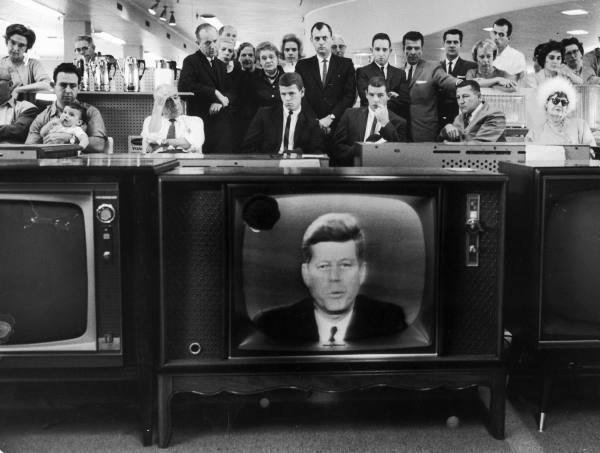
Photo: Ralph Crane, Life Magazine, October of 1962. In a store in Los Angeles, people follow the news of the naval blockade against Cuba authorized by Pres. Kennedy during the Cuban Missile Crisis.

Translated by: Yoyi el Monaguillo

August 31, 2010

Prison Diary (5) (Mother) / Ángel Santiesteban

Photo: AP

She enters the room in search of her son; on the previous visit they told her he was in the punishment cell for indiscipline, he would be there for twenty-one days with half rations of food and no sun; so, to see him, she would have to come back the next month.

Now, she searches through the dozens of prisoners with their families without finding her son; it’s impossible not to recognize him, the guards must have been wrong to let her enter the visiting room. She goes to the door to ask the officers; her son isn’t there. They insist he is and show her his photo on the card everyone has for identification.

The mother returns to the room and patiently searches, one by one. Coming to the last one without finding him she starts to cry, but understands that she’s losing time and later the guards won’t take it into account, so she overcomes her nervousness and starts to search again, also fruitlessly.

When she returns anxiously to see them the guards fly into a rage, they tell her son is there, that if she didn’t raise him, find the person who did to show her where he is.

She prefers to keep quiet, without clarifying that she raised her children alone and never had anyone to help her. And she looks again at each face. When she searches and doesn’t find him, she ashamed to bother the sergeants one more time.

In the room, there is only one boy who is sleeping, alone, with his face hidden in his arms, but as much as she looks at him there is nothing to indicate he is her son. The shaved hair, too small head, skinny arms, very white skin and narrow back. Her son is tall and strong. Still, she notes that all the prisoners are with their families and he is not. She approaches him, heartbroken, despite knowing that he needs to sleep.

Fearfully, she touches his shoulder; the boy raises his head and hugs her.

September 1, 2010

HIP HOP 2010 in ALAMAR…! / Orlando Luis Pardo Lazo

EL HIP HOP DEL 2010 EN ALAMAR…!, originally uploaded by orlandoluispardolazo.

This Thursday, September 2, 2010, at 3:00 in the afternoon, irremediably

or enviably, the Alamar Siberia will return to the site where

OMNI ZONA FRANCA plus 26 Cuban rappers will throw themselves in an

independent way on the only theme that UNITES EVERYONE which without a doubt will be the Hip

Hop of the Year (no danger no tricks). The audiovisual chronicle will be on

www.twitter.com/OLPL and in my blog POST-REVOLUTION MONDAYS

(www.orlandoluispardolazo.blogspot.com).

August 30, 2010