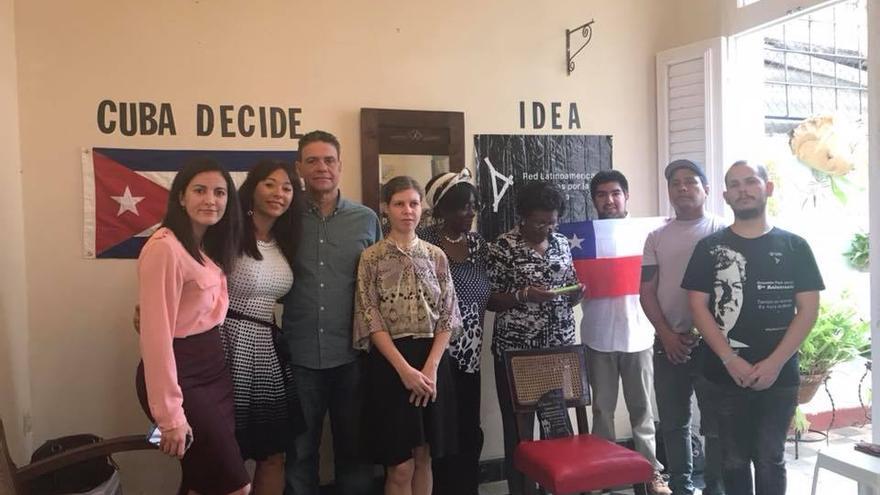
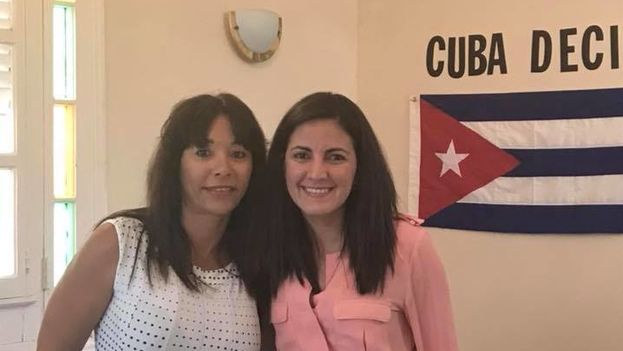
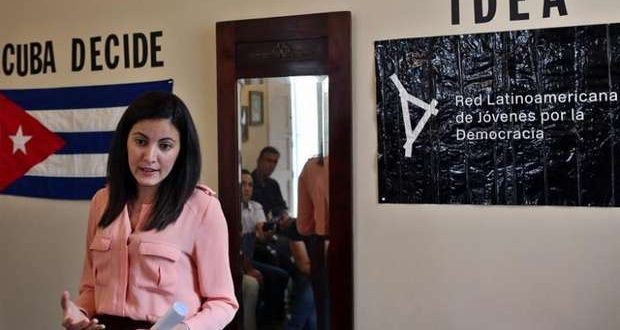
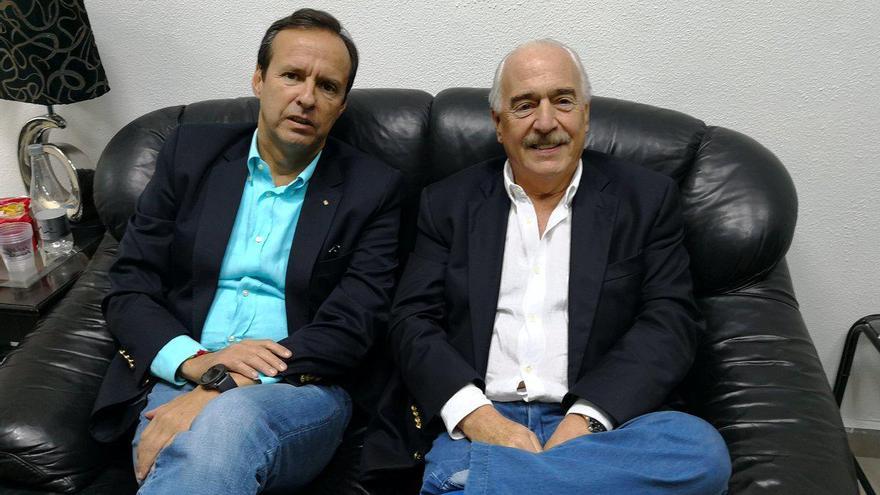
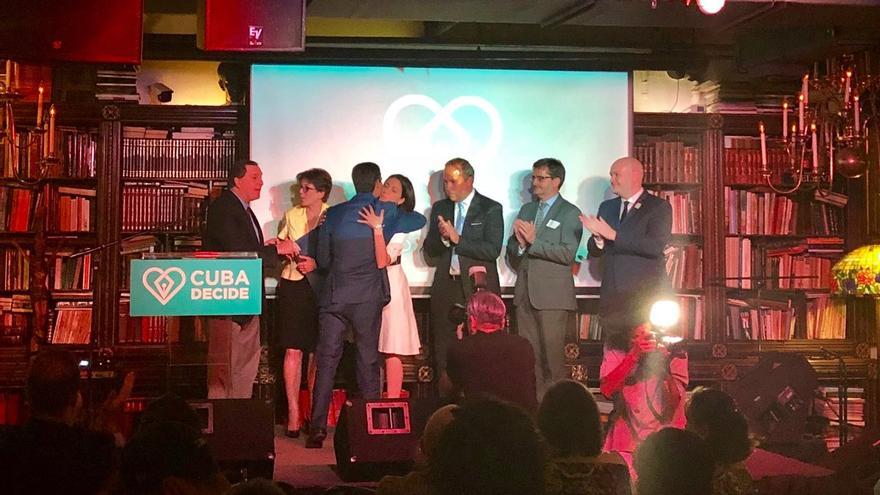
Call for a Plebescite, Yes or No / Rosa Maria Paya

YES or NO? [See full text below]. Poster by Rolando Pulido

YES or NO? [See full text below]. Poster by Rolando Pulido

Let no one speak again for all Cubans. Ask them in a plebiscite.

“Let them call free and democratic elections on the basis of a new electoral law and an atmosphere that allows all Cubans to have the right to be nominated and elected democratically, exercising freedom of expression and of the press and freely organizing themselves into political parties and social organizations with full plurality. Yes or No?”

Oswaldo José Payá Sardiñas, on behalf of the Christian Liberation Movement, Havana, Cuba, 17 January 20122.

Plebiscite Now.

More information at: oswaldopaya.org/es

1 May 2013


Cuban Regime Blog Threatens Rosa Maria Paya With Prison / Juan Antoni Guerrero

Rosa-Maria-Paya-Cuba-Europa_EDIIMA20130401_0272_4

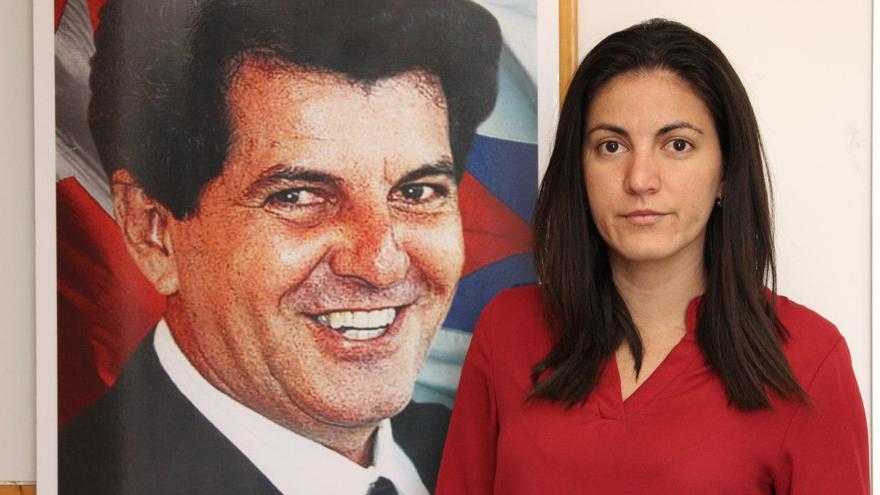
Rosa María Payá

The Cuban government sponsored blog Herlado Cubano is trying to intimidate Rosa Maria Paya in a recent post in which it criticizes the allegations Oswaldo Paya’s daughter had made about his death. The official blogger, who goes by the name Arthur Gonzalez, said that for accusing the Cuban government for being behind the death of the opponent Oswaldo Paya, Rosa Maria Paya could be indicted for false accusations, a crime under article 154 of the Penal code, which provides penalties from six months to two years in prison.

“It is not appropriate for Rosa Maria and her mother Ofelia Acevedo, with complete impunity, to accuse and defame the Cuban state; Cuban Institutions can also exercise their right and bring their accusations. Whoever plays with fire is going to get burned,” writes the blogger.

Paya just returned to Cuba after several months in different European countries and the United States to build support for the opening of an international investigation into the death of her father.

From Punt de Vista, the blog of Joan Antoni Guerrero Vall

27 April 2013


Rosa Maria Paya: Summary of Press Coverage of Her Travels

Spurce: www.express.co.uk -

Source: www.express.co.uk

The following materials include both Spanish and English language sources.

TAMBIEN  EN” BOLETINES PERIODICOS DEL MCL” http://www.oswaldopaya.org/es/boletines-de-noticias/

April 4, 2013

New York Times: Inquiry Is Sought Into Death of Castro Critic

http://www.nytimes.com/2013/04/05/world/americas/inquiry-is-sought-into-death-of-oswaldo-paya-cuban-dissident.html?_r=0

April 7, 2013

The Wall Street Journal:

http://on.wsj.com/14PUUua Continue reading


Rosa Maria Lives / Orlando Luis Pardo Lazo

Rosa Maria Paya. Photo by Orlando Luis Pardo Lazo

Rosa Maria Paya. Photo by Orlando Luis Pardo Lazo

Tomorrow, at dawn, Rosa Maria Paya returns to Cuba, just as she promised at the Havana airport two months ago. Her word, contrary to what is common in Cuba, is honest.

Rosa Maria will return without bodyguards and without a media scandal, vulnerable and smiling, caressing her tireless cross, back to her already classic humble home on Penon street, near Manila Park, where her father Oswaldo Paya Sardinas (1952-2012) will never return, nor her good friend Harold Cepero Escalante (1980-2012). Both were leaders of the Christian Liberation Movement, both died on a tragic Sunday of last July, passed onto the hands of strangers and in a place in Cuba that is still uncertain, given that the official version has become unsustainable after all the evidence and testimonies exposed to the world by Rosa Maria Paya, without even having to raise her voice. Before the grotesque screaming of all forms of State Totalitarianism, the voice of a Cuban, an orphan of friendship and love.

Rosa Maria Paya will return to the land where the mortal remains of the martyred leaders of the Christian Liberation Movement rot. She will return alive and with a wish to resuscitate the sacred desires of living in truth in a socialist society, so panic-stricken and full of hypocrisy. Rosa returns and will sprout in Cuba without any accomplice disease of our octogenarian regime. She will return without any pretensions of violating travel laws or declaring herself on hunger strike. She returns inflamed with life and freedom. She returns, with an L (for ‘Liberty’), just like she left on a Friday this past February.

Cuban State Security did not care, at all, about her 24 years of age, grown into them with resistance in the face of horror. The Paya-Acevedo family is a family that still receives anonymous threats of “before the Revolution ends, we are going to kill you”. And, in effect, there is lots of that in the rheumatic rhetoric of the Revolution: anonymity, fear of having a face beyond Fidel and Raul (our Nuremburg trial will be in a minimal format).

Tomorrow morning Rosa Maria Paya will step out of media’s hands, out of the hands of f Human Rights organizations and parliaments, NGOs and democratic governments that have joined in solidarity. Because in Cuba, only bodies count, and the new face of the Christian Liberation Movement, without vocations of sacrifice, will return to a perverted nation which possibly may not let her travel again. It’s possible that we may never see her paused gesticulation, without the improbable arrogance of our caudillos. We may never again hear the vehement tenderness of her valor. In this sense, we should bid a soulful farewell to Rosa Maria Paya.

The main thing here lies, of course, not in her virtuoso image, but in the legacy of a work that is still powerful and possible in the citizen initiatives of the Varela Project, the Heredia Project, and the Path of the People, and many other concrete propositions which reduce the impunity of the Cuban government, as it forces it to comply with its own legality to transform itself according to popular will. An effort of dozens of thousands of citizens which continues to be ignored by our inoperative National Parliament, governmental organ which apparently prefers to opt for its own suicide instead of facing a future transition.

It is precisely this intimidating silence, that insulting impunity on the margin of morality, it is the malicious muteness of lies and death, that’s the welcome with which the authorities of Havana will now spy on Rosa Maria Paya. The Cuban State continues to be deaf, up to the point of insolence. Their operational logic is in no means institutional. Instead, it is like a secret sect.

Consequently, any abuse of power is expected against her and her family, both in and out of the island, now or in the survival of a decade in which they tortured her own father in her childhood eyes. Nothing is insignificant in that criminal boiler where the most ‘problematic’ activists of the Cuban opposition have been, are, and will be converted from bodies to corpse.

World, take a better look.

Rosa María Payá is alive today.

Translated by Raul Garcia, Jr.

15 April 2013


To Root Out the Remnants / Miriam Celaya

Orlando Luis Pardo Lazo, Yoani Sanchez, MJ Porter in New York City. Photo from Penultimos Dias

Many of my dear readers have written asking for a comment on the long tour of Yoani Sánchez through several countries, and the travel abroad of other figures of internal dissent such as Eliecer Avila, Rosa María Payá, Berta Soler and Orlando Luis Pardo, just to mention some of the best known, and the significance this could have for the opposition on the Island

The topic requires, perhaps, a long essay, but it’s enough to follow the statements of the dissidents mentioned as published in various media, the packed agenda Yoani is covering on her journey, and the links that have been strengthened between Cubans critical of the Castro government on all shores, to understand that there is a before and after with regards to these journeys. The issues raised by all of them range across all the problems of Cuban society today and the crisis of the Castro model.

Rosa María Payá (Another promising young person of the Cuban opposition)

Most significant in this case could be the variety of opinions expressed by them and the fact that, despite differences of nuance, there is a consensus on the need for democratic changes in Cuba and that these must be achieved through peaceful and concerted means. I dare to suggest that, save for some specific remnants of some opponents who feel disenfranchised or who refuse to make way for new ideas and figures which have emerged in the political spectrum of resistance, there are many more who identify with and feel represented in the statements of all these young Cubans who are traveling the world.

Just recently I received a bitter critique from a longstanding opponent who felt diminished in importance because I didn’t mention her in an interview I did with my colleague Pablo Pascuel Mendez which was published in Cubanet in January. She did not understand that the questions put to me by the journalist had nothing to do with her activity, much less did my answers encompass disrespect for any of my fellow travelers from before or now.

The are no pedigrees nor privileges in the Cuban opposition, only fighters for democracy; it doesn’t matter who came before or after, we all matter. At least as I understand it. For that reason I have no problem promoting debates, which I consider essential, because a lack of transparency is nothing more than repeating the patterns of the government we condemn.

I think, in the end, that the words of our compatriots abroad will not only strengthen us by offering a more dignified and truthful picture of what the Cuban opposition is in the light of these times, but will also serve to further understanding and support for us within Cuba, which perhaps would be one of their most important contributions. Yoani, Rosa María, Eliecer and Orlando Luis are offering a magnificent example of the true variety of citizen awareness on the Island. Rooting out the remnants among ourselves would be a chance to feel that in them, somehow, we are all represented.

18 March 2013


What I Wanted to Say Last Night / Rosa Maria Paya Acevedo

rosa_maria_paya_lateralIt would have pleased me greatly to be able to join my friend Guillermo Gortazar in the presentation of his book, “Cuba: Freedom Road,” which I recommend you read. Sadly, I sent my apologies to all attendees, especially to Esperanza Aguirre, Berta Soler and to Mr. Gortazar. Our interview with Spain’s Minister of Foreign Affairs, Jose Manuel Garcia-Margallo, whom I thank for having us, was delayed and prevented us from being on time for the launch.

Guillermo is the president of the Cuban Hispanic Foundation, whose goal is the freedom of and the return of their rights to the Cuban people. This is also the commitment of the Christian Liberation Movement and the Path of the People initiative, which is the proposal of almost all of the opposition inside and outside Cuba. This Path is the answer to the Fraud Change intended to maintain the power and privileges of a group of people without the recognition of fundamental freedoms.

Economic reforms that do not give autonomy to the citizens, nor come accompanied by recognition of civil and political rights of the people, do not guarantee or facilitate a democratic transition. We are not talking about the recognition of private enterprise, but at concessions that the government offers to a few privileged people and that they use to show international public opinion an image of openings that is not real. It’s worth mentioning that at the same time we are seeing an increase in repression against pro-democracy activists on the island.

First people must be free, and then decisions can be made about what to do with the economy. On respect for the law and the practice of human rights guarantees that in all sectors of society we will have the opportunity to participate in and construct the real transition that leads to democracy. It is a task for Cubans themselves to discern and define the future of our country and to seek the prosperity of our nation.

My father, the founding sponsor of the Spanish-Cuban Foundation, taught us that neither the state nor the market can be above the decisions of the people and the rights of citizens. For the sovereignty of these decisions and respect for these rights my father and Harold Cepero gave their lives and it is for these objectives that the Cuban democracy movement continues to work.

22 March 2013


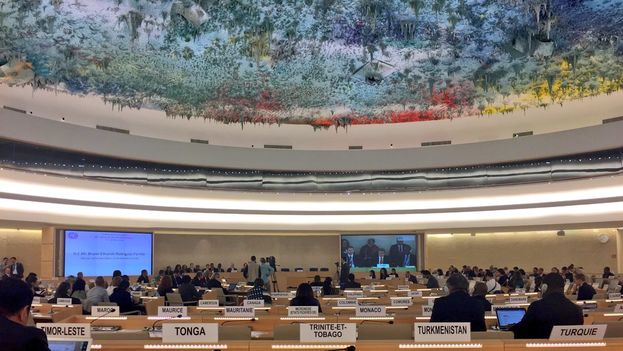
Cuba Tries to Block UN Speech by Oswaldo Paya’s Daughter / Rosa Maria Paya Acevedo

Thank you, Mr. President.

My name is Rosa Maria Payá, member of the Christian Liberation Movement and daughter of its national coordinator, Oswaldo Payá, opposition leader and Sakharov Prize laureate of the European Parliament.

My father dedicated his life to working for legal and nonviolent change for Cubans to enjoy all basic human rights.

He promoted the Varela Project, a referendum supported by over 25,000 citizens, who have defied repression to demand legal reforms that guarantee freedom of expression, freedom of association, free elections, freedom of nonviolent political prisoners and the right to own private enterprises.

The government has so far refused to allow this plebiscite, and it imprisoned the majority of its leaders.

Yosvani Melchor Rodríguez is 30 years old, and has spent three years in prison as a punishment for his mother being a member of our movement.

Cuban authorities said that my father and Harold Cepero, a youth activist, died in a traffic accident. But after interviewing the survivors, we confirmed that their deaths were not accidental.

[Cuban delegate Juan Quintanilla starts banging on his desk.]

President of the Session (UNHRC Vice President Luis Gallegos Chiriboga, ambassador of Ecuador):

There is a point of order from the delegation of Cuba.

Cuba (Juan Quintanilla):

Thank you, Mr. President. I apologize for the noise in the room but it was necessary to interrupt the statement by the mercenary who has dared to come to this room. We would like to ask, Mr. President, if this debate on Item 4 refers to general questions that may show a pattern of violations of human rights, or whether it is also to be used to address specific issues such as what is being done now by the mercenary, who has been taking the floor at this juncture. We have this concern, Mr. President, and we would be very grateful if you could clarify things for us and if you could show this to the mercenary who is delivering a statement. Thank you.

United States:

Thank you Mr. President. We highlight that the US firmly believes that NGOs must be permitted to speak in the Council. The member states, including the United States, may occasionally disagree with the content of a NGO statement. It is essential that civil society voices be heard here in an atmosphere of open expression. Without addressing the substance of what the speaker was saying, we are of the opinion that what we have heard of the intervention so far is addressed to the subject matter at hand before this Council under item 4. Mr. President, we respectfully ask that you rule that the speaker be allowed to finish her presentation. Thank you.

China: Thank you, Mr. President. The Chinese delegation believes that the concern of the Cuban delegation is valid. I hope, Mr. President, that you will seriously consider the request by the Cuban delegation. Thank you.

Russia: Thank you, Mr. President. Our delegation would like to support what is being said by the delegation of Cuba, objecting to the procedure being used for conducting the meeting. We would like to ask you to appeal to the representative of the NGO which is speaking to adhere to the established rules of procedure for the Council and the agenda as established. Thank you very much.

Pakistan: We support the point of order raised by the Cuban delegation. Thank you.

Nicaragua: My delegation is asking for the floor to support the request put forward by Cuba in its point of order. Thank you very much.

Belarus: Mr. President, the delegation of Belarus joins the well-founded statement on the point of order and procedural issues as raised by the delegation of Cuba. Thank you.

President: I would like to remind the organizations that are speaking that we are on Agenda Item 4, the human rights situations which require attention in the Council, and that they confine to that subject matter in their statements.

[Paya then resumed her statement.]

Thank you, Mr. President.

The driver of the car told the Washington Post that they were intentionally rammed from behind. The text messages from the survivors on the day of the event confirm this.

The Cuban government’s state security calls my family home in Havana, saying: “We’re going to kill you.” These are the same death threats that were made to my father.  I want to be clear: The physical integrity of all members of my family is the responsibility of the Cuban government.

Today I wish to present this appeal, signed by 46 political leaders and activists from around the world. We urge the United Nations to launch an independent investigation into the death of my father.

The truth is essential to the process of reconciliation that is necessary for a transition to democracy in Cuba. We do not seek revenge. But we have a right to know:

Who is responsible for the death of my father?

When will the people of Cuba finally enjoy basic democracy and fundamental freedoms?

Thank you, Mr. President.

At the end of the general debate, Cuba took the floor again to exercise a right of reply.

Cuba, exercising right of reply:

An anti-Cuban mercenary addressed the Council today to try to blame the Cuban government for the death of her father, who died last year in a car accident. This mercenary was accredited by United Nations Watch, a reactionary NGO without any credibility. Nobody takes it seriously and it only works for the service of the United States.

Rosa Maria Paya is a created, invented individual — financed and promoted by the US government. She has close relations with the US Interests Office in Havana, which she has visited on many occasions.

As regards to the alleged facts, nobody in their right mind would believe them during the oral and public hearing. And on the basis of abundant proof, including expert proof, it was shown that Angel Carromero was driving at well above 120 kilometers an hour, and it was his lack of attention and care, the fact that he was driving too fast, and a wrong decision to step on the brakes too hard on a slippery surface that caused this tragic accident which cost the life of two individuals. Angel Carromero in fact recognized this.

Both Rosa Maria Paya and Regis Iglesias — speaking on behalf of another phony NGO — are vulgar agents, paid, educated and trained by the US government in order to bring about a regime change in Cuba. They both work for those who are in favor of the blockade and aggression against their own people.

[Note: Original posted in English on Rosa Maria's blog.]

20 March 2013


Angel Carromero Details Car Crash That Killed Oswaldo Paya and Harold Cepero

Angel Carromero speaking publicly in Cuba while still in custody of State Security.

Angel Carromero speaking publicly in Cuba while still in custody of State Security.

The Washington Post has published a lengthy interview with the Spaniard Angel Carromero where he details the events leading up to the crash that killed Oswaldo Paya and Harold Cepero, and what transpired afterwards.

The article can be read here.


The Death of Paya Was Murder / Orlando Luis Pardo Lazo

Oswaldo Paya’s daughter (Rosa Maria) and wife (Ofelia) at his funeral.
Disgusting freedom of expression.

The assassins always return to the scene of the crime.

Today I feel ashamed to be Cuban and that a Cuban coward can behave so criminally against another Cuban now incapable of defending himself, thanks to the “democratic security forces labor” of other Cubans.

www.cubaencuentro.com/opinion/articulos/la-muerte-de-paya…

All this is just proof that the truth is about to come out.

And that more good blood of innocent Cubans and Europeans will run.

February 28 2013