“The Community Services Company has left all this dirt on purpose,” complains a member from the parish of San Pedro Apóstol.
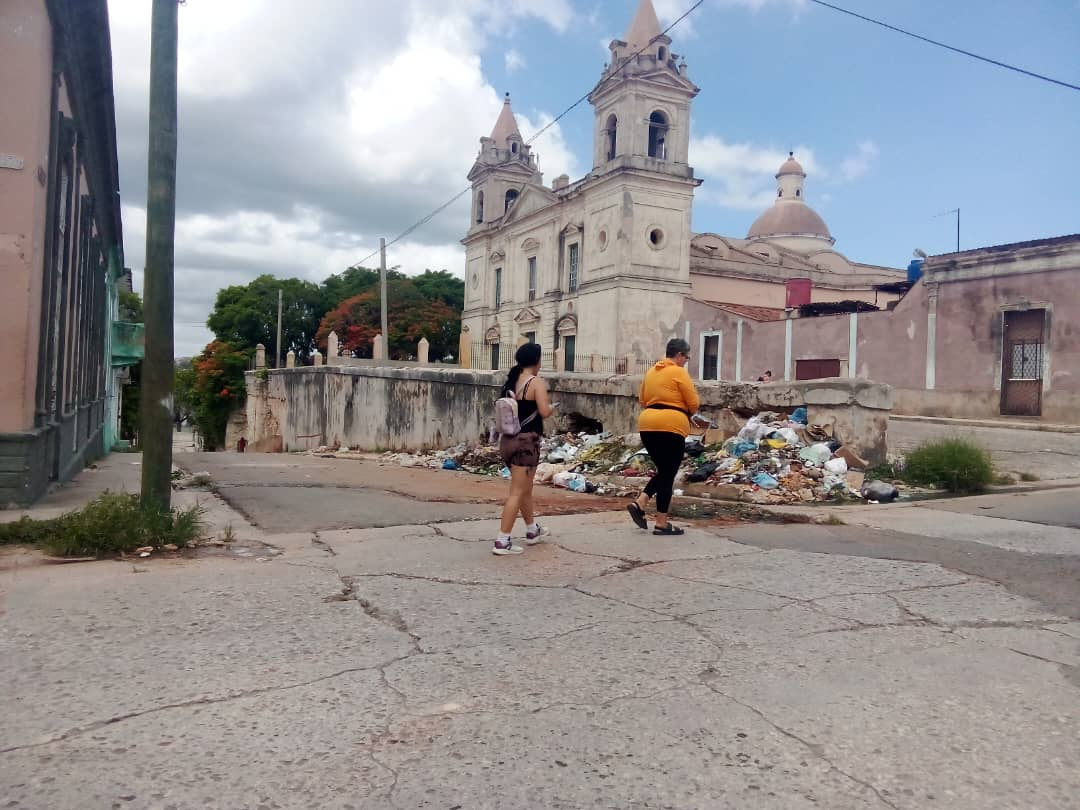
 14ymedio, Julio César Contreras, Matanzas, July 13, 2025 — “May the Lord protect us from so much garbage.” The phrase, pronounced by an elderly man who raises his gaze to the bell tower of the parish of San Pedro Apóstol, summarizes the concern about the debris that accumulates next to this church in Matanzas. The panorama is repeated throughout the city, but the mountain of waste reaches levels of heresy around the majestic building.
“I come to mass every Sunday, and the bad smell is very unpleasant,” says Lydia, a Catholic from the neighborhood of Versalles who considers the parish her “second home.” With more than seven decades of life, the resident from Matanzas claims to have “seen everything.” She lived through the days of anti-religious extremism, when scapulars were torn from the necks of those who publicly maintained their Catholic faith.
If in those years, Lydia had to put away the picture of the Sacred Heart that her grandmother had hung in the house and fill herself with courage to attend the Sunday service, she must now overcome the waste to be able to sit on the long wooden benches inside the building designed by Italian architect Daniel Dall’Aglio.
“I think the Community Services Company has left all this dirt on purpose, because no collector has picked it up,” she says, complaining about the lack of containers nearby and the ups and downs in waste collection. “We have sent letters to the Government and the Office of Religious Affairs of the Central Committee of the Party. They promise to clean up the area, but it’s nothing but words.”

As the priest loudly repeats fragments of the Bible, the stench of rotting garbage comes to the noses of the assembled parishioners. From the mountain of bags thrown on the sidewalk, which now reaches into the street, a putrid stream springs that continues spreading its miasmasdownhill. Passing bystanders try to avoid getting their shoes dirty and take small jumps to dodge the water.
Most of the countless Catholic churches on the Island are located in very central and densely populated areas. Hence, with the collapse of the garbage collection service, the image of waste that grows around the walls of churches, monasteries and convents is becoming more common. But the extent of the evil does not console parishioners, who believe that there is a more marked official neglect of these buildings.
“The garbage is piled on the wall of a building that has the status of a National Monument,” comments another resident in the vicinity of San Pedro Apóstol. “There is nothing left of the sidewalk that leads to the door.” The man reports that the municipal trucks assigned to the area do not meet the scheduled collection cycles, with the excuse that there is a shortage of fuel, personnel and spare parts.

Although he recognizes that the responsibility for dumping waste in the area lies with the neighbors, he justifies the attitude by the lack of sufficient containers to deposit household waste. “If they had to collect what the tourists throw away when they take pictures of the church they would have bought containers and they’d sing a different song,” he says.
The angry resident does not fail to notice that the problem is not repeated with the same magnitude in the vicinity of the main official institutions of the province, such as the headquarters of the Communist Party or the premises of the National Assembly. “There is no interest in churches looking more beautiful and people being happy to come to mass, that’s clear.”
Translated by Regina Anavy
____________
COLLABORATE WITH OUR WORK: The 14ymedio team is committed to practicing serious journalism that reflects Cuba’s reality in all its depth. Thank you for joining us on this long journey. We invite you to continue supporting us by becoming a member of 14ymedio now. Together we can continue transforming journalism in Cuba.