 Cuba produces passions, but also pain. I am taking the liberty of reprinting here the comments of some readers, showing how much this island in the Caribbean Sea is hurting.
Laritza Diversent
Gabriel
“I’ve met many Cubans living in Spain, and their greatest trauma was not just the loss of their home. I’m talking about a lady in her sixties who gave me music lessons when I was about 16 years old. That is, back in the decade of the 60’s. For her, the greatest trauma was that they would not let her take her family photo album out of Cuba. Nor would they let her contact her relatives who remained in Cuba, either by phone or mail.
They erased the reminders of her entire life. Those photo albums lacked any monetary value. They prohibited her from taking them only to hurt her. That nostalgia for lost photo albums has been recounted to me by several different Cubans. Memories can be more valuable than objects.”
Dora Amador
“Few people in Cuba think about the pain of being uprooted. The unspeakable trauma that leaving the country entails. That is my case. I left at age 13, I am now 61. All my life, I had no greater desire than to return to my country, which, God willing, I will, to a Free Cuba, wonderfully democratic. I know it’s not easy to achieve democratic institutions, not only in the republic, but in ourselves, respecting the diversity of ideas and the validity of elections, etc.
Being exiled is one of the most horrible sufferings that a human being can experience. You can now observe this in the case of Adrián Leiva, who died trying to enter his country, because the government would not allow it. That is my case, too. They will not let me enter, they will not give me permission to return to my country. Soon all this will change forever.”
Anae
“Every officer who attends those who leave Cuba has a kind of license that allows them to mistreat you, with or without words, through every proceeding. In my case it was in the final days, in one of the offices where they multiply the documents needed to finish, so as not to allow you to say goodbye to your family and friends in peace, always thinking that something is missing and “without that” you cannot go.
The lack of one simple document is fatal . . . and terrifying. It’s enough to lose sleep over, to say a quick goodbye and turn your face as you fight back your tears. Then, while waiting for the flight, you want to leave and say you’re sorry, to calmly say that you expect to return one day, but it’s not possible. Many people have not been able to return to reconcile themselves at this moment, and perhaps that is why they carry a heavy load. Many more than those who have been able to do so … ”
Eneas
“Yes, the wounds don’t heal, there are many. I left behind mother, child, childhood friends, etc. In short, every day of your life you live with nostalgia and suffering, because many of these wounds will follow you forever. I just wish that Cuba could return to normal, where the rights of every citizen are respected, and you can live in peace and harmony. Do you see? I don’t know … ”
Modesta García
“I too left Cuba 30 years ago and haven’t returned, because I also have open wounds, and I can’t forget. There were 10 years of waiting, when the exits were closed from 1970 to 1980, without hope. I started working with the government, and since I wanted to leave the country, I was considered a CIA agent. They invented sabotage plots, they watched me, etc. I can’t count all the intrigues, sufferings, and torments. All this cooled my desire to return to Cuba.
Although they tell me that it’s different now, I know that’s not true. Recent events show that nothing has changed, that it’s business as usual. I’m not a masochist, and as soon as I set foot in the airport, the humiliations by the employees would begin. I came to this country seeking freedom; I have it, and I enjoy it, and I don’t want to be without it for even a second.
This is not to say that I feel nothing for Cuba. On the contrary, for everything that happens, I’m sorry and I’m concerned and I very much want their freedom. But until there is freedom, I will not return. I’m not critical of those going to see their parents, siblings, children, etc., because that is human.
I am critical of those who visit the Island looking for cheap sex from unhappy girls who do it out of necessity, and of the “millionaires” who cover themselves with gold-plated jewelry, so people will believe they are wealthy and ought to be treated as celebrities. Unfortunately, these are the sad realities of travel to Cuba. I hope this nightmare ends, once and for all.”
Translated by: Tomás A.
 Sandy Olivera is a young Cuban who, two years ago, emigrated as a political refugee to the United States. His girlfriend remained on this side of the sea. A week ago, he returned to Cuba to marry her.
 Cubans are outcasts in their own land. Both those who reside in the country, as well as those living abroad. The latter are doubly discriminated against. They cannot invest in the economy because they are citizens of the State, yet when they return to the country they are treated as foreigners.
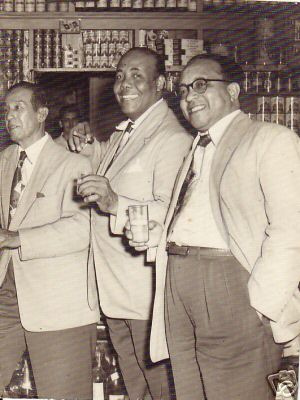 Fifty years ago, on May 10, 1960, the Matamoros Trio, headed by Siro Rodriguez, Rafael Cueto, and Miguel Matamoros, performed in public for the last time. They bid their farewells on the program called Partagas Thursdays, one of the most popular Cuban TV shows at the time.
 It is fair to acknowledge that foreign investment in Cuba brings benefits to the economy. But by itself it is not the solution for confronting the overwhelming problems.


 When I first went to his home, what struck me most was an old glass cabinet. Inside, sorted by date, were national newspapers from at least ten years before.