Patrols and State Security agents surround opposition members in their homes
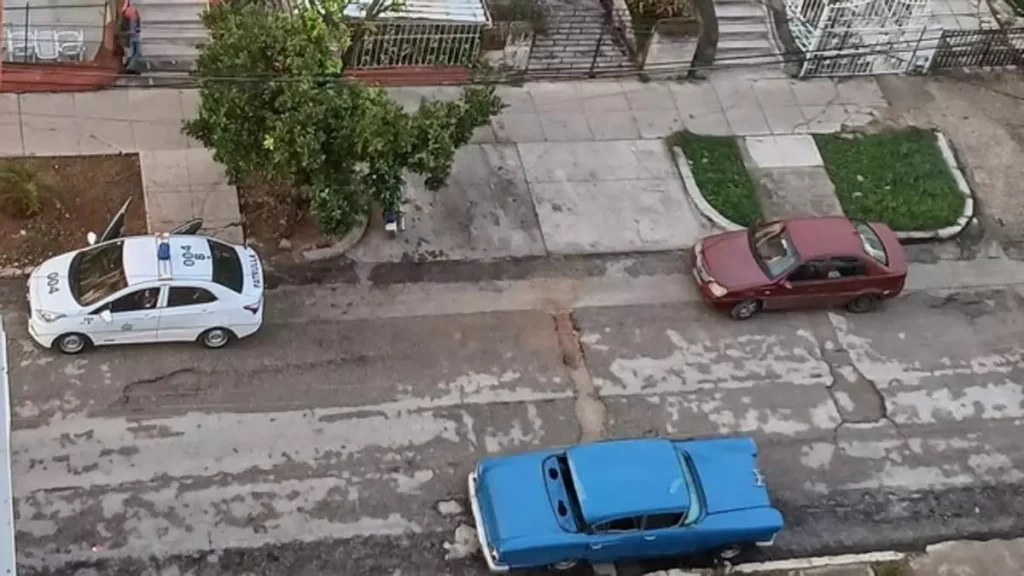
 14ymedio Havana, December 10, 2025 –- As every year, Cuba spent this Wednesday’s International Human Rights Day with police operations, internet cuts, and house arrests imposed on activists and independent journalists. The regime once again deployed its ability to silence any civic gesture.
The 14ymedio newsroom in Havana woke up without web browsing service and with a police operation at the entrance of the building where it is located in the Nuevo Vedado neighborhood. The repression has also extended to other journalists, such as Boris González Arenas, held in his home under the watch of State Security. “This Government only has energy to repress the people it is starving to death,” denounced Juliette Fernández Estrada on Facebook.
Activist Yamilka Lafita, known as Lara Crofs, reported that a man who introduced himself as “chief of the combatants, Eduardo,” accompanied by two police officers, arrived at her home to warn her that she could not go out. “They say it’s ‘for the reason I know,’” she wrote on her social media. “My door may be watched, but they won’t silence my voice,” she said, dedicating the day to the Cuban people, the political prisoners, and their families.
Cuba spent International Human Rights Day with police operations, internet cuts, and house arrests against activists and independent journalists
Wilber Aguilar, father of political prisoner Walnier Aguilar, also denounced a police cordon in front of his home. “Patrol car 241 is parked here. I can’t leave; I can’t move from my house,” he reported. “Everyone in my house came down with the virus, practically dying, and not a single doctor showed up, but today the State Security agents do come.” Bitterly, the father of the young man imprisoned for participating in the Island-wide 2021 July 11 protests summed it up: “We live in a country where human rights don’t exist, nor humans with rights.”
In the Havana municipality of Lawton, the leader of the Ladies in White, Berta Soler, warned of heavy surveillance against her and her husband, Ángel Moya Acosta, as well as against the headquarters of the movement. She explained that neighbors have reported several patrols surrounding the area. The operation is located at the corner of Martínez and D streets. “State Security repressors started early with their repressive deployment,” she
denounced.
The human rights crisis on the Island, recall the members of the Cuba X Cuba project, is not limited to political prisoners or those facing arbitrary proceedings. “It also affects millions of people condemned to live in degrading conditions,” they stated. “Twenty-hour blackouts, lack of medicines, food shortages, collapsed basic services, growing insecurity, and a health crisis form a landscape where surviving is an act of resistance.” On this Human Rights Day, the organization renewed its commitment “to dignity and freedom, to those still imprisoned, to those waiting for a nonexistent medicine or surviving in darkness, or watching their neighborhood, their school, their hospital, and their future deteriorate.”
Cubans abroad called marches and protests around the world to make visible the precarious human rights situation on the Island
Cubans abroad used the date to call marches and protests around the world with the aim of making visible the precarious human rights situation on the Island. Opposition leader José Daniel Ferrer García called for a global day for human rights and freedom in Cuba.
Various actions were organized in at least 13 cities, including protests, walks, gatherings, and symbolic acts, in countries such as Spain, Canada, Germany, Sweden, Chile, France, and the United States.
In Berlin, a group of members of Cuban civil society was received by German government authorities “for the first time in history,” explained activist Tania Tasé on her profile Las Taniadas. “We will do the best we can, for all Cubans,” she said moments before the meeting.
In Barcelona, a group of emigrants gathered in the streets to denounce the Cuban dictatorship. Videos posted on the page of the Coalition of Women for a Free Cuba show participants speaking on issues such as the severe health and food crisis in the country, political prisoners, and the total lack of rights faced by Cubans.
In Madrid, the protest of exiles took place in front of the Cuban embassy and was broadcast by the Council for the Transition in Cuba and the magazine Alas Tensas.
Translated by Regina Anavy
____________
COLLABORATE WITH OUR WORK: The 14ymedio team is committed to practicing serious journalism that reflects Cuba’s reality in all its depth. Thank you for joining us on this long journey. We invite you to continue supporting us by becoming a member of 14ymedio now. Together we can continue transforming journalism in Cuba.
