An engineer admits it will not be enough to “solve the generation deficit”
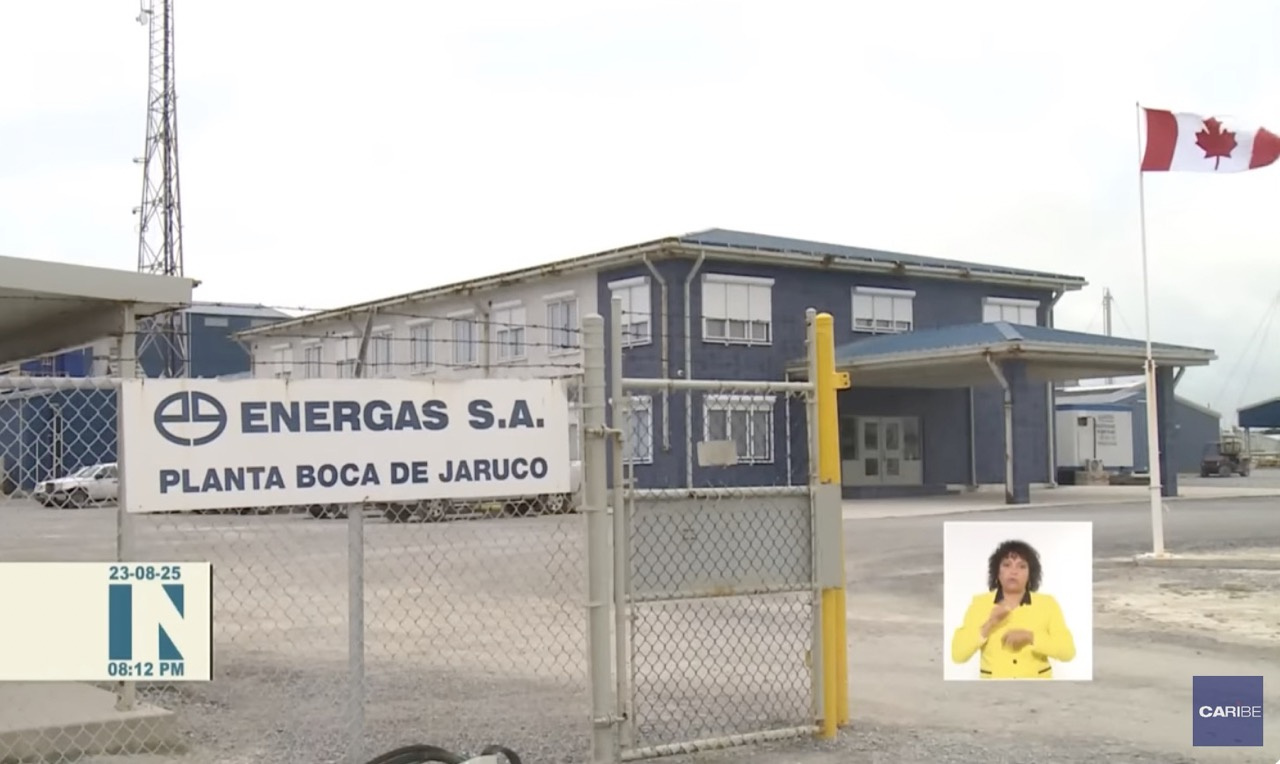
 14ymedio, Madrid, 27 August 2025 — “Energas has become the largest thermoelectric power plant in the country at the moment.” Statements to Canal Caribe by Luis Rolando Eres Grass, engineer of the Western Oil Drilling and Extraction Company, show the importance for Cuba of the gas plants in Boca de Jaruco (Mayabeque) and Varadero (Matanzas), which supply the national electricity system (SEN) with 400 megawatts (MW) daily, no less than 12% of the domestic demand in high consumption season, as is the case now.
The technician is one of the experts interviewed to give a statement that the official media disseminated with enthusiasm: Cuba-Petróleo Union (Cupet) has reached two million tons of crude oil equivalent thanks to the oil and gas extracted mainly in deposits in the province of Matanzas. He himself, however, lowers the expectations of the data. “Two million tons of oil equivalent will not solve the generation deficit,” he said, adding that they represent a value of more than one billion dollars “that the country stopped investing to generate electricity” and with which diesel can be purchased “for distributed generation.”
What Canal Caribe emphasizes is not the 98% of national production, which is in the northern strip -Mayabeque, Varadero, Cárdenas- and gives a crude oil of worse quality, but the hopes placed in new deposits. Nor does it mention that the Chinese company Great Wall makes the work possible. The report speaks of the “scientific and technological feat” that involves the horizontal drilling of eight kilometers to reach “deposits located below the seabed, reached from land.”
Experts never mention that Energas’ achievement is due to collaboration with Canadian mining giant Sherritt
This new well, belonging to the Fraile block, is expected to yield around 120 cubic meters (750 barrels) of oil per day by the end of the year, a small contribution for recovering national production, which at the end of 2024 had decreased by 138,028 tons compared to the forecast.
At no time did the experts mention that Energas’ achievement was due to collaboration with Canadian mining giant Sherritt, although at the end of the TV report -just when they are talking about “reducing dependence on imported fuels” and a “gain in energy sovereignty”- the flag of Canada clearly appears next to that of Cuba and the emblem of the state gas company.
The enthusiasm with which the news is communicated through official media, in any case, contrasts with the results of Sherritt itself. The company recently acknowledged that its situation in Cuba is critical, and Archivo Cuba published just a few days ago a report denouncing the scheme of “human trafficking” carried out by the regime with workers sent to the Canadian refinery of Fort Saskatchewan, in the province of Alberta.
But above all, it contrasts with the true energy situation of the island. For this Wednesday, the Electric Union of Cuba (UNE) again predicts a deficit that is on the way to 2,000 MW at peak hours. At the peak of demand, late-night, 3,780 MW will be required and 2,080 MW will be available. The deficit of 1,720 MW will result in a real allocation of 1,790 MW.
The figures are similar to yesterday’s 1,746 MW, well above the initially planned 1,660 MW. This Tuesday, says the UNE, ” service was affected for 24 hours and remained affected throughout the morning today.”
The 26 new photovoltaic solar parks, which contributed a maximum of 562 MW during daytime hours, still do not compensate for the calamitous state of the SEN. A total of six units in thermal power plants are down for failure or maintenance, and 38 distributed generation plants are not operating due to lack of fuel.
Translated by Regina Anavy
____________
COLLABORATE WITH OUR WORK: The 14ymedio team is committed to practicing serious journalism that reflects Cuba’s reality in all its depth. Thank you for joining us on this long journey. We invite you to continue supporting us by becoming a member of 14ymedio now. Together we can continue transforming journalism in Cuba.