Building Collapse Kills Four in Old Havana / 14ymedio

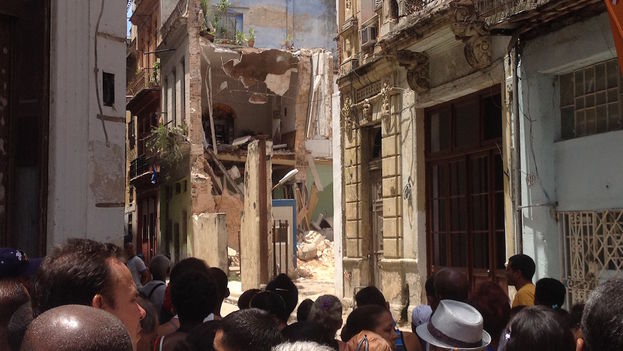
Building collapse on Habana Street in Old Havana.

14ymedio bigger14ymedio, Havana, 15 July 2015 – The peaceful early morning was turned into a tragedy for the neighbors of 409 Habana Street between Obispo and Obrapia, in Old Havana.

While the residents of the place slept, at six in the morning this Wednesday, the building fell down and caused at least four deaths, a figure that could risein the coming hours given the severity of the injuries.

A minor was taken to Juan Manual Marquez Pediatric Hospital and two adults are being cared for at Calixto Garcia Hospital. There they also received the last of the dead confirmed by 14ymedio, a young woman age 18, Glendys Amayi Pérez Kindelán, who was visiting Havana at the home of some family members. In the Tomas Romay Polyclinic in Aguiar Street Henola Álvarez Martínez, a little girl of 3 gravely injured in the collapse, died.

Jorge A. Álvarez Rodríguez, age 18, and Mayra Páez Mora, age 60, also died.

The street, located in a tourist area, was cordoned off from the very early hours of the morning and the police detained a young man taking photos of the incident. The roof was totally caved in and the façade is cracked in half. Among the rubble one can see furniture, clothing, beds and other items.

The building had two floors and the neighbors attribute the collapse to the ground floor tenant who was remodeling and may have removed some bearing wall. The most affected family had lodged several complaints and denunciations about these “construction movements” being undertaken in the downstairs dwelling. The intense rains that fell in Havana yesterday and the poor state of the housing could have contributed to the collapse.

The rescue brigades are working non-stop to remove the debris in order to be able to enter the building.

Another Way to be a Greek Hero / 14ymedio, Reinaldo Escobar

Prime Minister of Greece, Alexis Tsipras. (tsipras_eu)

14ymedio biggerReinaldo Escobar, Havana, 15 July 2015 — Homer would have narrated it differently, opting to die dismembered before giving in, but in these times the heroes are faced with the inexorable fatality of their tragedy, putting at risk their prestige, not their lives. Alexis Tsipras chose to stop right at the edge of the abyss because he believed more in the future of his nation than in his political career. Historians will tell us if he did well or badly, maintaining a pulse facing the Troika, even to extremes. Economists will draw pragmatic lessons watching whether Greece grows or sinks, while the militants of his party will reassemble their agendas with different promises.

Those from other latitudes who applauded the inflexible will now have to swallow their praise and, in passing, learn their lesson. The populists of Spain’s Podemos party will know they will not have a second chance at the polls, and those obsessed with an eternal Baraguá in these parts of the Caribbean will have to recognize that it is time to move on, saying “we do not understand.”

As someone whose name I can’t remember said, “Greece is very familiar to Cubans. She taught us the philosophy, arts and sciences of antiquity when we studied in school, and, along with them, the most complex of human activities: the art and the science of politics.

The story is not over, it never really ends. In the coming hours Tsipras will have to confront his personal Thermopylae in front of Parliament and face his constituents, who will not want to accept the reforms that will come over them. It will be Ulysses facing the pretenders, or Achilles with his wounded heel, but this time the gods will not intervene and it will be the chorus who decides.

Cult of Personality in Cuban Parliament / 14ymedio, Yoani Sanchez

Raul-Castro-Revolucion-Nikolai-Leonov_CYMIMA20150715_0001_16
The cover of the book “Raul Castro: A Man in Revolution ‘Nikolai Leonov.

14ymedio biggerGeneration Y, Yoani Sanchez, 15 July 2015 — The cult of personality has a thousand ways of showing itself. From the face that stares out from every schoolroom wall, to the flattery with which the government journalists refer to certain officials. It would seem, however, that the times of greatest excess in the veneration of a figure had been left behind, to the extent that the memory of Fidel Castro has languished since his forced retirement. However, the pernicious practice continues here, with its exaggeration and ridiculousness.

On Tuesday, the entire National Assembly of People’s Power dedicated itself to the presentation of the book Raul Castro: A Man in Revolution, written by the Russian Nikolai Leonov. A special session of the Parliament had as its sole purpose to attend the launch of this volume, published by Capital San Luis, and with more than 80 biographical photos, some of them previously unpublished.

Out of modesty, or because he had to lead the 11th Plenum of the Cuban Communist Party Central Committee, Raul Castro did not attend the presentation, but this does not detract from the gesture’s devotional character. This was compounded by the use of parliamentarians for purposes not included in their functions. How much did it cost for those deputies who had travel to the Palace of Conventions? With so many problems facing the country, which affect millions of people, how could a day of “the official organ of State power” be squandered to sing the praises of a single man?

Situations like yesterday are proof that the pernicious cult of personality remains intact among us, fostered by those who idolize a few and those who swell with vanity at the flattery.

Cremata Expresses an Artist’s Bellyful Against Cultural Repression / 14ymedio, Miriam Celaya

El Rey se Muere [The King is Dying] (Martinoticias)
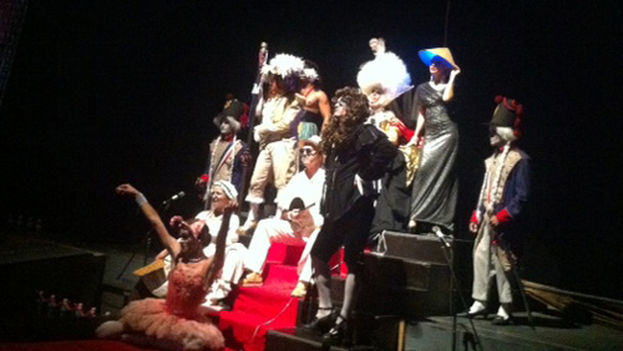
“What right does anyone have to rule over everyone’s thoughts?” The question, deeply subversive towards the Cuban reality, is at the heart of the open letter that artist Juan Carlos Cremata recently sent to an unknown Culture officer by the name of Andy Arencibia Concepción after a commission of the National Council of Theatre Arts (CNAE) suspended the theatre season which, under Cremata’s direction, was presenting the play The King is Dying*, the work of Eugene Ionesco, at the Tito Junco Auditorium of the Bertolt Brecht Cultural Center. After only two shows – Saturday July 4th and Sunday July 5th — the play was abruptly suspended by art officials.

Cremata’s letter, harsh and unadorned, was sent via e-mail to several friends and to 14ymedio for wider dissemination, in a gesture that calls to mind the phenomenon that took place more than eight years ago, termed “the little war of the e-mails” or “intellectual debate” initiated by a spontaneous reaction of artists and intellectuals to the introduction on national television program of the notorious censor-author “Papito” Serguera’s process of “parametración” that ostracized dozens of artists, writers and other creators. continue reading

On that occasion, the mere presence of that media commissioner set off alarms in the actors guild, especially in the surviving victims of the ill-fated Quinquenio Gris [The Five Grey Years], leading to the first open and uncontrolled intellectual debate, which took place on the emerging e-mail cyberspace, and came to question the cultural policy of the Revolution, outlined by Fidel Castro in his menacing and infamous speech known as Palabras a los Intelectuales [Words to the Intellectuals].

In 2007, the “little war of emails” made clear the fissure in the traditional pact of submissiveness of the artistic-intellectual sector to the cultural policy of the Government

Finally, after weeks of e-mails exchanged in ever escalating tones of criticism, the controversy was sealed in a closed-door meeting held at the House of the Americas, led by the then minister of culture, Abel Prieto, and a select group of participants of the peculiar debate. The protesting voices were silenced with some minor concessions to the better-known figures, and the frantic exchange of e-mails ended as suddenly as it had begun.

However, the “little war of e-mails” managed to set one important precedent, among others, because of two essential factors: it made clear the fissure of the traditional pact of submissiveness of the artistic-intellectual sector to the cultural policy of the Government, and new information technologies and communications were used for the benefit of free thought for the first time in Cuba, circumventing government censorship. It is not coincidental that shortly afterwards, in 2007, an emergence of true freedom of expression took place with the emergence of the first independent blogs that have caused so many headaches to the repressors.

Juan Carlos Cremata, the controversial director of film and theater, has already experienced the pressure of censorship from the commissioners of official art before, due to his strong preference for uncomfortable topics of the Cuban reality, and his incisive and direct manner in addressing them. Since his directorial debut with the film Nada [Nothing] (1995), where he successfully used comedy as means to deal with the drama of emigration, the intransigence of a female official, and the love of a young couple in the midst of the shortages of the economic crisis of the 90’s, he won the approval of the national public to such an extent that, since that time, he has carried on with close ties with film and theatre as well as with the attention of the ideological inquisitors.

Cremata has already experienced the pressure of censorship of the commissioners of official art before, due to his strong preference for uncomfortable topics of the Cuban reality

Despite this, Nada won the Premio Coral de Opera Prima at the 23rd International Festival of New Latin American Cinema in 2001, in addition to other international awards.

After that, there were other movies, among them, the renown feature film Viva Cuba, also the recipient of international awards, and several other short films denoting the caustic and questioning style ascribed to this filmmaker by the preference of the Cuban public and by the hostility the censors.

Crematorium 1 at Last… Evil, stands out among these works: a synthetic portrait of contemporary Cuba through an acid and biting satire of the rigidity and hypocrisy of the ideological dogmas imposed on society whose script, from start to finish, explicitly questions the loss of social values and the spuriousness of the moral foundations of the system. Crematorium has never aired on TV or been on film circuits billboards, but it has circulated widely among Cuba’s public through informal distribution networks, largely thanks to the interest that the forbidden often arouses.

Censorship only reinforces the message it tried to invalidate, in identifying King Eggplant the First with the Cuban ex-president – both are decadent, exhausted and obsolete

On the other hand, Cremata’s performance as a theater director has also had its obstacles. According to his own account, four years ago, in the same Tito Junco Auditorium, the play La Hijastra [The Stepdaughter], a work he directed, was interrupted, that season after 14 shows.

There have been allusions to excessive, unnecessary vulgarity on stage. In fact, Cremata supports the use of “foul language that is, excessive, irreverent (which is not the same as disrespectful), iconoclastic, rebellious and sometimes vulgar or profane.”

However, this argument could be put forward as the cause of censorship, particularly when vulgarity is a credential letter of the system and is legitimized by cultural officials, as demonstrated abroad in gross acts of repudiation against the representatives of Cuba’s independent civil society, orchestrated and directed during the last Summit of the Americas in Panama by many of those same jealous caretakers of the “national culture,” including the former minister of culture, Abel Prieto, the pseudo-intellectual Miguel Barnet (a so-called “anthropologist”) and the president of the Hermanos Saíz Association, such a grayish character that I could not even remember his name.

Paradoxically, the current instance of censorship against The King is Dying merely reinforces the message it is trying to invalidate, by identifying the play’s main character, King Eggplant the First, with the Cuban ex-president — they are both decadent, willful, exhausting and obsolete — even more so when the president of Cuban Theater Arts, Gisela Gonzalez, described the staging in terms of “treason” or “political lampoon”.

How could we ignore the many “cultural events” that are based on similar acts of repudiation against Cuba’s peaceful opposition in which certain art instructors even enroll primary school children? Can we possibly imagine greater vulgarity than what is being promoted by the administrations of our cultural institutions? Is there greater vulgarity than the censorship itself of freedom of creation and of thought?

A discrete, though growing transition has begun to take place in the consciousness of our best artists and creative individuals, and it is a contagious pandemic

The truth is that, when he directed this theatrical season with the intention of “talking about resistance to change,” Cremata ended up surpassing the uncomfortable subject category and reaching that of intolerable creator in the taxonomy of the cultural curator, one that is, precisely, the entrenched forefront of that resistance.

Cremata states: “I defend, above all, a plurality of readings in what I pursue or dream about, because, in some way, it encourages and obsesses me as artist, thinker and human being.” A principle that completely denies the exclusionary nature of a system that has imposed what the artist ironically defined as “limited independence”, “ration-book freedom” and other epithets. But it clearly defines, at the same time, the fascist nature of the official censorship.

When he warns his (our) censors that these are times when “a pandemic of freedom is flooding our senses” Cremata states what many of us have been suspecting all along: a discrete, though growing transition has begun to take place in the consciousness of our best artists and creative individuals, and it is a contagious pandemic, especially because it flows from voices that can exert a greater and deeper influence over society than any program or opposition march. Thus, the actions of the repressors become more visible and self-defeating.

Now we’ll just have to wait and see if Cremata’s letter becomes the trigger for the demands that our best Cuban creative artists have been making in the last few years, and whether it will unleash another debate involving these and other rights, or if another deep silence will turn it in an epilogue of what could have been the beginnings of a new intellectual polemic.

*Translator’s note: The play has been staged in the United States under the title “Exit the King”

Translated by Norma Whiting

Tsipras’ “Betrayal” / Yoani Sanchez

Greek Prime Minister Alexis Tsipras, during an interview with state television. (Alexandros Vlachos / EFE)

14ymedio bigger14ymedio, Generation Y, Yoani Sanchez, 14 July 2015 — A week ago he was a hero lauded by the official Cuban media, today he is a political corpse many fear to mention. Alexis Tsipras negotiated and lost. Sanity has been imposed over his his initial bravado, and the pact he is about to accept has turned him into a traitor to his own politics. The critical voices within his party are already being heard about the agreement he has closed with the Eurozone, and Havana’s Plaza of the Revolution is keeping an embarrassed silence.

A third rescue, which will be around 86 billion euros, has been approved to pull Greece out of the quagmire. The money will come accompanied by conditions that force the Greek government to raise taxes, cut pensions and engage in privatizations. Far from that intransigent posture of the man who was congratulated by Fidel Castro, “for his brilliant political victory,” in the recent referendum. continue reading

Tsipras has accepted what until recently he rejected. All his incendiary nationalistic rhetoric has ended in a pragmatic gesture of compliance. Political greatness? Awareness of defeat? A final grimace of goodwill before heading out the backdoor of power in Greece? It’s hard to know. Most importantly he has chosen not to separate Greece from Europe, to exorcise the demon of the “Grexit,” and in passing has disappointed all those who incited him to lead an entire nation to economic suicide.

The lines in front of the ATMs, the empty shelves, and the growing fear in the population have done more than all the winks of solidarity from other corners of the world that fell on this Greek, though the crisis has not marked his face with a single wrinkle, there is no ‘tic’ of concern. Even at the agreement table, where he spent his last political capital, he has been seen as imperturbable, beautiful, young.

The adversaries of the European Union will accuse him of having sold the country to foreign interests and those who never believed him will look on him with pity while muttering “we told you so.”

Now the diatribe rains down on him. The adversaries of the European Union will accuse him of having sold the country to foreign interests, and those who never believed him will look on him with pity while muttering “we told you so.” There is no way this Greek play where the Syriza party leader is the protagonist ends up as something more than a political tragedy for his party and himself.

Like a sublime statue, Tsipras has ended up trapped in the marble of his verticality; the populism he himself unleashed has devoured him. Some promises meant to charm the voters, when put into practice made the country fall below the point it had reached until now. The pantomime of a referendum was the ultimate gesture of vanity before reneging on his positions.

Tsipras will be diluted in the coming weeks, when the parliaments of the European nations, including Greece, discuss the agreement and approve its implementation. Every step toward getting the rescue and complying with its demands will extinguish this figure that dazzles a part of a nation with his rhetoric.

None of those who applauded his daring will pat him on the back to acknowledge he has chosen for his country and not for himself. For them, Tispras is the uncomfortable reminder of what might have been, the missed opportunity to project, through Greece, their own vendettas.

Juan Carlos Cremata: A Real Man / Reinaldo Escobar

Juan Carlos Cremata. (Cubadebate)

Reinaldo Escobar, Havana, 11 July 2015 — It is very likely that the youngest among us don’t know the reference to the 1951 novel “The Story of a Real Man” by the Soviet writer Boris Polevoy, which tells the story of Alexey Petrovich Maresyev, a fighter pilot who lost both his legs and through a heroic effort continued to pilot a plane and engage in new battles.

Juan Carlos Cremata (born 1961) is the least likely hero of Real Socialism. He is an artist from head to foot, irreverent and lucid, who has left his mark both in the theater and the cinema. He has received numerous national and foreign prizes and a great part of his oeuvre has been dedicated to works for children and teens. Among his most well-known films are Nada (Nothing) and Chamaco (The Kid: Chamaco) as well as works that have circulated via alternative means, as is the case with Crematorio (Crematorium). continue reading

However, now Juan Carlos has gotten into serious trouble. Saturday the 3rd and Sunday the 4th of July a work directed by him was staged by the group El Ingenio in the Tito Junco hall of the Bertolt Brecht Theater in Havana. The play was The King is Dying*, by the French-Romanian playwright Eugene Ionesco, the story of a king who resists the idea that death can touch him any day.

The leadership of National Performing Arts decided to suspend the play and accused the prize-winning artist of the worst insults. But, unlike others, Cremata did not choose to remain silent and responded, leaving nothing out.

Defending the censored artist could be dangerous in the short term, but silence, or even worse, complicit approval, would be disastrous.

Now it only remains to see the reaction of the Cuban intellectuals in the face of this despotic display of censorship. Defending the censored artist could be dangerous in the short term, but silence, or even worse, complicit approval, would be disastrous.

The youngest among us, those who do not know the work of the Soviet journalist and narrator Boris Polevoy, will be tempted to search for “A Real Man” in the digital dictionary Wikipedia, but will be surprised to find there that is a CD by the group Alaska y Dinarama. Some relationship will be found with the polysemic playwright, but those who read the odyssey of the mistreated pilot and who read the arguments of this courageous artist might conclude that, like Alexey Petrovich Maresyev, Cremato will once again fly and fight.

Translator’s note: The play has been staged in the United States under the name “Exit the King”


Condemn Us, It Does Not Matter: Art Will Absorb Us* / 14ymedio, Juan Carlos Cremata

The play 'The King Dies,' directed by Juan Carlos Cremata. (Havana Times)
The play ‘The King Dies,’ directed by Juan Carlos Cremata. (Havana Times)

14ymedio bigger14ymedio, Juan Carlos Cremata, Havana, 10 July 2015 — First of all, I apologize this time for speaking in the first person. I have always thought, like Garcia Marquez, that what I have tried to say is found in my work. And instead, it enriches me, much more, to hear the diverse interpretations that emerge about what, at times, we have done with pure artistic or professional intuition, supported, of course, in a wealth of collective proposals that emerge with the creation of the same. I defend, above all, a plurality of readings in what I pursue or dream about, because, in some way, it encourages and obsesses me as artist, thinker and human being.

I am also very fond of Pablo Picasso’s idea: “rather than search, find” on the path to art. Thus, it excites me, but much more, the act of aesthetic genesis itself, far beyond the finished work. Also, I always try, even at the abuse of the plural of modesty, contrasting it to a prolonged and ever more frequent and excessive “I” that is now habitual. Abundant, in the discourses that for so long have flooded every branch of thinking in our country, above all in criticism. And especially in politics.

But I am compelled to answer some “hasty” notes (also induced, commanded and/or dictated, which explains in some way their “precipitation”) regarding the [Havana] premier, on 4 July, of Eugene Ionesco’s play The King is Dying**, by our collective, El Ingenio.

Dear Andy Arencibia Concepción (with a copy to everyone who feels themselves alluded to):

I applaud your seriousness in researching my work and I admire the respect that you profess to me, despite the fact that, evidently, you fight, like the rest of your operators, in favor of maintaining intact your working life, or what is called, “looking after your job.” I understand. continue reading

If I remember correctly, you were also at the meeting where I was called in front of the “top brass” of the National Council for the Performing Arts to communicate to me the suspension of the season. And now I have no doubt that many of the views expressed in the letter respond in a personal way to the signals, although with harsher epithets such as “treason” and “political pamphlet,” from Gisela Gonzalez herself, who serves as President of Theater Arts in Cuba.

I do not know which came first. If it was hers or yours.

Raul could say it in his speech, but the theater, no. We were not authorized to expose it. Raul is applauded of course. Who dares to contradict him?

But either way, its deep and accelerated study comes to explain a little more the absurd and unintelligible initial note, suddenly appearing in CUBARTE, about the changes in programming at the Tito Junco Hall of the Bertolt Brecht Cultural Center, which did nothing more than hide a blatant censorship.

However you are smarter and saner. Your analysis is respectable, although conditioned.

And I am, believe me, very grateful to the attempt to elucidate a little all the indecipherable nebula that we try to stage. Your praise is also gratifying, your eulogies and superlatives, which I humbly hope to deserve.

However, it is likewise a little unfair and inexact, although entirely within your rights as a critic – not as a researcher – to offer an opinion in such a closed and categorical way about an artistic phenomenon, taking into account, only, your work as a screener.

In Art, as in every other subjective display, or even in medicine that is backed by science, that which could be good for you (all of you) not necessarily because it is for others.

Or for us, the others.

If any of you had attended the play on Sunday, you would have found another moment that, although essentially the same, wasn’t that staged on Saturday. I often tell my friends that it is better to attend the last evenings, when the actors and technicians have already tested, and even more savored, an experience that is enriched and transformed with each delivery.

Especially when the work staged by our collective depends heavily on the interaction with the audience to which your commentary refers. And where, in addition to the “mockery” to which you (or all of you) alluded to, there is a declared intention to rescue a very Cuban form of theater, quasi-lost or misplaced-censored-by-force-for-more-than-50-years, but that characterized the entire Cuban vernacular theater with the regular practice of political satire as a commentary on what happens in our country.

Shameless, excessive, irreverent (which is not the same is disrespectful), iconoclastic, rebellious, and sometimes even vulgar or profane, which you do not know, floods our countryside and cities. And it seems to be the language generated by the “New Man” that is forged in this imprecise society imposed on us.

Our intent with this staging was to talk about the resistance to change. Scathing obstinacy that today is made manifest again with the erratic decision of the Council itself

The theater is a live event, as is well known.

It is catharsis, shock, tremor and disturbance, above all in its relationship to the spectator. Be he for or against. Worse is to go to a play and return as if one had never gone. Is this what you want? Gallant and constant praise? A nice musical, naïve and inoffensive. The critique of what is authorized? The reinterpretation of our history, without questioning the present and much less the future? Independence restricted? The freedom of the ration book?

Because the ration coupon frees me? How much will this month’s emancipation cost me?

They are selling free will! Run! Run! They’re almost out of it!

We could point out a few years ago the same Council for Performing Arts, protected by a supposed “respect for the change in programming,” suppressed the huge success that we were having with our staging of the Rogelio Orizondo’s Le hijastra (The Stepdaughter) – without our even having seen much of them – and dealing with the disproportionate, frustrating and malicious comments that they immediately silenced when, a few months later, Raul Castro himself noted the same approach of “social indisciplines” with which all of Cuba is flooded.

Raul could say it in his speech, but the theater, no.

We were not authorized to expose it.

Raul is applauded of course. Who dares to contradict him?

We were condemned to exile in the same room to which we return, after four years, to again experiment, today with the decision to end our proposal, once again with the same punishment, the exact penalty, with the identical penance.

And, even worse.

We gave 14 performances of The Stepdaughter.

For The King Dies, we could only offer two.

It is the third try. And the third time is lucky.

Previously an onerous scandal was also unleashed with the presentation of El Frigidaire (Le Frigo) by Copi.

But this time they were definitive.

The affront to power is now unbridgeable.

And the barrier definitively raised, saying: Not one more, this far and no further They shall not pass!

They have gone too far.

Down with the embarrassment! Up with the stain!

At the same time, I want to add to the examples of theater collectives, which you (all of you) point to as worthy and paradigmatic (and to which you should undoubtedly also have added the commendable excellence of the Argos Theater, Theater de las Estaciones, Theater de la Luna or Theater Tuyo, among other very few examples), those which could contrast the work of more than a dozen collectives, where indeed no artistic metaphor or poetry flourishes. Where the proposal goes toward that radiant poverty of which not so long ago one of our media leaders boasted.

What about the profusion of revolting and senseless events whose only ambition is the sale of our art abroad?

Or the hundreds of political lampoons that we have had to shoot every day for so many years live and on television?

Or the thousands of public events where money is wasted by the boatload and bad taste is encouraged, the ineffectiveness, the falsehood and the injustice?

Recently an admired and recognized Cuban writer, also harassed from time to time, noted how little educated we Cubans have been in these times of the management, the habit, the cult of tolerance.

Most importantly – and I know you will agree with me, although feeling it in secrecy and not able to express its depth – the National Arts Council has every right to make known its differences, disagreements and decisions against a specific staging in its jurisdiction.

The abuse of an absolute power that holds, sustains and exposes the cruel exercise of an infamous censorship

But that does not exclude the qualifier of an immoral, medieval and incomprehensible measure, the abuse of an absolute power that holds, sustains and exposes the cruel exercise of an infamous censorship.

I shut you up to make myself heard.

Me. Me. And me.

And to not hear anything else.

Nor anyone else.

Typical behavior in the entire reign, dictatorial regime, or simply despotism.

Nepotism exemplified. Manifest and brazen arbitrariness.

Where is the possibility that others express opinions?

Why, and who, arrogates to himself the right to decide what others must think, propose or feel?

What right does anyone have to dictate the thinking of everyone?

These are other times, esteemed colleague.

A pandemic of freedom is flooding our senses.

If anyone disagrees with what we do, there will never be anything worse than condemnation and the penalty of silence, the penance of ostracism, the expiation of ignorance and the elimination, at a single blow, our freedom of artistic expression, our right to be wrong, our will and perennial vocation to argue, and even dissent, which doesn’t mean, although it could be so, to be against.

Our intent with this staging was to talk about the resistance to change. Scathing obstinacy that today is made manifest again with the erratic decision of the Council itself.

And it is not absolute and unconditional truth that we tried to make reference to a monarch, a chief, or any leader. Indeed, we are consciously trying to avoid it, although we knew full well that the sickly reading of these days would go, obligatorily, in that direction.

In the name of “national-socialism” we are restricted, repressed, sanctioned, gagged, trampled and hidden. This is embracing fascism. Pure. Absolute.

The actor who played King Eggplant the First studied the gestures of the great French comedian Loius de Funes, rather than delving into the nearer characters of our everyday lives.

You (all of you) could say and allege what you want. In addition, you can do it, because you have all the media under your control to disseminate it. They read the play and assumed the risk. They neglected the delivery.

But what is neither wise nor judicious, and it runs counter to the century in which we live, is the useless spell to silence others.

To decree and dictate the persistent and stubborn silence.

There is no right.

It is only imposed by force.

And where there is force reason pales.

It is helplessness facing the terror.

The bitter impotence of the offense.

The dream orphaned

The truth mocked.

Insisting on the error to drown in it.

In the name of “national-socialism” we are restricted, repressed, sanctioned, gagged, trampled and hidden. This is embracing fascism. Pure. Absolute and integral. The same as burning books and stigmatizing races, sexes, colors and even thoughts and ways of being. And it is also apartheid.

Like Fassbinder says, “Fear devours their souls.”

Nor is your observation about my most recent film work accurate, using precisely the example of Crematorium 1: in short… the evil, which is a project whipped by others, slyly veiled, or at least not officially released, and it has been appreciated only though this legalized and incoherent piracy that senselessly feeds our State.

That is, not even in the cinema are my “politically incorrect” steps well regarded by the nomenklatura, by the opportunistic, dull and mediocre bureaucracy that supports authority these days.

I am very clear-sighted and have learned since I was born that to be a revolutionary is NOT to be obedient nor to abide by the letter of everything that comes from “above.” That is being a sheep. That is: it is to be sheeplike.

From higher up come the things of God and you people disregard them.

He forgives you.

Our reason for being is to create. And we continue to do it. Although you would try to cut our wings. You can never crush thought.

Your duty (the duty of all of you) has been founded in mutilating, suspending, silencing, stopping, paralyzing, stalling, limiting, hindering, delaying, denying, and even unto death.

Our nation is its culture and our nationality as well.

Long live art!

The rest is cheap, hollow politicking.

And enough of hypocrisies, that you (all of you) do not feel.

Translator’s notes:

*The title is play on words of Fidel Castro’s defense in his trial for the Moncada Attack where he wrote: “Condemn me, history will absolve me.”

** The play has been staged in the United States under the name “Exit the King”
 

A List of Cuban Political Prisoners / 14ymedio, Martha Beatriz Roque

UNPACU activists being arrested. Screen shot from Youtube

14ymedio bigger14ymedio, Martha Beatriz Roque, Havana, 11 July 2015 — What classifies as a political prisoner is a cause for disagreement among the Cuban opposition. There are varying opinions about who has been jailed for political reasons or not, despite the criteria established by the United Nations and other organizations that concern themselves with these matters.

There are several lists of political prisoners compiled by various organizations circulating in and outside of Cuba. Said lists do not come from any specific dissident groups, but rather from individuals who publicize them. I unsuccessfully tried for all parties to agree on one list. Unfortunately, some individuals who have control over the names of political prisoners refuse to even listen to what others who made their own lists have to say.

Then we also have several groups of lawyers who do not actively contribute to lists of political prisoners, and who do not endorse the ones we have now either. continue reading

When the Cuban government wants a dissident off the streets, it accuses him or her of any crime. Moreover, when an officer of the law beats an opposition figure, the victim ends up accused of assault. Nevertheless, there have been cases in which opposition members were considered political prisoners when their incarcerations have had nothing to do with their political activities.

Twice in recent months, Jaime Cardinal Ortega y Alamino has stated that there are no political prisoners in Cuba. However, he later asked for lists of names of those who might now be incarcerated for political reasons to be forwarded to him. Due to the lack of consensus among the opposition, by now Cardinal Ortega must have several lists, including some containing names of individuals who have committed crimes not even remotely linked to the internal opposition movement, nor whose objective has been the nonviolent democratization of the country.

Several people have spent too many years in jail, and should be freed. Others have been given excessive sentences forbidding them from earning any privileges during their incarceration. These individuals should be classified separately from political prisoners, although we should still advocate for them. We should also continue speaking up for those on the list of prisoners with shorter sentences, namely those unjustly jailed for supposedly having a “special proclivity to commit crimes,” or “dangerousness.”

The Cuban government has never wanted to accept the existence of political prisoners in the country. It wants dissidents to be perceived as common criminals, mercenaries, terrorists, or anything else that would discredit both them and their oppositional activities. Its objective is to multiply political prisoners by zero.

In order to demonstrate how vitally important it is to come to an agreement on the lists of political prisoners and draw up only one that would have the approval of all the opposition, several inquiries have been conducted. We have contacted leaders of organizations, relatives, dissidents, and even some of the individuals whose names appear on the lists. Regardless of all the hard work, we have not always gotten the necessary responses nor reached any real conclusions due to a lack of understanding. Therefore, a commission should be created to analyze each case individually by evaluating the testimonies of witnesses and relatives.

The objective of the information below is not meant to disparage the work of any organization, and much less to belittle any prisoner. Only when we finally understand the importance of collective analysis, can we then reach an appropriate conclusion. I am sure that after each case is closely examined, we will all realize how important it is for us to work together.

It cannot be ruled out that there are no other prisoners jailed for political crimes just because they do not appear on any lists we examined. Cuba’s authorities do not allow access to prison statistics.

I wish to thank the support of the members of the Cuban Network of Community Correspondents (Red Cubana de Comunicadores Comunitarios), without whom it would have been impossible to gather the following data. I would also like to thank in particular Arnaldo Ramos Laururique, member of the Group of 75 and prisoner of conscience.

List of Political Prisoners Gathered from Several Different Organizations:

Coalition of the Opposition of Central Cuba (Damarys Moya Portieles, president)

  • Léster Castillo Rodríguez, sentenced on August 24, 2015 to one year for “dangerousness.”
  • Deibis Sardiñas Moya, sentenced on June 26, 2014 to three years for “dangerousness.”

United Anti-Totalitarian Front (Guillermo “Coco” Fariñas, president)

  • Joel Bencomo Rodríguez (not Díaz, as he appears on another list), sentenced on October 1, 2014 to two years for the crime of “disrespect.” The police have tried transferring him to a forced labor camp, but Mr. Bencomo refuses to budge.
  • Justo Miguel Fariñas Quey, sentenced on May 8, 2014 to six months in jail plus six months house arrest for his role in thwarting José Alberto Botel Cárdenas’ attempt on Guillermo Fariñas’ life. His sentence was made public before the last list was completed on June 19th. Still, his sentence was not noted.
  • Librado Linares, president of the Cuban Reflection Movement, and member of the Group of 75.
  • Yoelsi Llorente Bermúdez, Óscar Luis Santana López, and Miguel Ernesto Armenteros Hernández have been incarcerated since May 16th, waiting trial for “attempting against the State and resisting authority.” After these four individuals were expelled by the police from a discothèque in the town of Santa Isabel de las Lajas, about a hundred people gathered in the town’s main park for a spontaneous protest. All were arrested. Of the hundred, forty were given summonses ranging from thirty to fifty Cuban pesos.
  • There are five prisoners in the Cienfuegos Province’s Ariza Prison.
  • Vladimir Morera Bacallao was transferred to Havana’s National Hospital after ending his hunger strike. He was arrested during the April 2015 municipal elections for putting a sign in front of his home that read “I vote for freedom!” Mr. Morera’s trial is still pending.

The Opposition Movement for a New Republic [MONR]

  • José Díaz Silva, the organization’s president, expressed to Jorge Bello Domínguez from the Cuban Network of Community Correspondents that the person who appears on the list as a political prisoner from his organization, Job Lemus Fonseca, no longer belongs to his group. Mr. Lemus had been ousted from the MONR, and the crime he is accused of is non-political.

Patriotic Union of Cuba [UNPACU] (José Daniel Ferrer, president)

There are fourteen discrepancies in the lists of prisoners associated with UNPACU:

  • Edilberto Arzuaga Alcalá, was sentenced to one year on February 15, 2015. He had been fined five thousand Cuban pesos for drawing graffiti in the town of Santa Cruz del Sur, Camagüey Province. Arzuaga refused to pay the fine. After protesting in front of Santa Cruz del Sur’s Poder Popular*, [People’s Power] Mr. Arzuaga was arrested.
  • Ariel Eugenio Arzuaga Peña, was sentenced to six years for “attempting against the State.” UNPACU did not exist at that time, so it would be ianccurate to classify him as a prisoner of this organization. At the time of Arzuaga’s imprisonment on March 17, 2011, UNPACU’s president José Daniel Ferrer was also incarcerated. Therefore, Mr. Ferrer does not have any personal knowledge of the charges brought against Mr. Arzuaga, although he does have testimonies from the group “Factors for Change,” and other sources. Mr. Arzuaga is currently held at the San Blas forced labor camp in Granma Province. San Blas is what the government calls a “plan confianza,” or “confidence-building strategy.”**
  • María del Carmen Calá Aguilera was arrested on April 24, 2015 in Holguín Province. Ms. Calá was accused of “attempting against the State” after insulting the doctor responsible for the death of her son, a non-political prisoner who died in jail from negligence.
  • Darián Ernesto Dufó Preval, Ricardo Pelier Frómeta and Yoelkis Rosabal Flores, were detained on May 15, 2014, in the town of Caimanera, Guantánamo Province, accused of “conspiracy to commit murder” after staging a sit-in demanding the release of Johane Arce. Some lists incorrectly state “they are still pending trial,” but these four men have already been tried and convicted for “incessant disorderly conduct.” Mr. Dufó was sentenced to two years of incarceration, Mr. Pelier to three, and Mr. Rasabal to four.
  • Yuselín Ferrera Espinosa was arrested on September 24, 2014, and sentenced to one year of incarceration for “causing injury to another person.” As Mr. Ferrera was enjoying a recording of the hip-hop duo Los Aldeanos, a member of the Communist Party ripped the cables off his sound system. There were no injuries, nor any medical documentation stating the contrary.
  • Mario Ronaide Figueroa Diéguez incorrectly appears on a list as having been arrested on December 2, 2012. According to UNPACU president José Daniel Ferrer, the exact day of Mr. Figueroa’s detention –along with ten other activists– was November 27, 2012. The political police told them that if they left UNPACU they would be released. Mr. Figueroa accepted the offer, yet was rearrested at the beginning of December of 2014. The rest of the group appeared on the list of 53 prisoners that was shown to the government of the United States.
  • Aracelio Ribeaux Noa was arrested in the town of Playa de Aguadores, Santiago de Cuba Province, accused of “physically assaulting prison guards.” According to the list, Mr. Ribeaux has been jailed since November 27, 2012. However, he had been freed on January 8, 2015 along with the rest of the group of 53 announced by the Cuban government. Mr. Ribeaux was an UNPACU member when guards of the Vigilance and Protection Corps caught him drawing graffiti. He refused to leave with them, but a few days later, a retired major from the Ministry of the Interior bayoneted Mr. Ribeaux, injuring his hand. He was taken to the hospital, where a few days later the political police sent him a message ordering Mr. Ribeaux not to press charges against the retired major, but he responded that he had already done so. He was then arrested in May. The authorities told Mr. Ribeaux that if he abandoned UNPACU and dropped the charges against the former Interior Ministry official, he would be freed. There are no official documents charging Mr. Ribeaux with any crime.
  • Emilio Serrano Rodríguez, incarcerated since February 7, 2015, is accused of “illegal commercial transactions” (he is not an “independent salesman” as the list says), and is still awaiting trial. An UNPACU member, Mr. Serrano had come to the defense of two Havana women who were licensed street merchants as the police were harassing them. These women, Sonia de la Caridad Mejías and Melkis Faure Echavarría, were at that time members of UNPACU.
  • Carlos Manuel Veranes Heredia, from the town of Caimanera, Guantánamo Province, was sentenced to one year incarceration on May 17, 2015. He is still being held at the provincial jail. Mr. Veranes was first informed he had no charges pending, yet one year later was arrested, given a summary trial with no defense lawyer, and convicted for the crime of “disrespect.”
  • Amado Verdecia Díaz, has been imprisoned since October 20, 2014. The police began harassing him in August 2013 by informing him that his driver’s license had expired. When Mr. Verdecia proved them wrong, the police told him that his problem was his poor driving skills. He was then arrested during a protest in the city of Palma Soriano, Santiago de Cuba Province, but was later released thanks to the pressure of UNPACU activists. Ten months later, Mr. Verdecia was arrested, tried, and sentenced to five years for “attempting against the State.” According to UNPACU’s José Daniel Ferrer, Mr. Verdecia’s crime was volunteering his car for the organization’s needs.
  • Santiago Cisneros Castellanos, a peasant and member of UNPACU, went to a store on July 21, 2014 to buy the bread ration allotted to him. When he arrived he was informed that all the bread was gone, and he responded that he was going to file an official complaint. His local delegate to the “Poder Popular” accused Mr. Cisneros of being a counter-revolutionary and told him that bread was meant only for revolutionaries. When he arrived to file his complaint at the offices of citizens’ services in the town of Cruce de los Baños, Santiago de Cuba Province, Mr. Cisneros was arrested and accused of the “attempted murder” of his local “Poder Popular” delegate, and for “possessing a firearm.” His trial took place on June 15,, 2015, and his sentencing is still pending. Mr. Cisneros does not appear on any list because those who have compiled them do not believe his crime is political in nature.
  • Yosvany Arostegui Armenteros has been incarcerated in Camagüey Province’s Cerámica Roja Prison since January 8, 2015, the same day as the group of 53 was released. Mr. Arostegui is accused of “attempting against the State” and “menacing.” Although he has a history of being treated for psychiatric disorders, Mr. Arostegui owns a horse and a cart he used to distribute UNPACU leaflets. The authorities organized an act of repudiation in front of his home, pelting it with excrement. As is the case with Santiago Cisneros Castellanos, Mr. Arostegui does not appear on any list.
  • Eglis Heredia Rodríguez was returned to prison to complete a sentence of eight years and six months, with the right to occasional supervised visits home. According to UNPACU president José Daniel Ferrer, Mr. Eredia’s sentence is not related to his role in the opposition, as is stated on a list. Mr. Eredia is not a political prisoner, but he did join UNPACU upon being released from jail. He was serving a sentence for burglary with forced entry.

Democratic Alliance of Eastern Cuba (Rolando Rodríguez Lobaina, president)

  • Yeris Curbelo Aguilera was incarcerated for three years for “disrespect and disobedience.” He has been serving his sentence in Guantánamo Province’s Combinado Prison since February 19, 2015.

The Juan Wilfredo Soto García Human Rights Movement

  • René Rouco Machín, the organization’s president, appears on one list as serving a sentence for “disrespect” since August 4, 2014, and on another as serving four years for “attempting against the State.” Independent journalist Daniel González Oliva reports that Mr. Rouco is serving both sentences. On December 17, 2014, two officials from State Security paid him a visit at the Escalona Forced Labor Camp. Mr. Rouco refused to speak with them, still he was forced to meet with the officials, where they proceeded to beat him and break his arm. Mr. Rouco was subsequently accused of “attempting against the State,” and sentenced to four more years.

The José Martí Current

  • Rolando Joaquín Guerra Pérez is an opposition member and leader of The José Martí Current. According to one of the lists, while attempting to leave Cuba on a flimsy vessel, he was intercepted by the United States Coast Guard on November 6, 2012, and then repatriated. Mr. Guerra was awaiting trial for larceny, but escaped from the Canasí forced labor camp where he was being held. A few months ago, and without even informing his relatives, Mr. Guerra was tried, found guilty of several offenses, and sentenced to six years. He is currently housed in in the prison of the town of Melena del Sur, Mayabeque Province.

Other Cases

  • Juana Castillo Acosta, her husband Osvaldo Rodríguez Acosta, and her son Osvaldo Rodríguez Castillo were found guilty of “attempting against the State,” although some lists accuse them of “attempting to murder police.” Mrs. Castillo was originally given five years. She was mistakenly listed as serving her sentence under house arrest. Mrs. Castillo’s sentence was actually commuted to a forced labor facility she can commute to from home. Her husband, Osvaldo Rodríguez Acosta was sentenced to nine years, and her son Osvaldo Rodríguez Castillo to seven. Currently, the son is being allowed occasional supervised visits home.
  • Ricardo Hernández Ruiz belongs –according to one list– to an organization that no longer exists, Camagüey Unity. Virgilio Mantilla, who was the organization’s president, says he has no connection with the prisoner, who also does not belong to any opposition group. José Luis S. Varona, a dissident nicknamed “Pescao” (Fish), stated that Mr. Hernández is being held in a forced labor camp in Camagüey Province. According to Daysa Durán Galano of the Rosa Parks Feminist Movement of Camagüey, Mr. Hernández tried to leave the country illegally through Guantánamo Province in order to reach the U.S. Naval Base. Five people who are now free accompanied him.
  • Yosvani Melchor Rodríguez is a young man who returned to Cuba illegally after having lived in the United States for one year. He was sentenced to twelve years of incarceration for human trafficking. Mr. Rodríguez’s codefendent, Jorge Luis Sánchez Carcassés from Santiago de Cuba, is now free. Mr. Melchor’s mother, Rosa María Rodriguez reported that her son is mentally retarded and is not a member of the Christian Liberation Movement. He is currently incarcerated in the Toledo 1 Prison, has been allowed to return home twice on supervised visits, and is waiting to be paroled.
  • Mauricio Noa Maceo has been incarcerated since August 6, 2010 for “‘ideological diversionism (divisionism),’ illegal economic activity, and accepting stolen property,” according to the information on one of the lists. Mr. Noa was tried on December 9, 2014 and was sentenced to three years imprisonment after having served more than four years. He is supposedly waiting for his appeals trial, but the deadline has passed. A prisoner only has a few days after a trial to appeal, and the bench has 45 days to respond.
  • Santiago Roberto Montes de Oca Rodríguez appears on several lists. Mr. Montes de Oca is simply classified as an “activist” without specifying to what organization he belongs.
  • Ángel Santiesteban Prats, a writer, does not appear on all the lists, although he is certain he submitted all his documentation, and that on February 26, 2013 –two days before reporting to prison– Amnesty International contacted him to confirm that he was indeed a prisoner of conscience. Currently there are those who doubt that Mr. Santiesteban is a political prisoner. He was sentenced to five years of incarceration for trespassing and causing bodily harm.

There are other persons who should appear on the lists since their legal status have yet to be clarified. For instance, take the case of Egberto Ángel Escobedo Morales. He was imprisoned on July 11, 1995 to a term of twenty years for “espionage, enemy propaganda, and stealing secret military counterintelligence documents.” Mr. Morales was released on December 29, 2010, after a 75-day hunger strike. First he was informed he had been pardoned, but then was told that due his improper behavior, he was just being paroled. He has yet to receive an official document signed off by a judge.

Translator’s Notes:
*Literally, “The People’s Power.” The local Communist Party government offices.
** A “reeducation” forced labor camp.

Translated by José Badué

Don’t “Be Dazzled” Says Number Two in Communist Party to Cuba’s Young People / 14ymedio

14ymedio biggerEFE, via 14ymedio, Havana, 12 July 2015 – The number two man in the ruling Communist Party of Cuba (PCC, the only legal party), Jose R. Machado Ventura, called on young  Cubans not to be “dazzled” by consumerism and “nice things” in the new era posed by the process of restoration of diplomatic relations with the United States.

“The first challenge is not to be dazzled by consumerism and beautiful things, they attract the attention of young people,” said Machado Ventura, in an interview published in the Sunday edition of Juventud Rebelde (Rebel Youth), the official newspaper of the Union of Young Communists, the youth subsidiary of the PCC, to mark the tenth congress of that organization to be held next week. continue reading

Cuba and the United States confirmed earlier this month their decision to restore diplomatic relations, broken in 1961, and also announced the reopening of embassies in their respective capitals.

The opening of the embassies will occur on 20 July 2015, according to a statement from the Cuban Foreign Ministry reported on its website.

Machado Ventura insisted that the new generations of Cubans should be “more prepared and know how to move behind the scenes,” and know what is going on so as “not to be conquered by the consumer society.”

He also asked that they not forget their “roots, history, the background of confrontation we have had with American imperialism,” and defend the “prosperous and sustainable socialism that we are developing.”

“This will bring steadfastness and not let us be confused, because the ideas of imperialism remain the same. We need to acquire more knowledge and a strong preparation; knowing that the US authorities are planning the same thing, they have just changed the methods in order to try, through other means, to destroy Cuba’s political system,” he said.

The veteran Communist leader said that young people have to understand that with this new policy the United States “is trying to lead Cuba to capitalism and we can’t return to that.”

With regard to the use of new technologies and access to the Internet, Machado Ventura acknowledged that they pose “a great opportunity,” because in his opinion they are “new and vital,” not only for communication between people, but also for development.

“Everyone knows why there isn’t more internet in Cuba, because it is very expensive. There are some who want to give it to us for free, but not so that the Cuban people can communicate with each other, but in order to penetrate us and undertake ideological work toward a new conquest,” he sustained.

In this sense, he affirmed, they “are trying to ideologically soften” the young people because often these technological platforms can also be “mechanisms of subversion powered by big money and their communications media.”

But he supported the use of technology to “have more influence” on young people, “taking advantage of it to defend what we have built in these years of the Revolution,” and so that “they aren’t detached from today’s world.”

The Visit Of Pope Francis Confronts The Opposition With A New Test / 14ymedio, Eliecer Avila

 Pope Francis in Quito last week. (Christian Torres / Presidency of Ecuador)
Pope Francis in Quito last week. (Christian Torres / Presidency of Ecuador)

14ymedio bigger14ymedio, Eliecer Avila, Havana, 13 July 2015 – Pope Francis’s visit to Cuba is approaching and the scenario represents a new opportunity for civil society and the political opposition to live up to the expectations of thousands of Cubans inside and outside the country, who have been waiting for a long time for a coherent and worthy action be a real force for change.

On previous occasions, when it has been able to exert political influence and have a positive impact on public opinion – and mainly in front of Cubans on the island – someone has always managed to polarize the forces and present us as divided and quarreling, incapable of working together to achieve a minimum degree of strategic consensus. continue reading

Some organizations have already advanced efforts to have their representatives received by the pontiff. More than a few of us have never understood what the criteria are, established from outside, for choosing those who deserve the vote of legitimacy awarded by a handshake with figures universally seen as prominent.

I suppose that the impossibility of doing internal surveys or seeing some reflection of people’s opinions of our society’s political and social actors, forces many advosors to lean toward the most picturesque, whether positive or negative, because in any case that is who stands out.

We have never understood what the criteri are for choosing who deserve the vote of legitimacy awarded by a handshake with figures universally seen as prominent

This, coupled with some external gestures by those who have mastered well the techniques more for devils than for old men and who have the contacts, results in the same impassable and sacred media ghetto.

From my point of view, the Civil Society Open Forum is an ideal forum to coordinate the plural and inclusive message that Pope Francis should receive, given the high confluence of civil society and actors and organizations among its ranks.

The ideal would be to choose a representative capable of carrying out the mission with the seriousness, elegance, education and professionalism to send a unified message from all the Cubans who make up a part of this seed of democracy, of this free and independent island that beats within the country.

Hopefully we can begin to undertake good democratic exercises for this and other similar situations. The time is now to practice at home what we propose for the country.

Ladies in White March Ends With 120 Arrests / 14ymedio

Act of repudiation against the Ladies in White in the vicinity of Linea Street tunnel last February (14ymedio)

14ymedio bigger14ymedio, 13 July 2015 – A group of 120 activists and Ladies in White was arrested on Sunday during the traditional weekly march. Among those arrested were the opposition leader Jorge Luis Garcia Perez (known as Antunez), who in the days before had called for support for the Ladies in White, the artist Tania Bruguera, and the photographer Claudio Fuentes, who has now been released.

Most of the arrests were concentrated in Havana, near the Church of Santa Rita. In the town of Aguada de Pasajeros, in the province of Cienfuegos, arrests and acts of repudiation were also reported.

During the morning, at least 20 activists and Ladies in White were prevented from reaching the Mass in the parish in the Miramar neighborhood. Others, such as Berta Soler, managed to reach the site and subsequently fell victim to an act of repudiation with posters and shouting.

The independent journalist Ivan Hernandez Carrillo reported on “mobs stationed on two blocks” of the Aguada de Pasajeros parrish, where on June 21 eight Ladies in White were expelled from Mass by the priest.

From the town of Cienfueguero, the activist Tania Echeverria reported “severe beatings of the Ladies in White Olga Ravelo Vega and Diurbis de La Rosa Hernandez.”

Tania Bruguera Now Has Her Passport / 14ymedio

Pasaporte-Tania-Bruguera-FacebookYoTambienExijo_CYMIMA20150711_0011_16

14ymedio bigger14ymedio, 11 July 2015 — The Cuban government finally returned her passport to the artist Tania Bruguera, who can now travel outside the island, she reported this Saturday in a statement on her Facebook site #YoTambiénExijo. The document had been seized last December when she was arrested before staging a performance of political art in Havana.

According to the statement, State Security and a police instructor returned her only passport, a Cuban one, to Bruguera at a meeting on Friday. However, the artist declared that she would not leave Cuba, “Until I have an official document in my hands that legally assures me I can reenter the country without problems,” which the Cuban authorities have promised to have to her within the next two weeks. continue reading

“My argument was never that I would leave Cuba: my argument is that there is work so that freedom of speech and expression exist in Cuba, so that violence against thinking different politically different is penalized,” Bruguera said in the statement.” In Cuba people should feel happy to speak their minds without fear of losing their jobs or their university careers, without fear of being isolated or going to prison. ”

The artist also expressed her wish that “one day the police will be in a proud demonstration of those who think differently from them. My argument proposes an amnesty and eliminating the figure of the political prisoner because no one would be punished for thinking for themselves.”

“My argument was always Cuba’s need for a civic literacy campaign where everyone knows and learns to defend their rights as citizens,” concludes Bruguera.

Since the Cuban government prevented her from staging her performance six months ago, Bruguera has had several run-ins with State Security. On June 8 the artist was detained along with 47 Ladies in White at the exit of Santa Rita Church in the Havana’s Playa municipality. A few weeks earlier, during the activities of the Havana Biennial, Bruguera decided to pay tribute to Hannah Arendt with more than 100 consecutive hours of reading, analysis and discussion of the book The Origins of Totalitarianism. The event was hijacked by successive acts of police pressure, a noisy street repair project outside the home of the artist and the subsequent arrest of her and several companions.

Stirring Up the Book Publishing Hornet’s Nest / 14ymedio, Jose Gabriel Barrenechea

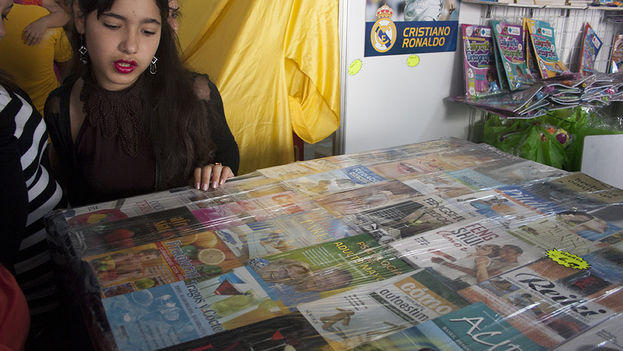
The Havana Book Fair. (14ymedio)

14ymedio bigger14ymedio, José Gabriel Barrenechea, Santa Clara, 7 July 2015 — The printed edition of the weekly Vangaurdia* dared mess with hornets. In her article “Let him who does not know you buy you?” the young journalist Laura Rodríguez Fuentes identified several inconvenient truths that will surely make waves in the tiny world of Cuban letters.

According to the journalist “many people ask if publishing houses are really thinking about the public for whom their publications are intended.” Her response, while only inferred, is of course no. Ms. Rodríguez continues: “An assessment of what is published is urgently needed, while opinion polls on topics, genres, and authors should be disclosed nationwide.”

After acknowledging that “except for children’s titles, the quality of many books is poor,” Ms. Rodríguez goes on to scrutinize Cuban publishing marketing strategies. With plenty of evidence to support her claims, she states that these policies are too focused on yearly book fairs. continue reading

Ms. Rodríguez continued by shoving a stick into a hornet’s nest and shaking it violently with the following paragraph: “Effective book publishing policies cannot be focused on writers who want to have their books published just because. They should focus on the consumer, the reader.”

State-sanctioned authors control Santa Clara’s publishers for their own ends. Despite the efforts of qualified editors such as Isaily Pérez and especially Idiel García of Ediciones Sed de Belleza (Thirst for Beauty Publishers), it is the clique of authorized writers that decides who can and cannot get published, while guaranteeing they will be published first. In order to ensure their place in the “publishing strategy,” these authors will write anything and on any subject.

The fact is that this clique is more concerned with making money than having its work disseminated. Such was the case in recent events in the town of Remedios. Several writers, who were not paid immediately for their work on a special publication commemorating the town’s 500th anniversary, behaved very uncivilly. According to off-the-record sources, even the police got involved as fists flew in middle of a brawl worthy of the worst Havana slum.

It seems none of the authors involved cared much about the significance that comes with being part of such a publication. Their only concern was cold hard cash and the fleeting moment.

Ms. Rodríguez concludes with the following observation: “There should be a direct link between opinion polls and the titles offered at book fairs. Book publishing should not be centered on favoritisms, but rather on consumers’ preferences and wishes.”

We could not agree with her more.

* Translator’s Note: The official newspaper of Villa Clara Province’s Communist Party’s Central Committee.

Translated by José Badué

Holguin Hospitals Throw Away Biological Wastes in the Cemetery / 14ymedio, Orlando Palma and Fernando Donate

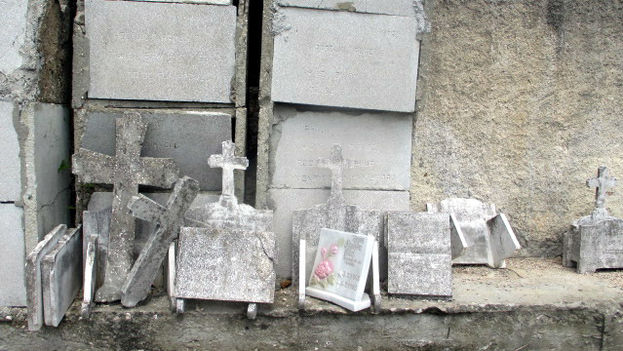
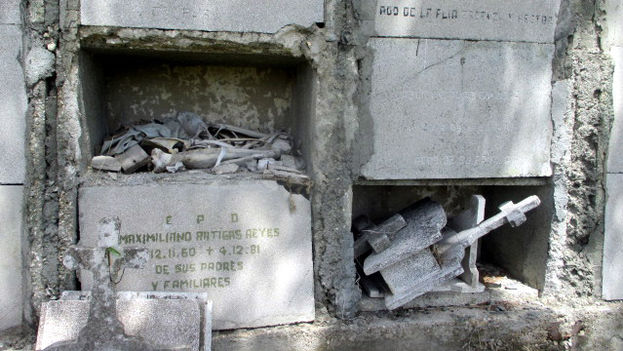
Broken tombstones in the Mayabe cemetery, Holguin. (14ymedio)

14ymedio bigger14ymedio, Orlando Palma and Fernando Donate, Holguin, 11 July 2015 – Broken tombstones, open graves, dilapidated tombs, and, here and there, scavengers that devour shallowly buried remains. This is no scene from a horror movie but images from a video that exposes the serious situation in the Mayabe Cemetery in Holguin.

Released by the Patriotic Union of Cuba (UNPACU) in 2014, the film was produced by journalists Nairovis Zaldivar, Yainiel Diamela Escofet and Rosaida Check, and has been distributed through the illegal “weekly packet” that circulates widely in the province without any official media picking up the story.

Almost a year later, the problem has not been solved; it was caused because the Vladimir Ilich Lenin University General Hospital, the Lucia Iniguez Landin Surgical Teaching Clinic and the Provincial Military Hospital bury their wastes in the place, since their crematoriums are not functioning. Criticism of the mismanagement of biological wastes has been heard at various levels but local authorities have not taken action in the matter.

In the investigative work the errors committed by the medical institutions depositing the remains from surgeries, abortions, amputations and tests, without proper precautions, are laid bare. For months, those who have visited the grave of a relative in the cemetery have been overwhelmed by carrion birds and other animals that helped themselves to the hospital wastes barely covered by a little dirt. continue reading

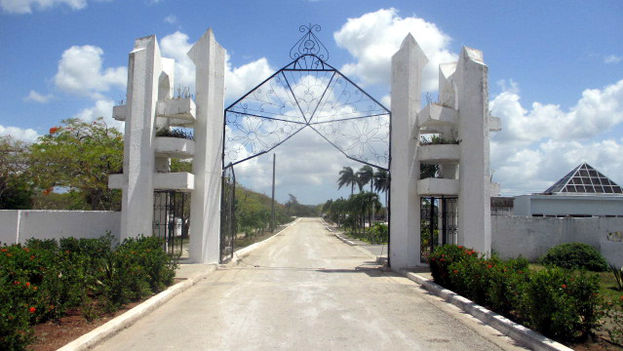
Gate to the Mayabe, Holguin, graveyard, one of the biggest on the island. (14ymedio)

Located six kilometers from the city, the Holguin cemetery has some 500,000 square meters and is one of the biggest in the country. Although there are no homes nearby, at midday the bad odor is unbearable, especially in the area at the back of the site where the three medical centers dump their wastes.

On the Cuban Medicine Blog, Doctor Eloy A. Gonzalez calls attention to the fact that “the management of hospital wastes, above all biological materials, is a problem of the highest priority for health systems and the organizations and institutions charged with management and disposal of the same.”

The doctor points out that “you cannot walk around in cemeteries throwing away biological wastes, barely buried where soon stray dogs and carrion birds notice the anatomical parts that come from a hospital. Are there no incinerators in hospitals in Cuba?” he asks. His text circulates through the email of various health professional with accounts on the Infomed service.

Specialists consulted by this daily agree that a first step to solving the problem would be to diminish as much as possible the biological wastes that the hospitals generate. Once reduced, their collection, transport and disposal must be rigorously controlled. Failure to fulfill the measures associated with the treatment of these wastes can present a serious health risk.

With the scandal uncovered by the UNPACU video, now the wastes are buried more deeply, although still without regard to the measures required for their handling. The regular edition of the February 15, 1999, Official Gazette governs the responsibility of “the heads of the entities that are in charge of installations and release areas whose operations generate dangerous biological wastes.”

Here and there are seen exposed remains in the neglected niches of Mayabe. (14ymedio)

Under Cuban law, wastes that may contain “biological agents, organisms and fragments of agents or organisms with genetic information, that represent a real or potential danger for human health and the environment in general” must be removed in a way that “guarantees the protection of the environment and in particular the population and workers.”

On questioning about the topic at the Vladimir Ilich Lenin University General Hospital, the employees shy away from responding about the conditions in which the wastes from the health center end up at the Holguin graveyard. Only one employee from the laboratory area, who preferred anonymity, submits: “We have problems with resources, for example with the correct bags and containers for placing the samples that we process.”

When they will repair the crematorium is a question that finds no answer in the management of the health center and much less in its administration. Nevertheless, the epidemiological risk from the wastes is not the only cause for worry for those Holguin residents who visit the cemetery. The use of an area laden with funereal connotations as a biological dumping ground bothers many, too.

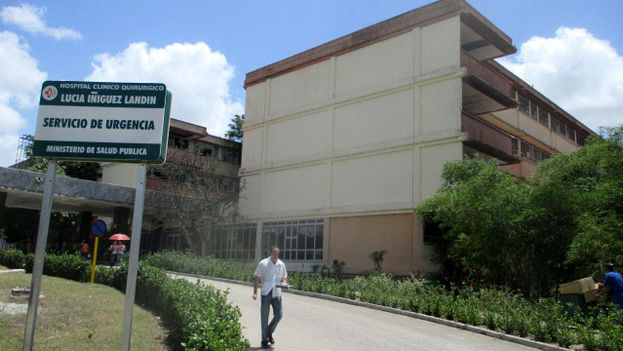
Lucia Iniguez Landin Surgical Hospital Clinic, one of those denounced for burying biological wastes in the Holguin cemetery. (14ymedio)

Lucia, 72 years of age, often visits the family mausoleum which is located a few meters from the place where the hospitals bury their wastes. “It is a lack of respect that they do this because this is a sacred place for the dead to rest in peace,” this lady complains, and although she has not seen the journalistic report, she asserts: “I realized that something was going on when I arrived and this was full of miserable buzzards.”

The main complaint, however, lies in the fact that such a sensitive matter that involves ethical and epidemiological issues has still not been dealt with by the province’s official media. “It seems that they are waiting for something grave to happen, for someone to get sick or to protest because of this disrespect, before they put it in the press,” says Lucia.

Translated by Mary Lou Keel

A New Case of Fraud Jolts Cuban Universities / 14ymedio, Mario Feliz Lleonart

Students of the Faculty of Medicine of Villa Clara. (Facebook)

14ymedio bigger14ymedio, Mario Feliz Lleonart, Villa Clara, 9 July 2015 — A new case of academic fraud jolted university campuses this Thursday. A group of first year students in Medical Sciences in the province of Villa Clara had prior access to the answers for the Morphophysiology III exam, given on Thursday, 2 July. According to several witnesses, the sale and circulation of the test was extensive and affected sites in other cities such as that in Sagua la Grande.

The immediate solution will be to retest all first year students on Monday, 13 July. So far it is not known if sanctions will be applied to those who committed the fraud, nor if the source of the link is known. The only details come from those who must retake the test, a measure some students consulted lamented as “paying for the sins of others.”

Scandals of this kind in Cuban academia have become common at all levels of education. Last June, this newspaper reported on the leak of several final exams in the No. 1 Medical School in Santiago de Cuba. On that occasion, 23 students were directly involved in leaking and distributing the content of the second year Anatomy and Statistics exams, fourth year English and the well known State Test. On that occasion the school’s director asked for a two-year suspension from higher education for the students involved in the incident.