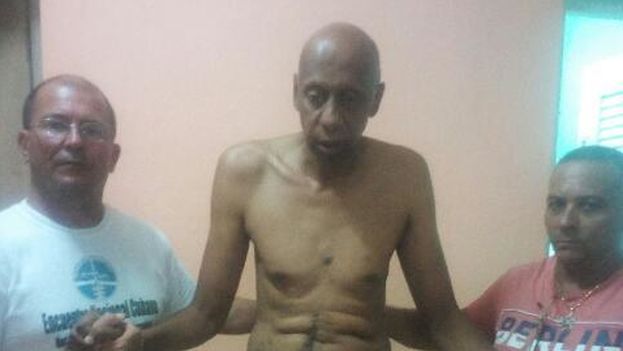
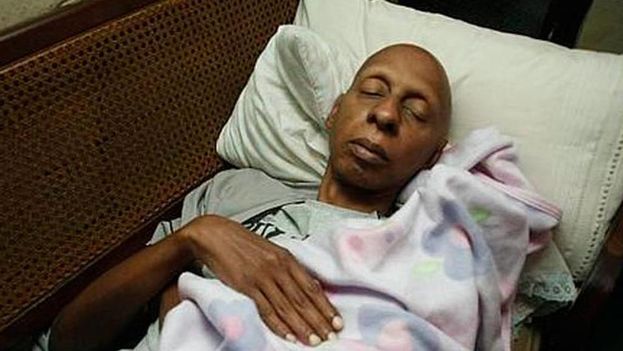
Guillermo Farinas on hunger and thirst strike. (Courtesy)
EFE (via 14ymedio) – The Cuban National Congress (ENC), which consists of 65 opposition organizations inside and outside the island, said today of the dissident Guillermo Fariñas, 54, who is on a hunger strike, that if the Cuban government “lets him die” it will have committed “premeditated murder.”
In a press conference in Miami to present the results of the ENC’s second meeting held in Puerto Rico last month, several members of the organization’s recently created Coordinating Board stressed that all their attention is focused on Fariñas, leader of the United Anti-Totalitarian Forum (FANTU), and they asked the international community to exert pressure to save his life. continue reading
Fariñas, a resident of Santa Clara in central Cuba, has been on a hunger and thirst strike for 49 days to demand that Raul Castro’s government end its repression of peaceful dissent and open a dialog with the opposition, according to reports from other opposition members.
“We need him alive for the future of Cuba,” Guillermo Toledo, ENC’s general coordinator for liaison representing Cuban exiles, said today.
Toledo, who lives in Puerto Rico, as well as Ramon Saul Sanchez and Julio Shiling, also members of the ENC Coordinating Board, stressed that Fariñas’ state is “serious” and could become “critical” at any time.
The Cuban government periodically gives Fariñas emergency rehydration treatment and returns him to his home a few hours later, opponents said.
“Fariñas needs intensive care in a hospital,” Toleda said, adding that the fact of having to move him every time he loses consciousness amounts to “premeditated murder.”
Given the situation, Alice Fariñas, daughter of the dissident, intends to launch an international “SOS” for her father on Friday.
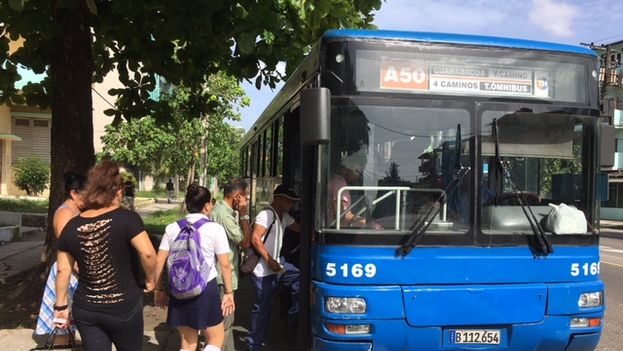
In many neighborhoods bus service changes coincided the beginning of the school year, which has caused a chaos among users. (14ymedio)
14ymedio, Havana, 7 September 2016 – The P15 bus now begins its route at the Santa Fe Bridge and new routes with the letter A have appeared in Havana’s bus system as of the end of August. The changes in the route names and destinations has been the result of a proposal from the Planning Department in the Provincial Transport Agency to ease service problems, but bus riders have not embraced the changes.
The reorganization of the bus routes in the capital began on Sunday, 28 August, in the zone east of the city, but at the beginning of this month it was extended throughout the city. In many neighborhoods the changes coincided with the beginning of the school year, which caused real chaos among riders, who don’t know if the route they’re waiting for still comes to the same stops or if it has been renamed.
The changes were made following the recommendations of a study undertaken by the authorities about the mobility of Havanans and the network of routes circulating, but the deficiency in information has hindered its event. An attempt was made to eliminate parallel routes, the longest routes and the least direct routes, but the result has been confusion and a sense of making the problem worse.
“Before I never knew what time I would get to work, but not I don’t even know if a bus is going to come by here,” a woman waiting for the bus near the Monaco Cinema in the 10 de Octubre district of Havana said on Tuesday morning.
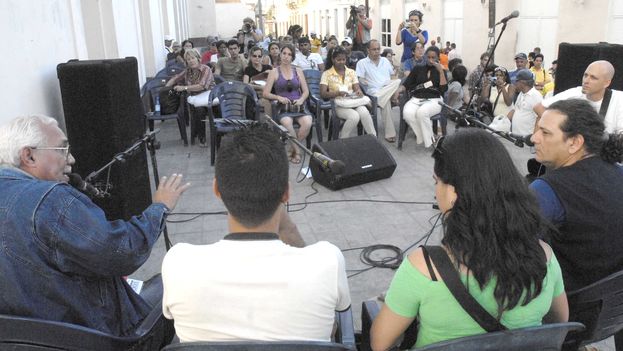
Debate on literature on a street in Santa Clara, with Aristides Vega Chapu, fourth from the left. (Verbiclara)
14ymedio, Jose Gabriel Barrenechea, Santa Clara, 5 September 2016 – A certain letter from Aristides Vega Chapu to the weekly Vanguardia, already quite old and that I believe I came into my hands in the middle of last July, set off a media frenzy last week. Knowing, as I do, that there is a lot going on beneath the apparent tranquility of Santa Clara’s intellectual media, my first reaction was surprise at the extraordinary resonance of this document in particular, as there had been previously with the similar reception of another in its time, from the young people of Vanguardia’s base committee of the Young Communists Union (UJC).
So I said to Aristides this Saturday, while trying to convince him to be interviewed by the newspaper, which he politely declined: “Gabriel, I already said what I had to say and where I had to say it,” was his response, and I understood, because he really did and has always been a powerhouse of the national culture. continue reading
This is not Aristides’ first letter, nor has he only denounced censorship in his letters. Not is it the first movement of intellectual concern from here. Not to mention that in the now distant nineteen-nineties, there emerged more than a few groups of challengers and even open opposition in the world of pilonga* letters.
The first movement I remember in those times of raulato was that led by a group of young authors back in 209: they demanded a less crazy tax framework, having suffered the anger of certain cultural officials, they managed to collect a number of important signatures in support of their petition. One of the most outstanding figures of this movement that soon transcended the limits of Villa Clara was the narrator Anisley Negrín, the best graduate of my course in the Onelio Literature Center, and winner of the 2008 David Prize**, someone who has apparently left our city, in the current move of the best of our writers to the United States.
Ultimately, the question is that some seem to have suddenly discovered this little corner “of the interior,” and avidly launch themselves on the first scandal they come across, with which they create the false impression that it is now Santa Clara that is moving. Thus they forget, in my mind, two complaint letters from Otilio Carvajal, one from Perez de Castro, another famous one from Aristides himself, denouncing the badly handled finances of certain cultural organizations here, and one from Pedro Llanes in which he complains about the discrimination against certain of his friends on the guest lists of the Provincial Book Fairs.
Nor do they take into account two posts demanding profound changes in the Cuban State that Ernesto Peña published on my blog, El Hidalgo Rural Cubano (The Rural Cuban Gentleman), and that as a result of the harassment he was then subjected to by the “compañeros” of State Security, he had a nervous breakdown. Or in the semblance of insignificant arm wrestling that, under the name of the baseball team from here, Lorenzo Lunar and Feliz Julio Alfonso have maintained for the last two years with none other than the province’s first secretary, in the egregious ears of whom a gray sportscaster and snitch with political police license plates never tires of dispensing accusations against those two as “restorationists” – that is supporters of capitalism.
That the literature in this city is in a keen state of restlessness is demonstrated by Otro Lunes (Another Monday) or Árbol Invertido (Inverted Tree), the two most serious Cuban cultural magazines edited from the opposition camp. What other city in the country, including Havana, has provided a similar number of collaborators? In what other city, besides the Havana of Voices, have the intellectuals dared to collaborate massively with a magazine with as few antecedents as Cuadernos de Pensamiento Plural (Notebooks of Plural Thinking)?
As for Vanguardia, the June issue is not the first clash in the last three years. In Ranchuelo Yandrey Lay Fabregat is now dedicated to narrative, and is perhaps one of the best cultural chroniclers of this region, to whom they have made it very difficult in Vanguardia, with the usual censorship in the country compounded by the abysmal mediocrity of those who lead or have led it in recent years.
In Santa Clara those who dedicate themselves to literature have worked in silence for a long time, without so much adherence to the tremendismos***. If you are not aware of this it is because you never had the opportunity to attend some of Aristides’ gatherings, especially the so-called “The Moment of Truth,” where more devastating truths than those of his letter of long ago have been heard.
Translator’s notes: *Pilongo/a is a term used to refer to someone from Santa Clara, Cuba. It is a reference to those baptized in the huge baptismal font – called a “pilón,” hence “pilongo” – opposite the Cathedral which was demolished in the 1920s. **The David Prize, awarded by the Artists and Writers Union (UNEAC), is one of the most important literary awards in Cuba (see Wikipedia). ***Tremendismo is a literary narrative technique developed in the Spanish novel in the 1940s which features violence, sordidness and direct, hard language (see Wikipedia).
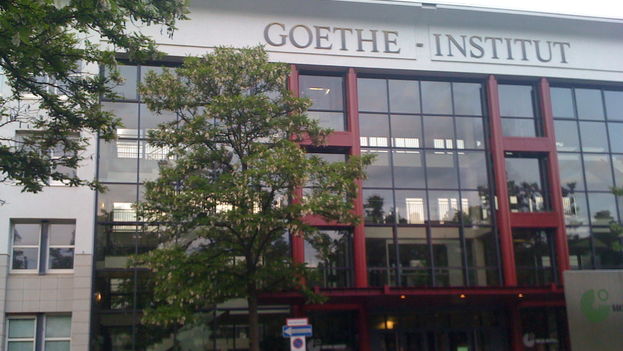
The Headquarters of the Goethe Institute in Munich. (Goethe Institute)
14ymedio, Yoani Sanchez, Havana, 6 September 2016 – The word made me smile. I read Kaffeeweißer – coffee whitener – on the tiny envelopes near the coffee machine in a Berlin hotel, that promised to “whiten” that dark beverage that was relieving my jetlag. I had forgotten how direct and powerful the German language can be. For years, along with the Cuban Germanophile community, I had awaited the inauguration of the Goethe Institute on the island, but last week a report in Deutsche Welle poured a bucket of cold water on our aspirations.
The longed for opening of the center that would let us observe German culture was only a matter of time. In July of last year, the German Foreign Minister, Frank-Walter Steinmeier, made the first official visit of a German chancellor to our country since the fall of the Berlin Wall. In May of this year it was followed by a visit of Cuba’s Foreign Minister, Bruno Rodriguez Parrilla, to the capital city of bears and sausages. continue reading
Like a diplomatic dance, we waiting impatiently for a step here, another there and the prodigal handshakes for the camera. Meanwhile, we counted the days until the country of Georg Wilhelm Friedrich Hegel, Herta Mueller and Gunter Grass would honor Havana with a center of the stature and quality of the Alianza Francesa.
I’ve never found a word that is better at expressing the breakage of something than the German word kaputt. To this, my language of dreams and nostalgia, I owe the force of the verbal sledgehammer that Spanish hides in sinuous constructions and compromises. This crack that means “broken,” and carries with it a sense of frustration, resonated in my mind this Saturday when I read the declarations of the president of the subcommittee on foreign policy for material culture, Bernd Fabius, about the possible causes of the sine die – the indefinite postponement – of the Goethe Institute among us.
“Cuba fears that with the Geothe Institute, which promotes the German language and culture in the world, Germany will encourage the counterrevolution,” said Fabius, noting that the refusal “shows how fragile the systems of such states perceive themselves to be.”
The Cuban government has preferred that the “German dose” come through its own educational institutions and under tight control. In the Faculty of Foreign Languages at the University of Havana there is a lectureship for teaching the German language, but the autonomy of a cultural center – managed directly from Berlin – is not in its plans for now.
A real shame in a country where it is calculated that around 30,000 Cubans studied or worked in the German Democratic Republic while many others have gone in recent years to live in this now united European nation and there is a curiosity mixed with empathy for the Teutonic culture, despite the distance and the marked differences in identity.
Bernd Fabius’s conclusion about the fears of Cuban officialdom are not too far from the real motive for freezing out the Goethe Institute’s project. Every place that is not under the strict rules of ideology, that offers literature not filtered by the island’s publishers, or promotes a view beyond the borders of political blindness and the sea that surrounds us, causes the Plaza of the Revolution to break out in hives.
Most instructive is that the German government has spent years “behaving itself” so that it might make a sign with the name of the author of Faust shine on a Havana street. More than five years of exploratory feelers, plugged ears, caution, and maintaining a great distance from any phenomenon that might upset the olive-green hierarchy. After all this time invested to avoid hurting feelings, the Bundestag has received a loud and clear nein, as can only be heard in the language of Nietzsche.
Guillermo Fariñas on hunger and thirst strike. (Courtesy)
14ymedio, Havana, 6 September 2016 — Cuban dissident Guillermo Farinas, after 47 days on a hunger and thirst strike, was transferred on Monday afternoon to Arnaldo Milian Castro Provincial Hospital. The dissident was discharged hours later because doctors felt that he did not meet the “entry criteria for intensive care,” he told 14ymedio activist Jorge Luis Artiles Montiel.
Sources close to Fariñas detailed that the intake occurred at 2:45 pm after he lost consciousness at his home in the neighborhood of La Chirusa. Hours earlier, the daily report on his health issued by members of the United Anti-Totalitarian Forum (FANTU), reported severe pain in the “joints, knees, ankles and shoulders.” continue reading
The note also explains that Fariñas was experiencing “dizziness, weakness and fatigue” and said his weight was 151 pounds, according to Dr. Yorkis Rodriguez Cardenas.
The winner of the European Parliament’s Andrei Sakharov Prize for Freedom of Thought is demanding that Raul Castro “publicly state that he will put an end to the beatings of nonviolent opponents,” and that he will schedule a meeting with a member of the Council of Ministers and “representatives of the Cuban opposition,” to explain what the government’s strategy will be “to end the beatings.”
A dozen Cuban dissidents have released a letter in which they call themselves Fariñas’ “brothers in the struggle” and say they share his demands. However, they also state that they need him alive to continue with them “on this path” until they “achieve freedom.”
“We respect you and we are aware of your sacrifice, but we would ask you to put an immediate end to your strike,” says a letter from dissidents Félix Bonne, Eduardo Díaz Fleitas, José Daniel Ferrer, Iván Hernández Carrillo, Ángel Moya, Félix Navarro, Arnaldo Ramos Lauzurique, Vladimiro Roca, Martha Beatriz Roque and Berta Soler.
Since the beginning, Fariñas has reiterated that, in the event that “Raul Castro will not yield to the demands” he will continue the hunger and thirst strike “until the end.”
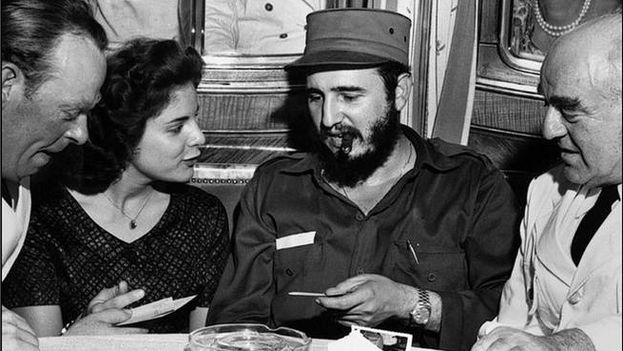
Photo of Marita Lorenz and Fidel Castro on the cover of the book “I Was the Spy Loved by the Comandante” published by Peninsula
14ymedio, Madrid, 5 September 2016 — Marita Lorenz’s first kiss (1939) came from Fidel Castro. Daughter of a ship’s captain, she met the leader of the Revolution at age 20, at a dock at the port of Havana. After she showed him around the ship, the leader asked her where her cabin was and, once they were there he pushed her inside and kissed her. But Lorenz didn’t feel intimidated, “I was enthralled. Fidel gave off an enormous seductive power!” she said, in an interview with the French weekly Paris-Match, subsequently translated by YoDona, a magazine belonging to the Spanish daily El Mundo. In the interview, Fidel Castro’s ex-lover offers every kind of detail about the relationship they maintained in 1959, before she joined the anti-Castro ranks.
Almost six decades later, Lorenz says that Fidel Castro was the great love of her life, despite her claim that he wasn’t a good lover. “He was more interested during the caresses than during the sexual act itself. But dictators are all like that,” she says from experience, having also had a relationship with the Venezuelan dictator Marcos Perez Jimenez. continue reading
“Fidel was a narcissist. He loved to look at himself in the mirror while he stroked his beard. He lacked self-confidence, or rather, he needed adulation and pampering, like a little boy,” she told YoDona, denying that she feels any resentment toward the leader of the Cuban Revolution.
Lorenz lived in Suite 2408 in the Havana Hilton (the hotel where Fidel, Raul and Ernesto Che Guevara were also living) between March and November of 1959, a time when Fidel Castro still had not broken off relations with the United States nor become linked with the USSR.
“Fidel was a narcissist. He loved to look in the mirror as he stroked his beard. He lacked self-confidence, or rather, needed to be flattered and pampered, like a little boy”
Castro’s lover was aware that the relationship would not end in marriage. “I’m married to Cuba,” he told her. However, she was soon pregnant, and although her son was supposedly taken away from her, she met him in 1981: “I saw him when I visited Fidel the last time, after 20 years of separation,” she said. “They told me I’d undergone an abortion, but the gynecologist in New York told me I had given birth. What they said about an abortion was false. My pregnancy was almost full-term and my son was born when I was in a coma in Cuba. He is a boy. He grew up there and is called Andres Vazquez.”
It was during her pregnancy when she came into contact with the CIA indirectly through Frank Sturgis, an American who presented himself as an ally of Fidel, although in reality he was allied with Batista and defending the interests of the mafia in Cuban casinos.
“He said he could help me and, in return, asked me many things. To get rid of him, I ended up giving him documents that Fidel threw in the trash and that, in my opinion, were of no interest. But that seemed to satisfy him,” she recalls.
In October 1959, after a poisoning attempt she gave birth to her son and after a few months hospitalized in the United States she returned to the island at the end of the same year, having already become a spy.
During her convalescence, she joined the anti-Castro side motivated by her conversations with the FBI, which supposedly asked her to assassinate Castro in 1961. “Oh, my little German,” Fidel greeted her, knowing she was going to kill him. “He handed me his gun and I took it. Then, looking into my eyes, he said to me… ‘No one can kill me’ He was right I dropped the gun and I felt liberated.”
Despite not meeting their expectations – “They explained that if he had been killed would not have had to launch the Bay of Pigs operation” – Lorenz remained linked for years to espionage: “I came to know in Miami, at a meeting of those anti-Castro, Lee Harvey Oswald, who was implicated in the Kennedy assassination. But he was not alone, I’m sure there was someone else. In my view there was a plot to kill the president,” she believes.
At 76 years, the former spy lives in Queens (New York) in a semi-basement and wants to return to Germany to reunite with her son Mark, from her relationship with the Venezuelan dictator Perez Jimenez. “He has a job there, because he is going to run a museum devoted to the secret services.”
A foreigner may have to pay five CUC to enter the Museum of Fine Arts, while a Cuban disburses 1/24th of that in local currency. (14ymedio)
14ymedio, Dominique Deloy, Havana, 5 September 2016 — Sometimes I have the impression I’m talking to myself inside an aquarium: I can’t open my mouth without fear of drowning, no one wants to listen to me, my questions are never answered. Some, of course, consider me indiscreet, daring, even a comemierda (literally “shiteater”) as they say here, although I don’t know what this word is really meant to convey, untranslatable in French but pleasing to my ears: stupid, timid, naïve?
It is a fact that asking too many questions is frowned upon here. They often reply to me, “I don’t know, I haven’t asked,” implying that one has to be very strange to ask about such things, almost suspicious. continue reading
And it is not just when it comes to politics. Politics? Who talks about politics here? The word itself is… suspicious! How many people have said to me, “I don’t like to get into politics, it is of absolutely no interest to me.” To even talk about this here is like something obscene, unseemly. Pity the French returnee, who adores politics and likes to remake the world over and over talking with her friends! Almost a national sport! Shut your mouth, poor little fish-returned-to-her-native-waters, comemierda!
Politics? Who talks about politics here? The word itself is… suspicious!
But that’s how it is. The French returnee wants to know everything. Not only why the monthly salary of her aunt Candita, architect and head of Housing Services, isn’t enough to buy a pair of shoes. Also why Cuba still has two currencies: one called “national” and the other… what to call it, then? “Foreign” perhaps? And how to know when to pull out which one (when both the bills and coins are very similar)? Why is it that sometimes you can pay with either, making the conversion, and sometimes you can’t: when there are two different prices for the different currencies, one for real Cubans and the other for tourists, or “fake Cubans,” like me?
Yesterday I had to pay five CUC (Cuban convertible pesos, the “foreign” currency) to enter the Museum of Fine Arts – even though its magnificent roof is on the point of collapsing on the works of Courbet and Degas, and you can see the sky through it – while my companion paid one-twenty-fourth as much in national currency (CUP); with no explanation, as if the teller was deaf, looking at me in silence when I asked him why. Why, yes indeed, why? A real brainteaser.
It is fortunate that they do not charge me for my bread ration in CUCs, but I always go to the bakery with apprehension and a little shame, as if I was thief trying to steal bread out of the mouths of real Cubans. I feel the same when I travel alone in one of those fascinating machines, my hair blowing in the wind, my nose filled with the smell of gasoline and reggaeton thundering in my ears. I pay like the rest: 10 pesos in national money, but I feel “clandestine, illegal,” to quote Manu Chao’s song.
Yes, the French returnee wants to know everything. She likes unambiguous explanations, rational, direct words, clear
But it is not only the money, although this is the main topic of conversation (along with finding out where you can get yogurt or chicken today). I also want to know why the border between legality and illegality is so thin here. For example, why, in front of everyone, in a bakery with a French name, do they give me an open, half-empty package of cookies, and especially why, when I ask for an explanation, do they sneer at me instead of apologizing? It is the same for bottles of water and packages of pasta, where the eye can discern the subtle and clever slits used to remove a third of the product from its container while the price remains the same.
Yes, the French returnee wants to know everything. She likes unambiguous explanations, rational, direct words, clear.
Furthermore, in her aquarium, the returnee is deaf: there is no internet here or very little. A few incredibly expensive minutes in a wifi zone, as long as it hasn’t crashed, in which case you can never know for how long or why. It’s clear you can’t use the internet to be informed. And don’t even talk about the press… which says whatever it wants whenever it feels like it. There’s nothing left but Radio Bemba – Big Lip Radio – word of mouth. So here you never know anything. The returnee is obliged, therefore, to ask without any answers, to open and close her mouth in her aquarium. With no results.
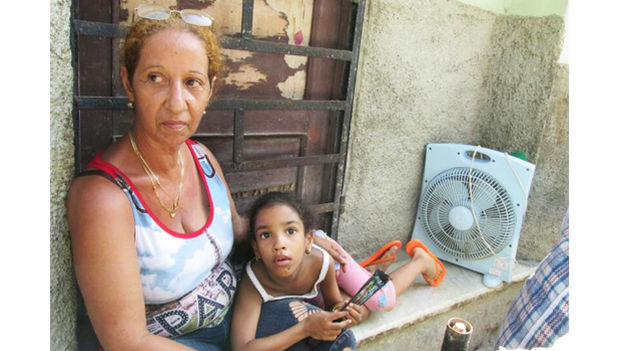
Denise Rodriguez Cedeño with one of her granddaughters, says she would rather sleep in the street for fear that the roof of her house will fall in. (14ymedio)
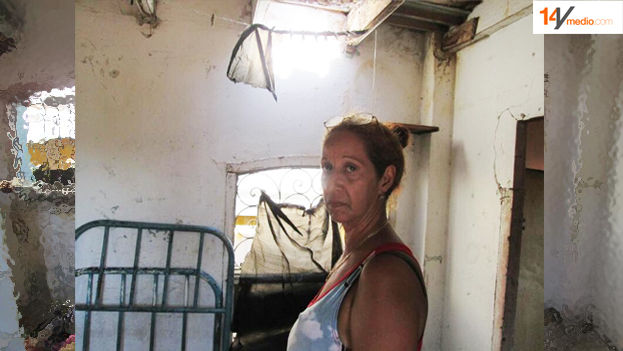
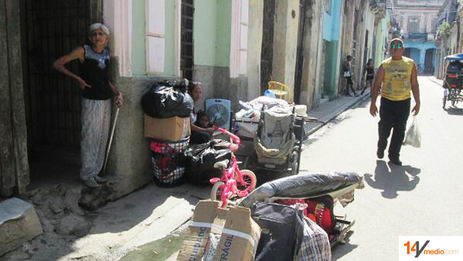
14ymedio, Yosmany Mayeta Larada, Havana, 4 September 2016 – After the heavy rains that have hit western Cuba in recent days, many residents of the capital fear an increase in the number of building collapses. Denise Rodriguez Cedeño, 54, a resident Luz Street, between Egido and Curacao, in Old Havana, placed her family’s belongings in the street after part of the roof of her house caved in on Saturday.
Those who pass through the busy street, in the heart of the historic center, can see the bundles with clothes piled up outside the building, along with kitchenware and a fan. The Rodriguez Cedeño family made the decision to spend their hours outdoors, in protest against the lack of response from the institutions charged with distributing materials for home repairs. continue reading
The already poor state of her home worsened with the storm that brought heavy rains, linked to the ninth tropical depression of the hurricane season, a weather phenomenon that caused intense rains in the west and center of the island and moderate flooding in the coastal town of Surgidero of Batabanó.
Rodriguez Cedeño works for Community Services and has lived in her home for more than 35 years. The resident told 14ymedio that her housing problems began in 2003, but she has not yet received a reply from anyone. Right now her situation is desperate.
“For 13 years I have been asking for repairs to my house, but but always tell me there are no building materials”
The anguish has led her to also pressure the authorities with the warning that she is not going to send her grandchildren to school this Monday, when the new school year begins nationwide, because she does not have the conditions to guarantee them a “home.”
“For thirteen years I have been asking through a technical report for repairs to my house, but they always tell me there are no building materials,” she says. On other occasions, Rodriguez Cedeño has chosen to “make repairs with my own resources,” but the deteriorating economic status of the family, made up of “four women and two little girls who have chronic asthma,” has prevented her from being able to make the arrangements to do it herself.
Denise Rodríguez Cedeño shows the deterioration of her home exacerbated by heavy rains in recent days.(14ymedio)
After several hours in which the women stayed with their belongings in the open street, the authorities of the Council of the Municipal Administration (CAM) of Old Havana arrived, to learn what damage occurred in the house and to call for calm. Dozens of people, especially foreigners passing through the city, were filming what was happening.
The directors of CAM explained that the family would be located in a Transit Community (a shelter) for about seven days and then taken to inhabitable housing in another community for people whose homes have been declared uninhabitable or have collapsed.
Rodriguez Cedeño had spent the whole night between the street and the half-ruined house, waiting for the authorities keep their word this Sunday. She warned that they would “plant themselves in the street again” if they didn’t provide a permanent solution to her case.
These residents of the Old Havana have become part of the 33,889 families across the country who need a home
In their current situation, these residents of the Old Havana neighborhood have become part of the 33,889 families (132,699 people) across the country who need a home, many of whom have spent decades living in shelters for victims. The population census of 2012 showed that 60% of the 3.9 million existing housing units on the island are in poor condition.
During the last session of the National Assembly of People’s Power, in July, the deputies met in the Standing Committee on Industry, Construction and Energy, and agreed that “the housing problem is the number one social need in Cuba.” The parliamentarians criticized “lack of coordination, integration and priority” at the municipal level in managing the demands of the population in terms of applications for materials and construction permits.
In the first half of this year, at least 90,652 people who have received subsidies for construction work have gone to the stores selling materials. However, only 52,000 have been able to buy all of the materials they were assigned, due to shortages of key products such as steel, cement blocks, bathroom fixtures, tiles and roofing.
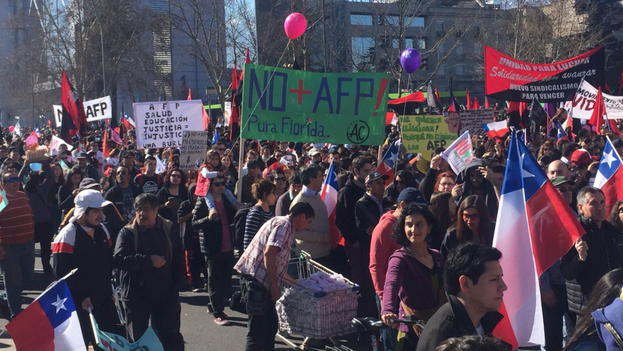
Protests in Chile against the AFP have been underway for several days throughout the country (Twitter/@mariseka)
14ymedio, Carlos Alberto Montaner, Santiago de Chile, 28 August 2016 – I have arrived in the country in the middle of a cacophony, fortunately peaceful and civilized. It is Sunday, and tens of thousands of people are protesting against the AFPs.
They complain about the “Pension Fund Administrators,” a retirement system founded on individual capital accounts, more or less like the 401(k) and the American IRA. One contributes a part of his salary to an account that belongs to him, and thus, after a certain age, he can dispose of his resources or leave them to his heirs when he dies. The money is his. It does not come from the benevolence of other workers. continue reading
The AFPs are private financial companies that invest the money that the workers entrust to them in reasonably safe instruments, so that the risks are minimal. They charge about 1.5% to manage these resources. There are a few so that competition exists in price and services.
Since the economist Jose Pinera created the AFPs at the beginning of the 1980’s, the average annual return has been 8.4%. The government merely establishes strict rules and carefully monitors the financial entities. So far, in 35 years, there has been no collapse or scandal.
Today the mass of savings generated by the AFPs is approximately 167 billion dollars. That is very convenient for the stability of the country. A third of these funds comes from workers’ direct deposits. Two-thirds, the rest, are interest generated by these deposits. Without doubt, it has been a great business for the prospective retirees.
Until the creation of the AFPs, the distributed funds model prevailed in Chile, as in almost the whole world. The worker’s investment went to a general fund that was used to pay the pensions of retirees or finance the fixed expenses of the growing public workforce. In many countries, often, the money of elderly retired people ends up in the pockets of devious politicians and officials or is dedicated to other purposes.
As happens in Europe and the United States, the relationship between the number of workers and retirees is more problematic with each passing year. Fewer people are born, especially in developed or developing countries, and they live many more years.
Hence the retirement systems based on the distribution model are in crisis or heading towards it. They tank just as “Ponzi Schemes” always end badly; named for Charles Ponzi, a creative scammer who paid good dividends to investors … as long as there were new investors to meet the commitments.
When the capitalization system began, there were seven workers in Chile for every retiree. Today there are fewer than five. By mid-21st Century there will be two. The individual capitalization system, rather than a maniacal predilection of liberals dictated by ideological convictions, is the only possible model of retirement in the medium term. It is much safer for a worker to have control of his savings than to leave that sensitive task to intergenerational solidarity or the decisions of politicians.
What has happened in Chile? Why are they complaining? Half of Chilean workers, especially women, do not regularly save, or they have not done so in a long time, and since they have not saved enough, the pensions they receive, consequently, are small, and they are not enough for them to survive. That is why they protest and want the state to assume responsibility for their old age and give them a “dignified” pension, without stopping to think that the supposed right that they are angrily soliciting consists of an obligation for others: those who work must give them part of their wealth.
At the same time, students passionately demand free university studies, while many Chileans demand the “decent” living promised by politicians in the electoral fracas, to which are added modern and effective medical services, also “free,” proper to a middle class country like Chile currently is. It is not well understood why, by the same reasoning, they do not seek free food, water, clothes, electricity, and telephones, all items of absolute necessity.
It is a shame. A few years ago it appeared that Chile, after a 20th Century of populism from the right and left, with a population dominated by an incompetent and greedy government that had bogged down in underdevelopment and poverty, finally had discovered the correct road of individual responsibility, the market, the opening up and the empowerment of civil society as a great entrepreneurial player and the only wealth creator.
There was enthusiastic talk of the “Chilean model” as the Latin American road to reaching the First World. With 23,500 dollars per capita GDP (measured in purchasing power), Chile has put itself at the head of Latin America and boasts a low crime rate, honest administration and respect for institutions. It would not take long to reach that development threshold that economists set at about 28 to 30 thousand dollars per capita GDP.
It may never happen. A recent survey shows the growing irresponsibility of many Chileans convinced that society is obliged to transfer to them the resources that they demand from the state, which means from other Chileans.
It is a pity. A substantial part of the population has returned to populist ways typified by claiming rights and evading responsibilities. If Chile again sinks into the populist quagmire, we Latin Americans all will lose a lot. Prosperity and, who knows, even liberty. We will be left without a model, aimless, and in some sense, without a destination.
On the streets of Yangon there are no motorcycles. (E. Avila)
14ymedio, Eliecer Avila, Yangon, Myanmar, 2 September 2016 — During his visit to Cuba, US President Barack Obama mentioned the changes in Burma (now Myanmar) as an example of the most recent democratic transition from a fierce military dictatorship that lasted over half a century.
Since then, the idea of an exchange between the opposition and Cuban civil society and their counterparts in Myanmar was developed. Today this political and cultural contact is a reality full of very valuable lessons that can only be appreciated by seeing how changes take place and are managed in real time, the interactions between contending forces and their interests, the pros and cons, the alliances and the ruptures, the shared joys and disappointments of a frustrating process, which many say, is just beginning. continue reading
From the air, the tremendous difference in infrastructure and development in Myanmar and, for example, its neighbor Thailand, is remarkable. It is like when you leave Miami and then fly over Cuba. It is clear that this country was left out of the democratic, educational and technological changes that catapulted the so-called Asian Tigers.
At a time when those countries focused on global integration with millions of young people ready to conquer the art of creating products and services on a grand scale, Myanmar’s military dictatorship chose total ostracism, shutting off the country like a strongbox to avoid any “foreign influence.” It always tried to keep the county semi-enslaved in the service of an army that, like an octopus, controlled the social, economic and spiritual life of this nation, located exactly on the other side of the world.
Going through immigration is somewhat tense because the military is not yet entirely accustomed to looking at tourists as ordinary people.
At the airport, going through immigration is somewhat tense because the military is not yet entirely accustomed to looking at tourists as ordinary people. To alleviate this problem they have thoroughly replaced all possible customs and immigration clerks, placing in these positions young people who are a lot more open and unprejudiced, and who even smile.
Myanmar currently receives just over a million tourists a year, an insignificant figure not only compared to its neighbors, but in proportion to its nearly 60 million inhabitants. This figure, however, is growing due to democratic changes, which in turn attract many investors.
Currency exchange offices accept the US dollar, the euro and the Singapore dollar, but in order to pay for anything in any one of these currencies, you have to be sure the bill is not the least bit wrinkled, because they won’t accept it. And don’t panic if you see people spitting out a red substance on the street. It is not blood, but rather a pigment that comes from a mix of herbs and is constantly chewed, as in Bolivia.
On the streets of Yangon there are no motorbikes. Here superstitions are very important even when making policy decisions. In a nearby country it happened that there was a wave of crime in which the criminals used motorbikes to move around and perpetuate attacks, so the military junta completely banned them in the capital “just in case.”
Myanmar currently receives just over a million tourists a year, an insignificant figure not only compared to its neighbors, but in proportion to its nearly 60 million inhabitants
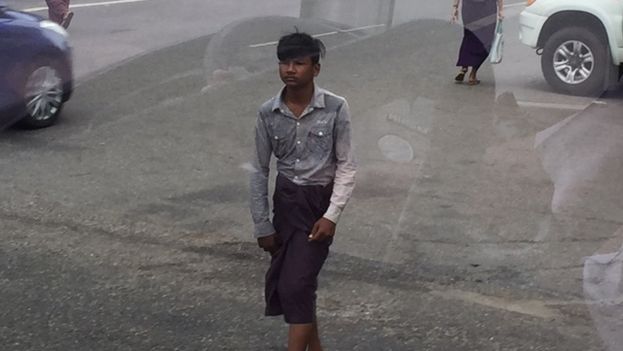
In Myanmar men wear a kind of wide skirt that is adjusted through a knot just below the navel, without underwear. Women are often seen adjusting the typical costume that covers them from the ankles to the neck, an elegant garment emphasizing the sensuous curves of a perfect waist, as described by George Orwell in his novel Burmese Days.
They are as thin “as sticks” with shapely legs and smooth hair that falls in perfect shapes… no thanks to the gym or expensive treatments, but from a traditional diet based on vegetables, plus genetics and a life marked from childhood by hard work.
Incredibly decent and helpful, one and all, the citizens of Myanmar grab your heart with their extraordinary mixture of simplicity and nobility, probably a reflection of the basic teachings of Buddhism, among which one stands out in particular: “We must live to give love, not only to our friends, but also to our enemies.”
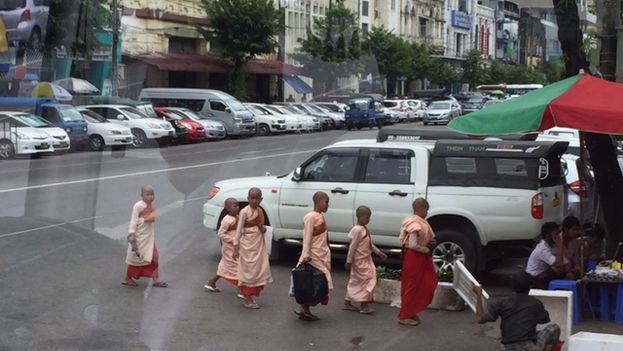
Although the country is an infinite melting pot of ethnicities and religions, Buddhism predominates as a belief, significantly influencing the moral base and value system that rules society. The presence of the monks and their temples (pagodas) is everywhere. You cannot touch the monks and much less can they touch a woman. They, however, can touch you at will.
The monks are greatly venerated and were the protagonists in several of the largest protests against the abuses of the military power and in support of changing the terrible economic situation of the country. The majority of these demonstrations were held in the late eighties and were called the Saffron Revolution, after the color of the monks’ clothing. Many of them were sent to prison and served long sentences as political prisoners.
In general, those who were young students in 1988 are called “Generation 88,” in memory of the heroic attitude that many of these boys, some of them mere children, assumed in defense of their country and their rights, paying a high cost in innocent lives at the hands of the armed forces.
That sacrifice laid the foundation for the process that is happening today in the country, overthrowing for the first time the one-party military rule in that year. There then emerged 235 political parties, which were more or less consolidated into 91 ahead of the 1990 elections, the first competitive elections since 1948.
Although the country is an infinite melting pot of ethnicities and religions, Buddhism as a belief prevails. (E. Avila)
The National League for Democracy (LND), which already had more than three million members (of which, one million are women), swept the elections getting a historic triumph that gave them the capacity to govern, but the defeated military didn’t go along, they broke the rules, ignored the election results and imprisoned the leaders of the winning party, among them its leader Aung San Suu Kyi.
With this coup, the military frustrated the aspirations of the whole nation for freedom and progress, but that would be temporary.
In 2011, after the release of Aung San and thousands of political prisoners, new elections were called, but several of the most influential parties chose not to participate, citing the obvious lack of confidence in the military and demanding a change in the Constitution to offer real guarantees to civil parties.
The constitution is the legal instrument that guarantees the supremacy of the military class, still today. The constitution establishes that 25% of the seats in parliament are reserved for the military, regardless of the results of the election. The trap closes completely with the provision, in addition, that the constitution can only be changed with more than 75% of the votes, so it is mathematically impossible to modify anything, no matter how small, without the consent of the military.
Not satisfied with this, the constitution gives the military permanent control of the country’s most important ministries: Borders, Armed Forces and the most strategic, Interior. This latter entity, in addition to the usual functions of controlling order, in Myanmar also controls all public administration, a great part of the economy, and also education. The decisions of the military in these institutions are virtually autonomous and unquestionable.
For these reasons, although the country is very happy with the second victory of the NLD in 2015 and the rise to power of Aung San, many believe that as long as the military holds on to all that power they will not have a true democracy.
It is mathematically impossible to modify anything, no matter how small, without the consent of the military.
Aung San and her party assumed from the beginning a conciliatory attitude, trying to reach agreements with the military leadership that will directly benefit citizens, and working so that the country can begin to emerge from its deep poverty, making it easier and offering guarantees for both foreign investment and internal trade.
These negotiations have been possible in part because the current top leader of the military and Aung San have a certain personal empathy and have maintained a constructive dialogue. This aspect was strongly criticized by other political parties and many civil society organizations, who demand clarifications and that the military take responsibility for its crimes, as well as the release of political prisoners who remain in jail.
Many of these prisoners were sanctioned for “resistance” against attempts of certain members of military or their associates to take away all or part of their land.
Beyond these issues, thorny and inconclusive, there are hundreds of examples of positive transformations that quickly began to empower people, especially young people. In 2012, a SIM card for a cellphone cost about $1,000. Today you can buy one for just $1.50 and it provides completely free access to the internet, creating overnight more than 10 million internet users ravenously exploring the web, creating new ways to organize and discuss issues that previously didn’t exist. In Myanmar, as in Cuba, meeting with others without permission from the military junta was prohibited.
Another important change was to eliminate the tax demanded by the military of 100% on the purchase value from anyone who acquired a vehicle. This was reduced to between 3% and 5%, which has facilitated the importation of millions of light trucks and buses for public transport. This measure represents an accelerator for the growing economy that is trying to flourish, but which in turn poses great challenges of infrastructure, because at certain times the city collapses in traffic jams of a size never expected or imagined.
Impressive and positive is also the great work being done in the country through hundreds of supportive organizations and NGOs
Impressive and positive is also the great work being done in the country through hundreds of supportive organizations and NGOs which, along with the new authorities, are contributing their experience on issues of all kinds: entrepreneurship, agriculture, digital commerce, the broad-based development of women, political participation, mediation in ethnic conflicts, issues of sexual orientation and gender identity, water purification and conservation, etc., through training in systems provided not only in the capital but in the most remote villages of the 14 states that make up the vast territory of the country.
All this cooperation has also contributed to statistical studies, surveys and research to bring to light for the first time in history the true picture of the country in very sensitive areas such as human trafficking, the sex trade of children, drugs, discrimination, recruitment of children by ethnic guerrillas, etc., so that from this information the state can implement programs and make decisions to improve the situation.
The media, now much more free, foster discussions of all these issues and put pressure on the authorities from their platforms, both physical and digital. The young people working on a Yangon newspaper talk about the official media after the change, saying “nobody recognizes them,” because “they changed their stale and censored discourse for another kind of more dynamic journalism, objective and real; they are now becoming real competitors for us.”
This shows that journalism’s heart was always beating, but it was subjugated by a regime that annulled it and appeared more before the people.
The young Burmese man who acted as my translator said, “For me, the most important thing is that people are no longer afraid, they laugh now, before they were serious, now they dream of work and prosperity; before, most young people regretted being born here… For myself, I’m not going anywhere now!”
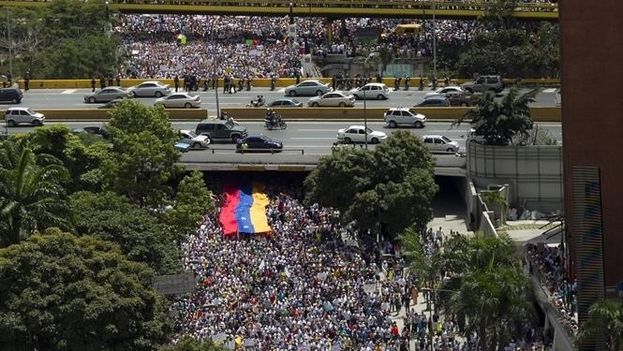
14ymedio, Carlos Alberto Montaner, 3 September 2016 — It may have been the largest march in Venezuela’s history. Did it serve for anything? We’ll get to that. I begin my analysis with a view of the government.
Maduro and the Cuban DGI agents, who actually rule the country, faced a dilemma: in the face of a giant demonstration, should they remove the fragile democratic mask they still wear sporadically, declare martial law, suspend constitutional guarantees and dissolve the National Assembly on the pretext they were impeding a coup planned by Washington’s perfidy, or should they obstruct the demonstrators, arrest the leaders and cause the demonstration to abort by disrupting the march at various spots in its course?
They opted for the second. They believed that they could do it. That’s what the authorities do in Cuba. They arrest, disperse, infiltrate, harass the opponents, pit them one against another with a thousand intrigues and prevent them from seizing the streets. The streets belong to Fidel. That’s the task of the vast and secret body of Cuba’s counterintelligence (55,000 to 60,000 people), the regular police (80,000), plus the rough-and-tumble mob of the Communist Party, while the three regular armies remain on standby in case they need to join combat. Total: 350,000 rabid dogs, not counting the Communist Party, to bring to bay 11 million terrified lambs. continue reading
They were wrong. The social control is not the same. In Cuba, the opposition was liquidated by gunfire in the first five years of the dictatorship. There was resistance, but the authorities killed some 7,000 people and jailed more than 100,000. Two decades later, in the late 1970s, when the cage had been hermetically shut, they began to release them. The Castros have held Cuban society in their fist for half a century now. The Soviet KGB and the East German Stasi taught them how to lock the padlock. Today, Raúl has perfected his repressive strategy. It was the one the Chavists futilely tried to use in Venezuela.
The Venezuelan opposition holds on precariously in a virtual zone of the state apparatus. They are mayors, governors or deputies. They hold posts but neither power nor a budget. Chavism has deprived them of resources and authority, although, because Chavism emerged from a democratic setup, it has not been easy for it to build a cage. According to surveys, the Chavists are opposing 80 percent of the population, including a good portion of the D and E sectors — that is, the poorest.
They are an undisguised gang of inept caretakers engaged in larceny. To hide and disguise reality, they bought, confiscated or neutralized the media, except for a couple of heroic newspapers, but the country’s situation is so catastrophic that there’s no human way they can hide the disaster.
Nevertheless, the opposition lacks the muscle needed to force Maduro’s overthrow and the system’s replacement. In general, the oppositionists are peaceful people, trained for 40 years in the sweet exercise of electoral democracy. What could they do? They could march. Bang on pots and pans. Stage peaceful protests. It was the only way to express their opposition in the desperate situation in which they found themselves.
They could fill the public squares in the manner of Gandhi and Martin Luther King, but against an adversary much more unscrupulous than the Anglo-Saxons. They have done so, dozens of times. It was a civilized way to confront totalitarian harassment. The people who kill, the scoundrels, the organized criminals are on the side of Chavism. The armed forces have been taken over by the Cubans and the top leaders are knee-deep in drug trafficking. Letting the army brass dirty their hands was a clever and vile way to tie them. Today they are not united by patriotism but by crime and the fear of the United States’ Drug Enforcement Administration.
In the end, do marches and peaceful protests serve a purpose? Of course they do. The Poles and the Ukrainians demolished their dictatorships marching and shouting slogans. It’s a matter of persistence. He who tires, loses. But there is a very important physiological factor. Participating in a common cause that expresses itself physically — marches, slogans — provokes an exceptional secretion of oxytocin, the hormone of affective linkage produced by the pituitary gland.
That’s the feeling of unity, of bonding, experienced during military marches, sports competitions or the innocent crowd gatherings to listen to popular musicians. That’s the substance that generates “esprit de corps” and permanent loyalties.
The opposition feels fraternally united in these street demonstrations. There’s a burst of trust in the coreligionist and hope in the resurrection of the homeland. That’s all that Venezuelans desperately need to find themselves again in a close and brotherly embrace, because their country in fact is dying. It’s being killed by Chavism.
14ymedio, Yoani Sanchez/Reinaldo Escobar, Havana, 3 September 2016 — If you are considering sending a text message to a friend to wish him a “happy coexistence” with his family or to suggest that he not give in to “the dictatorship of work,” it is very likely that the phrase will never reach its destination. A filter implemented by the Telecommunications Company of Cuba S.A. (ETECSA) blocks certain words from flowing through the cellular network. (See below for the list.)
For years, users of the only cellphone company in the country have suffered from congestion on the lines and areas of poor coverage, but few have noticed that there is also a strict blockade on the use of key terms and phrases in mobile messaging.
The discovery of this list has happened almost by chance. Several users, upset that their messages were charged for but not delivered, exchanged experiences. This week they connected the dots and found that texts containing the following references never reached their destinations: “human rights,” “hunger strike,” “José Daniel Ferrer,” or the name of the independent magazine “Coexistence.” continue reading
Texts with references to “human rights,” “hunger strike,” “José Daniel Ferrer,” or the name of the independent magazine “Coexistence” never arrive
Over several days and at different points in the national geography, this newspaper has run tests from terminals with very different owners, ranging from opponents and activists to people without any links to independent movements. In all cases, messages containing certain expressions “were lost on the way.”
Cubacel is ETECSA’s cellular network and the contract that each user signs to get a mobile line makes clear that the among causes for which the service will be terminated are uses “prejudicial to morality, public order, state security or that serve as support in carrying out criminal activities.”
The customer is never warned that their messages will be subjected to a content filter or that a part of their correspondence will be blocked if it alludes to opponents, concepts that are uncomfortable for officialdom such as “human rights” or to blogs critical of the government in the style of “Generation Y.”
Arnulfo Marrero, deputy chief of the ETECSA branch at 19 and B in Vedado, Havana, was surprised on Friday morning by a complaint presented to his office about the censorship. “We have nothing to do with this, you should contact the Ministry of Communications (MICOM),” the official explained to the bearer of the complaint.
“MICOM governs communications policy, because we don’t make any decisions here. All I can do is report it,” said Marrero.
Censorship, however, is not yet activated on messages that are sent to foreign countries, perhaps because of their high cost: 1 Cuban convertible peso (about $1 US) per 160 characters. Blocking them would provoke more complaints from disgruntled customers and would have set off alarm bells much earlier. However, in text messages received from abroad the same censorship applied to domestic text messaging is also applied.
In the Cuban case it is not morality that guides the scissors of censorship. Cubans can narrate an entire orgy in 160 characters, but cannot send the word “democracy”
In late 2001, Pakistan implemented a similar filter on cellphone text messages. The telecommunications authorities of that Asian country created a list of more than 1,600 prohibited terms in English and Urdu, which included obscene and insulting words, as well as words such as “condom” and “homosexual.”
In the Cuban case it is not morality that guides the scissors of censorship, because all the words in the popular argot alluding to sexuality can be sent freely. Cubans can narrate an entire orgy in 160 characters, but cannot send the word “democracia” to their recipients, not even when they try the trick of changing the “i” to a “1” and try to sneak in “democrac1a.”
The difference with Pakistan lies not only in the reason for blocking certain phrases or words, but also in the secrecy with which this censorship has operated for months, perhaps years, in Cuba. Few have noticed the relationship between certain expressions and communication problems, because they attribute it to the chronic problems of congestion and Cubacel’s bad service.
With more than three million cell phone users, the Cuban authorities have bet on few people associating errors in receiving messages with a desire to prevent the transmission of concepts and words.
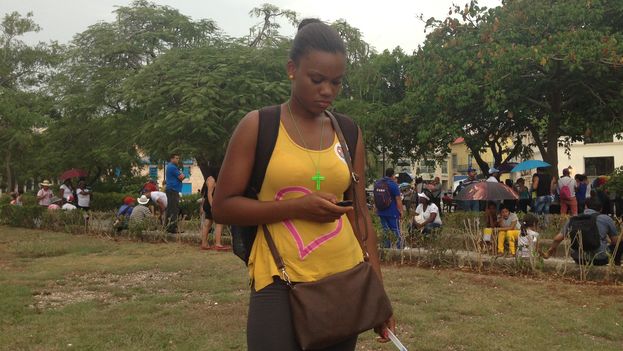
The meticulous choice of what terms to block has not been random. Despite the high prices for mobile phone service, where one domestic call can cost as much as half a day’s wages, the presence of cellphones in the hands of Cubans has changed ways of interacting and people find parallel paths to avoid the excessive controls the government impose on all areas of activity.
“I didn’t know this was happening, although now that I read the list of censored words I’m sure I’ve used one of them at least once,” says Leo, 21, who was waiting outside the Cubacell office on Obispo Street in Havana this Thursday.
“I watch the news with breakfast,” said an astonished young man next to him, who said he had not noticed blocked terms, “although ETECSA works so badly that nothing should surprise us any more.” During special days, Christmas or Mother’s Day, communicating becomes a real ordeal.
At the University of Computer Sciences, as part of Operation Truth, a group monitored the internet and created matrices of opinions favorable to the Government
During his students years at the University of Information Sciences (UCI), the engineer Eliecer Avila worked on the so-called Operation Truth. His group monitored the internet and created matrices of opinion favorable to the government in forums, blogs and digital diaries. At present, Avila leads the independent Somos+ (We Are More) Movement, which is also on the long list of terms blocked by Cubacel messaging.
“We implemented algorithm projects that, given certain phrases or words entered by a user into their browser, they would appear preferentially in official pages,” Avila recalled for this newspaper. “We tried to invisibilize alternative proposals or criticisms.”
The presence of an intelligent filter is obvious in this case. If you type in the text “cacerolazo” – a word meaning the banging and pots and pans as a form of protest – your message will take much longer to arrive than some other text. A similar slowdown occurs if you write the names of Fidel Castro or Raúl Castro, and it is true in the latter case with or without the accented letter U.
How many dissident meetings have been frustrated because the invitation message never reached the invitees’ inboxes? How many misunderstandings between couples, domestic squabbles, and uncompleted professional tasks result from the filtering of messages that include last names such as Biscet and terms such as plebiscite?
Telecommunications censorship is not a new tool for the Plaza of the Revolution. Activist frequently denounce the blocking of their cellphones on December 10th, Human Rights Day, or other times when they want to gather together.
During the visit of Pope Benedict XVI to the island in September of 2012, more than 100 opponents reported the suspension of their cellphone service, along with house arrests and arbitrary detentions.
A blockade of uncomfortable digital sites has also been a common practice for officialdom. On the list of inaccessible sites are portals set up from abroad such as Cubaencuentro, as well as local newspapers like 14ymedio. More than a few users manage to circumvent the censorship by sending news via email or sending offline copies of pages that pass from hand to hand thanks to technological devices like USB flash drives and external hard drives.
China has transferred to Cuba its experience with the so-called Golden Shield Project, known as the Great Firewall, which employs more than 30,000 censors
In March of this year, Amnesty International noted that “only 25% of the Cuban population uses the internet and only 5% of households have a connection.” This situation has strengthened the use of mobile phones, especially texting, as a way of using “the internet without internet.”
Only since 2008 were Cubans legally allowed to have a cellphone contract and Cubacel currently has over three million users. Last year 800,000 new lines were established throughout the island, despite the high cost of a national call, the equivalent of half the salary of a working day.
In July 2014, the governments of Cuba and China signed an agreement on “cooperation in cyberspace.” China has transferred to the island its experience in monitoring and blocking content on the web, especially what they have learned from their launch in 1998 of the so-called Golden Shield Project, known worldwide as the Great Firewall, which employs more than 30,000 censors.
Raul Castro’s government has not only copied China’s content filtering strategy, but also the creation of its own social networks to discourage Cubans from using Facebook, Twitter or Google Plus. To achieve this an ersatz Wikipedia, called Ecured, was created, along with a platform-style Facebook dubbed La Tendera (The Shopkeeper) and an unpopular substitute for Twitter known as El Pitazo (The Whistle), all with little success.
We now know that the Cuban Government wants to go beyond such crude imitations and aspires to follow in the footsteps of its Great Chinese Brother, which has a long history of censoring text messaging through a “keyword list.” A user can have their entire messaging function disabled if their content does not pass the filter of the censors. In the city of Shanghai alone, the Hong Kong newspaper Apple Daily reports, messaging has been blocked for some 70,000 users.
List of Words and Phrases Known to be Blocked by Cubacel
14 y medio
14ymedio
Antunez
Antúnez
Berta Soler
Biscet
Carlos Amel
Coco Farinas
Coco Fariñas
Convivencia
Cuba Posible
Cubanet
Damas de Blanco
Democracia
Democrac1a
DDHH
Derechos humanos
Dictadura
Disidente
Elecciones libres
Generacion Y
Generación Y
Guillermo Farinas
Guillermo Fariñas
Hablemos Press
Huelga de hambre
Jose Daniel Ferrer
José Daniel Ferrer
Oscar Elias Biscet
Óscar Elías Biscet
Plebiscito
Policía Política
Policia Politica
Primavera Negra
Represión
Represion
Seguridad del Estado
Somos+
Todos Marchamos
Unpacu
Yoani Sanchez
Yoani Sánchez
Meet Cuba can be used without internet connection.
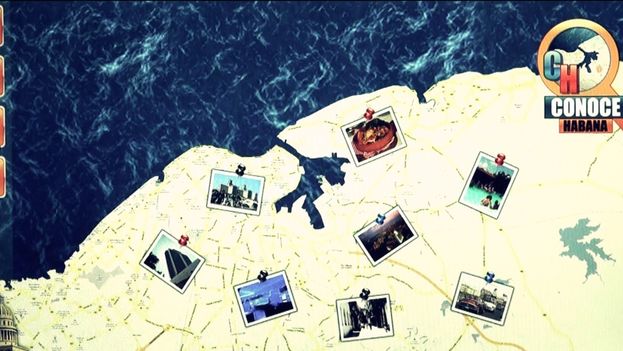
14ymedio, Zunilda Mata, Havana, 31 August 2016 – The daughter of necessity and ingenuity, the application Conoce Cuba (Meet Cuba) has been gaining ground on Android phones throughout the island. With an intuitive design, well made and functional, it stands out among other tools that also seek to provide information about private services and places to eat or be entertained.
Conoce Cuba is distributed free in the weekly packet. Its developers, the young engineers Eliecer Cabrera and Pablo Casas Rodríguez Yordi, come from Camagüey and two years ago wrote the tool’s first lines of program code. Today, it is the work of their lives of which they feel most proud. continue reading
The two young men have designed versions with similar characteristics for other provinces, but the capital city is where they have the most complete inventory of restaurants, scenic places, clubs, cafes and homes for rent. “In the future we want to offer new services,” says Cabrera Casas, but they prefer to move forward in careful steps and consolidate what has been achieved.
The tool can be used without an internet connection, a trait shared by many of the apps created on the island. Some of them were demonstrated and exchanged during the first meeting of the Cuban Android Community, which was held last Saturday at the studio of the artist Alexis Leyva (Kcho), under the slogan “For a technological culture available to all.”
The creation of these two camagüeyanos is “useful for visitors to the island,” they explain and they say they have focused “on the private sector from the beginning.” The app only provides “information on places that offer different services, but doesn’t include prices or ratings, so users have the freedom to choose,” says one of the creators.
The long-held dream of the student was taking shape in Cabrera Casas’ mind and when he graduated he made the decision. “If it doesn’t exist, we’re going to do it,” and he turned his hand to the work with an obsession that knows no bounds.
Totally free, the developers are careful not to include any license or restriction that would impede the massive use of Conoce Cuba.
To distribute it, they based their strategy on visiting cellphone repairers and developed an advantageous collaboration with their owners. At first, they walked around the city knocking on doors of the self-employed to offer their product.
The proprietor of the Ultracell workshop in Havana was one of the many who learned of the existence of Conoce Cuba on the street. After offering the tool as a part of the installation package he loads on the phones that come his way, he believes it has increased his numbers of clients and their satisfaction.
Currently the two engineers have also developed a way for business owners to contact them via email so they can request changes and updates in the tab associated with their business.
They acknowledge, however, they have had to overcome many obstacles to pursue their dream. Technological limitations hinder any work of this kind, but above all they are held back by the restricted internet access afflicting the country.
Cuba is one of the nations with the lowest rate of connectivity in the world, with only 5% of the population on-line, a percentage that is reduced to 1% in the case of broadband.
During the first months of work, the young engineers relied on the internet rooms operated by the Telecommunications Company of Cuba (ETECSA), or on friends who copied for them “some tools” they didn’t have, said Cabrera Casas.
Today, competitors abound, such as the app Isladentro (Island Within) one of the most popular in Cuba. This tool also offers a guide for travelers, is available for free, and in addition it not only shows private services, but also state services and is organized by province.
“That people can find a great deal of information no further away than their pocket” was the objective guiding the two engineers who created Conoce Cuba, and so far they seem to have succeeded.
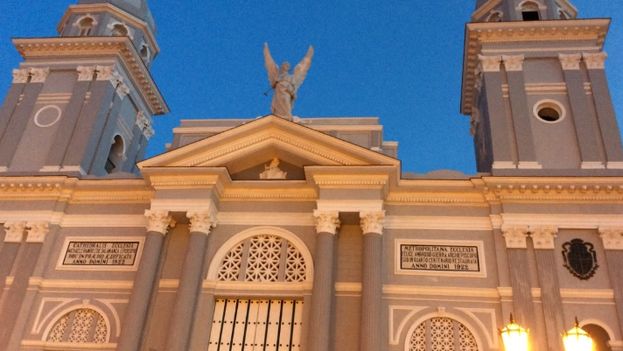
The newly restored Cathedral of Santiago de Cuba. (D. Deloy)
14ymedio, Dominique Deloy, Santiago de Cuba, 2 September 2016 — It had been years since I’d seen my husband’s family. So we traveled to Santiago de Cuba, where many of them live. Upon arrival, after 17 hours by bus with a broken suspension, a pleasant surprise awaited me: the city seemed more flirtatious than ten years ago.
“Thanks to [hurricane] Sandy,” say the santiagueros with the black humor that characterizes them, the city has been beautified: a new public transit station, some gaily painted houses, the cathedral restored and its angel re-clothed in golden garments. They also told me that Sandy has cleaned the beaches, in fact we were able to enjoy one of them, a wonder of trash-free white sand, as we had never seen before. continue reading
We also saw, although this has nothing to do with the terrible hurricane of 2012 – works of art decorating the streets, paintings, sculptures, lamps of pretty colors and, above all, a maritime promenade that doesn’t make you want to cry like before, where now you can really walk, and even connect to the internet! In addition, you can take a boat ride on the magnificent bay, for a low price in Cuban pesos.
Unfortunately, when it came time to visit the family, a bitter disappointment awaited me with the other side of the postcard: everyone seemed to live in the same conditions as before, and the young people thought of nothing but escaping to another country at any cost, so as not to have to live like their elders.
My aunt Candita, 59, an architect and Head of Service at the Housing Institute, continues to earn the same salary as before: it doesn’t exceed 18 CUC (roughly $18 US) a month. My niece Glaydis got a big promotion: now she is the manager of a very famous candy store in the city, where she works seven days a week for 13 CUC a month. And she’s lucky because she can bring home cakes! Although she must pay for them of course. My cousin Juan, who also completed his higher education, is the head of a large furniture company. He is 53 and has worked there for forever: he is the most fortunate of all these professionals, earning 20 CUC a month.
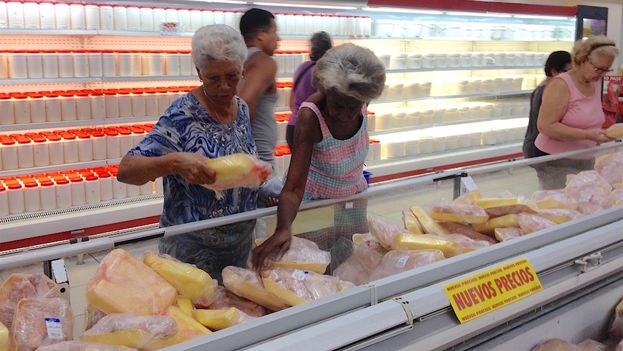
I was pensive and on my return to Havana I went to the supermarket near my house to note down some prices, because sometimes my friends in France don’t believe me. How can a person live on a salary ten times lower than those in some countries in Africa? Perhaps the prices of basic products are significantly lower? No way! They are as high or higher than in France. You don’t have to be a great mathematician to realize that Glaydis, over the space of a month, cannot purchase any more than a pound of cheese, two quarts of juice and bottle of detergent.
Sometimes I feel that everyone is being punished here. But what did they do?
Decades of shortages and economic hardships have led us to a plane of survival where food is the center, obsession and goal of millions of people who inhabit this island. (14ymedio)
14ymedio, Yoani Sanchez, Havana, 2 September 2016 – At the dining room table the grandparents are playing with their two granddaughters. They ask them what they would ask the genie for if they happened to stumble on a magic lamp in the corner. “I want a plate full of chicken and French fries,” the littlest one said immediately, while the older said she wanted it to rain candy. Their second wish included ice cream by the ton and the third wish concentrated on endless cheeseburgers.
National television broadcasts a report about a popular camping site that has been renovated and reopened to the public this summer. One customer smiles at the camera and says, “The food is good.” The administrator of the recreation spot enumerates the dining options and promises that culinary offerings “suited to all pocketbooks and well prepared” await whose who book one of the cabins scattered in the countryside. continue reading
Education Minister Ena Elsa Velázquez, calls for moral and material respect for teachers to avoid the exodus that profession is suffering as teachers quit for other—more lucrative—jobs in other areas. The official recommended holding agricultural fairs next to school buildings, with sales of pork and produce, so the educators can buy food after work.
An opponent of the Castros visiting a market in Miami recorded a video in which he says the only way his compatriots would be willing to “overthrow the dictatorship” would be if they were promised that the shelves would then be full of the same variety of beers on offer in Miami. The well-known dissident lists the prices, the quantity of food available in pounds and the high quality of the products that star in his video.
A nouveau riche couple books two nights all-inclusive at a Varadero hotel. They manage to polish off a lunch with two pork steaks each, a serving of fried beef, several helpings of rice and beans, along with a pile of succulent shrimp and lobster. Returning home they fail to describe a single example of the scenery they admired during their trip.
When was it that we Cubans came to be ruled by our stomachs? At what moment were we conquered by a mouth that swallows and a brain that thinks only of food? Can our dreams and desires be reduced to filling our bellies, whetting our appetites and cleaning our plates?
Unfortunately, yes. Decades of shortages and economic hardships have brought us to a plane of survival where food is the center, obsession and goal of millions of people who inhabit this island. That obfuscation often does not allow us to see beyond, because “with an empty belly, who will think about politics,” as any materialistic philosopher would say.
The problem is that “hungry once, always hungry.” When a tongue of flame rises into the esophagus, when a few grains of rice are at the center of wet dreams and some crumbs of bread are the be-all and end-all, it is immoral to talk about something beyond whetting the appetite.
We have been condemned, as a people, to mastication, gastric juices and digestion. In the process we have lost what makes us human and become creatures of the feedlot, more focused on the dinner bell than on our rights of free association or expression.
We are like Pavlov’s dog, whoever brings us a plate of food will make us react and salivate. How sad!
 EFE (via 14ymedio) – The Cuban National Congress (ENC), which consists of 65 opposition organizations inside and outside the island, said today of the dissident Guillermo Fariñas, 54, who is on a hunger strike, that if the Cuban government “lets him die” it will have committed “premeditated murder.”