Cuban Faces of 2016: José Ramírez Pantoja, Journalist (b. Holguín) / 14ymedio

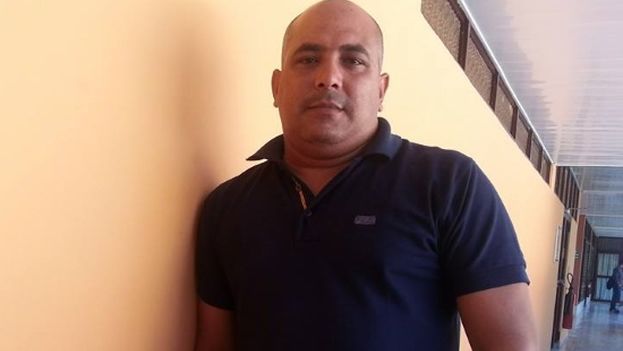
Jose Ramirez Pantoja, Holguin Radio journalist and author of the blog Verdadecuba. (Facebook)

14ymedio bigger14ymedio, Havana, 27 December 2016 – Cuban faces of 2016: The journalist José Ramírez Pantoja starred this year in one of the most publicized cases of censorship within the official press. The reporter was fired from his job at Radio Holguin after being accused of printing on his personal blog the words of Karina Marron, vice president of the official newspaper Granma, who expressed concern at a union meeting about a possible social explosion like the 1994 Maleconazo.

Since the ruling, Aixa Hevia, vice president of the Union of Journalists of Cuba (UPEC) accused Pantoja of positioning himself to be able to move to the Miami media. Despite the appeal made by the journalist, the Municipal Court of Holguin ratified his dismissal. The National Ethics Commission of UPEC also ruled against him.

Ramírez Pantoja says that the injustice committed against him has led him to consider the need for a journalism that is more serious and committed to people’s needs.

Museum Dedicated To The Yacht ‘Granma’ of Fidel Castro’s Expedition Reopens / EFE, 14ymedio

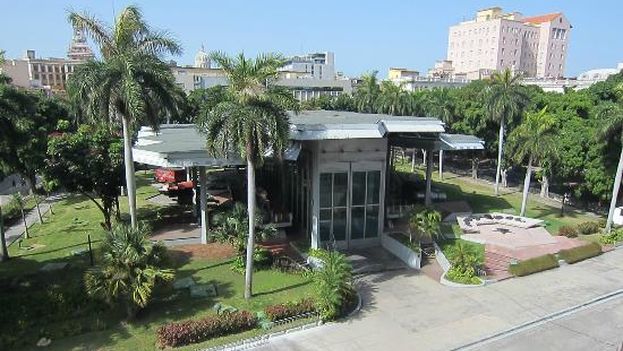
The Granma Memorial originally opened its doors on December 1, 1976. (Tripadvisor)

14ymedio biggerEFE (via 14ymedio), Havana, 30 December 2016 — The Granma Memorial, an open-air exhibition that shows the namesake* yacht along with other vehicles and weapons, reopened Thursday in Havana after undergoing a comprehensive restoration to commemorate the 60th anniversary of the expedition led by Fidel Castro.

The site, located on the grounds of the former Presidential Palace which is now the Museum of the Revolution in Old Havana, was completely renovated with an “attractive museography” that changed the way the pieces are exposed, according to a statement from the state-run Cuban News Agency. continue reading

The repairs included a new lighting system that “offers greater splendor, a better image and perception of the historic yacht,” the replacement of hydraulic networks and air conditioning, work on the garden and the paving of the interior street.

The Granma Memorial was inaugurated on 1 December 1976, with a collection which highlights the yacht in which Fidel Castro, his brother and current president Raul Castro, Ernesto Che Guevara and others traveled from Mexico to Cuba.

The boat is displayed in a heated glass facility “for better preservation.”

The Granma left from Mexico with more than 80 men who landed in eastern Cuba on 2 December 1956, to become the germ of what later would be the Rebel Army with Fidel at the head, and which would triumphantly enter Havana a little more than two years later.

The ship is considered a symbol of the Revolution and its replica will be in the parade on 2 January 2017, in the mass march that will celebrate the anniversary.

This commemorative parade of the triumph of the Revolution is usually held every December 2nd, but this year was postponed a month due to the mourning period for the death of Fidel Castro on 25 November at age 90.

Also carrying the name Granma is the country’s most important newspaper, the organ of the ruling Communist Party of Cuba (the only party permitted in the country), and a province on the east of the island.

The site, which receives more than 500 visitors daily, also shows pieces related to historical events of the 20th century on the island, including two aircraft, one of them captured by the Rebel Army during the fighting in the eastern Sierra Maestra.

The second, a Seafury model, was one of the few aircraft of the revolutionary fleet that faced the Bay of Pigs invasion in 1961.

Also on display are vehicles used in the last war by Camilo Cienfuegos, Ernesto Che Guevara, Fidel Castro, Raul Castro and Juan Almeida, some with bullet holes.

Also featured is the red truck that carried a group of young people who stormed the Presidential Palace and attempted to assassinate then President Fulgencio Batista, on 13 March 1957 and the turbine of an American U-2, shot down by the Cubans while it was spying on the island during the Missile Crisis in October 1962.

Nearby is the Monument to the Eternal Heroes of the New Homeland, with an “eternal flame” that was lit by Fidel on 19 April 1989.

*Translator’s note: The yacht, owned by an American in Mexico, was named ‘Granma’ when the revolutionaries bought it and they did not rename it; instead they ended up naming things in Cuba after that American’s affectionate moniker for his grandmother.

Sounds Of War To Drown Out The Economic Crisis In Cuba / 14ymedio, Mario Penton

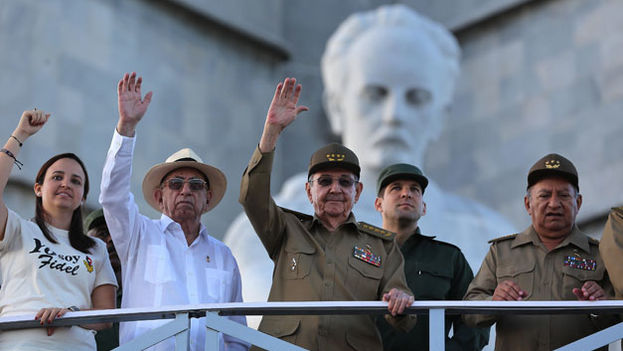
Raúl Castro with senior level government staff greets the crowd from the stand in the Plaza of the Revolution. (EFE)

14ymedio bigger14ymedio, Mario Penton, 2 January 2017 – With a military march and a “parade of the fighting people” the new year dawns in Cuba. This time there were no tanks in the Plaza of the Revolution, but thousands of Cubans were taken there from their workplaces in order to demonstrate unity with the Communist Party and the figure of Raul Castro in the absence of his brother Fidel, who died on 25 November of last year.

The event was dedicated to the young, “those who are carrying on the work of the Revolution,” to the deceased leader and to the disembarkation from the yacht Granma, which in 1956 brought a handful of revolutionaries from Mexico to Cuba who overthrew the government of Fulgencia Batista. All this in a year that is called ‘complicated’ after a fall of 0.9% in the GDP, which reflects the failures of the Raulist reforms and resurrects the old ghosts of the Special Period. continue reading

“It is ironic that they dedicate this demonstration to young people, because they are the first ones who are escaping to wherever they can because that don’t see hope or any possibility of progress in Cuba,” says Manuel Perez, a young Cuban psychologist who emigrated to Argentina looking for better work opportunities.

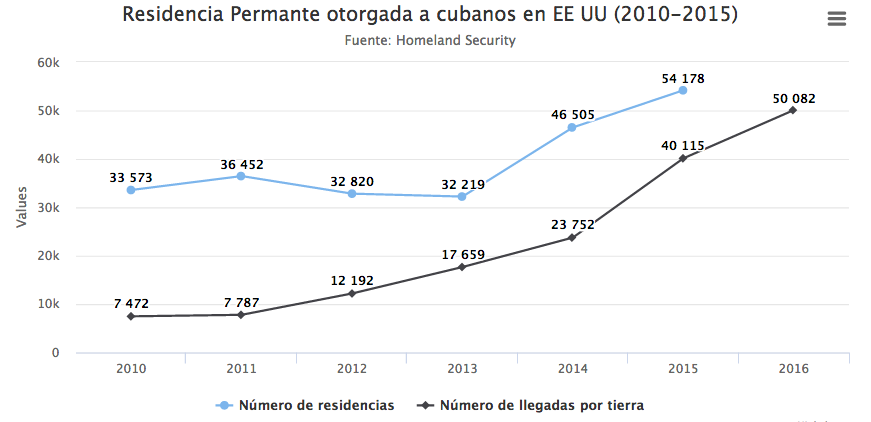
Residence awarded to Cubans in the U.S. (2010-2015). Upper line: Number of residents. Lower line: Number of arrivals by land.


Carlos Amel Oliva, youth leader of the Patriotic Union of Cuba (Unpacu), shares this view.

For Oliva, the Cuban government is in the midst of “a campaign whose strategy is well thought out” to revive nationalism among young people, following the ideological vacuum left by the reestablishment of relations with the United States.

“Young people are indifferent to these old demonstrations. The only thing that interests many young Cubans is to escape to any country to find what they cannot find in theirs,” he says.

In the last three years more than 100,000 Cubans have arrived in the United States by various means to avail themselves of the Cuban Adjustment Act and obtain residence in that country. A large proportion of these migrants are young or of working age, which increases the problem of the aging of the population on the island. In 2025 Cuba will be the oldest country on the continent in demographic terms.

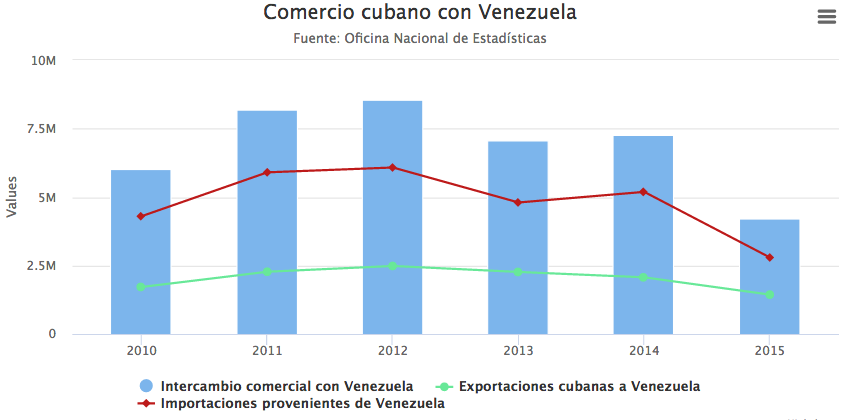
Negative migration balances, coupled with a low level of fertility, the already obsolete just-opened technology park, and the scarcity of foreign investments, which amounted to scarcely 6.5% of what was planned, constitute serious problems facing the country. Added to that is the crisis in Venezuela, the Cuban government’s main ally, which has substantially reduced trade with the country, according to official data.

Cuban trade with Venezuela. Blue: Commercial trade with Venezuela. Green: Cuban exports to Venezuela. Red: Imports from Venezuela.

“When the enemy disappeared, there was no one to fight against. That is something that should be given much attention and hopefully the US administration will maintain an intelligent discourse and offer no reason to revive the old Cold War discourse,” says Oliva, 29, who opposes the regime. This Unpacu leader believes that the warlike message was also addressed to the US government.

For Arnoldo A. Muller, president of the Social Democratic Co-ordination of Cuba, a Cuban opposition organization attached to Cuban Consensus, an umbrella organization that brings together several organizations in exile, the January 2nd march “is a demonstration of strength.”

“They want to maintain the continuity of the system and do not want change. It is a message about who has military control over the country, the regime makes it known to the people that Castroism continues,” he says.

The military parade was barely able to count on some troops trying to recall the significant moments of Cuban independence battles and the struggles against the government of Fulgencio Batista. Transportation in the city was focused on bringing thousands of people from their workplaces, and there were reports of traffic jams due to the terrible state of Havana’s main arteries.

From the province of Pinar del Rio, Dagoberto Valdés, director of the Center for Coexistence Studies, adds that military parades “are a throwback to the culture of war” and “the legacy of a history that has been written about warlike events and not about the development of civil society.”

For Valdes, it is a manifestation “of that tradition that has believed that the triumph of the Cuban nation is to make it strong as a Republic in Arms and not as a Republic of Souls.”

Valdés believes that, on the contrary, it is necessary to “change the logic of war for that of peace, the inheritance of war for the ethical inheritance, the building of the republic over virtue and love.”

Now It Is Colombia’s Turn To Help Us Win Democracy / 14ymedio, Sergio Segura

Meeting in Havana between the teams negotiating the peace in Colombia. (@ComputerPazGob) (TranslatingCuba Ed. note: … the all-male teams….)

14ymedio bigger14ymedio, Sergio Segura, 2 January 2017 – Cuba is no longer subordinate to the dictates of the man who imposed his will for more than half a century. The time has come to talk to the people, to recognize and give public voice to those who manifest different opinions.

The departure of an autocrat by natural death has very positive precedents in history. Changes occur peacefully, through dialogue and consensus. The most beautiful of these transformations occurred in Spain after the death of Franco. The case of Pinochet in Chile could also light the path of those who remain at the head of the Cuban Government at this time. The end of Ceausescu and his family, for refusing to hand over power to a people tired of his dictatorship, was pitiful.

It is not violence that Cubans on the island want, as they aspire to maintain several social achievements created by the Revolution in a new Republic, where the dream of José Martí – whom we Cubans of all stripes call our Apostle – is realized: With all and for the good of all.

It would do no harm to advise the opposition groups – which are many – to send a request to Colombian President Juan Manuel Santos asking that, in reciprocity for the attitude of the Cuban Government as a mediator for his country to achieve a final peace, he brings to a table of dialog in Colombia, in a respectful and impartial manner, negotiators from the Cuban regime and the country’s internal dissidence to reach a constructive agreement for the election of who will be, on 24 February 2018, the next president of our Republic.

Lots of Troops and Little Weaponry / 14ymedio, Marcelo Hernandez

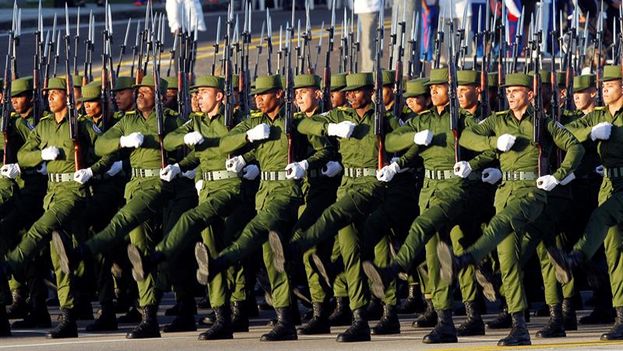
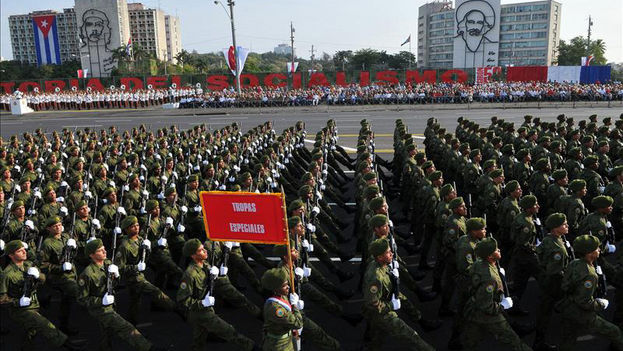
Thousands of soldiers marched in lockstep on this 60th anniversary of the creation of the Revolutionary Armed Forces. (EFE / Ernesto Mastrascusa)

14ymedio bigger14ymedio, Marcelo Hernandez, Havana, 2 January 2017 — The military parade this Monday for the 60th anniversary of the creation of Cuba’s Revolutionary Armed Forces concluded without the traditional display of antiaircraft rockets, armored tanks and heavy artillery. The martial parade, presided over by Raúl Castro, prioritized the display of troops over any display of military hardware.

Still sleepy after the holiday season, many Havanans were awakened by the noise of the salvos launched from the Plaza of the Revolution. With that signal, at barely seven in the morning, the first military parade after the death of former President Fidel Castro began, in a city paralyzed by the closing of streets and the gigantic mobilization.

The display of military force comes at a difficult time for the country’s economy. The recently concluded session of the National Assembly has confirmed that GDP fell 0.9% in 2016, and forecasts for 2017 are also not favorable, a context that has increased people’s criticism of the waste represented by this Monday’s military parade. continue reading

Thousands of uniformed soldiers marched in lockstep steps, along with elementary school students with their neckerchiefs and workers from different sectors under the motto “I am Fidel.”

“They threw the house out the window,” complained Raymundo, a pensioner who collects empty cans near the National Hotel to sell them as a raw material and feels that “the way things are right now, better to save even the last centavo.”

A little more than a mile away, thousands of uniformed soldiers marched in lockstep, along with elementary school students with their neckerchiefs and workers from different sectors under the motto “I am Fidel.”

The result was a peculiar combination of troops and civilians, a mixture of military parade and people’s march that lasted for less time than in previous years, barely an hour and 40 minutes.

Raul Castro remained on the dais for the entire exercise, surrounded by senior government officials, but left the main speech to Jennifer Bello Martinez, president of the University Student Federation (FEU). The young woman, who has risen rapidly in officialdom, was named as a member of the Council of State in December 2015.

“No one can make us forget our history, nor the symbols of this people’s resistance,” bellowed Bello from the rostrum. She alluded to the words spoken by Barack Obama during his speech at the Gran Teatro in Havana last March when the US president said he knew the story of the long dispute between the Cuban and US Governments but refused to remain “trapped” in it.

Those who hoped that this Castro parade feature a proud display of military paraphernalia had to content themselves with some modernized AK47s and rifles with telescopic sight for the Special Troops. Apart from that, the Cuban Army barely showed its armament.

Long gone are the times when the country could allow itself, thanks to the free supply from the Soviet Union, to be the most well supplied armed forces among Latin American countries. The great military campaigns in Africa were also in the past, and the economic situation of the island barely allows them to maintain their obsolete means of combat.

Nevertheless, Cuba continues to spend a huge amount of resources sustaining its military apparatus. At the end of 2016, the Island ranked 79th in the list of military powers, according to the Global Firepower site, a privileged position in the Latin American context, where it is only surpassed by countries with much greater population and resources, such as Brazil, Mexico and Argentina.

At the end of 2016, the Island ranked 79th in the list of military powers according to the Global Firepower site, a privileged position in the Latin American context

In the absence of renewed armaments, officialdom has sharpened the level of ideological discourse in the last half year. A turn of the screw that has become more pronounced after the election of Donald Trump as president of the United States and the recent death of Fidel Castro.

The younger generations are the main target of this offensive.

The daughter of Damaris, 38, is a fifth grader in Las Timba neighborhood and was chosen to be part of the pioneers who surrounded the replica of the yacht Granma. “She had to go to the three trial runs at the end of December and today is the fourth time that she is in the Plaza for this activity,” says the woman.

The participation of the girl in the parade caused some clashes in the family. The mother did not want her to do it, but she does not want an absence to “single her out so early.” She acknowledges, however, that her grandfather is very proud she was chosen for the demonstration.

As they finished passing in front of the podium, the children hurried along and continued to a school on Ayestarán Street. There they shared a snack with soda, bread with a hot dog, and some goodies that revived them after a long sleepless night. “Now we’re going to bed because we’re dead,” confesses Damaris.

Cuban Faces of 2016: Elaine Díaz, Director of ‘Neighborhood Journalism’ / 14ymedio

Elaine Díaz, director of Neighborhood Journalism. (Citizen Journalism)

14ymedio bigger14ymedio, Havana, 27 December 2016 — Cuban Faces of 2016: Elaine Díaz graduated with a degree in Journalism from the Faculty of Communication of the University of Havana in 2008, she has worked as an assistant professor and maintains the blog La Polémica Digital (The Digital Debate). In an episode of the series Cuba’s Reasons, broadcast by officialdom to demonize critical voices, the reporter was presented by way of a counterpart to independent bloggers, who were defined in the program as “cyberterrorists.”

Díaz was the first Cuban woman to win a Nieman Fellowship in investigative journalism at Harvard University, and last year launched the site Periodismo de Barrio (Neighborhood Journalism), a publications centered on communities affected by natural disasters and others occasioned by the hand of man. Her site has been harshly criticized by officialdom, which has questioned how it is financed and the use of fundraising campaigns through Paypal.

In October this year Diaz was arrested with her team in Baracoa while reporting from areas affected by Hurricane Matthew. All were questioned, their belongings meticulously searched and they were deported to the capital. The authorities alluded to an alleged state of emergency in the east of the island.

In an editorial published later, Periodismo de Barrio denounced that, “There are no good and bad monopolies Any monopolization, made by the State, a person or a corporation, just curtails freedoms,” a reference to government control over all press media permitted in the country.

Cuban Faces of 2016: Ariel Ruiz Urquiola, Scientist (b. 1974) / 14ymedio

The biologist Ariel Ruiz Urquiola. (Cubanet)

14ymedio bigger14ymedio, Havana, 26 December 2016 – Cuban Faces of 2016: Ariel Urquiola, a biologist and doctor of science, has participated in several research projects on Cuban biodiversity, especially related to marine and terrestrial species. He directed an international research project carried out between the University of Havana, the Museum of Natural History of Berlin and Humboldt University of Berlin on the origin and settlement of the Sierra de los Órganos in Pinar del Río.

This year Ruiz Urquiola was expelled from the Marine Research Center under the official charge of unjustified absences, but, according to the biologist, it is a plot against him because the the authorities of the scientific center do not consider him “trustworthy,” because of his political leanings.

In October of this year the biologist was arrested three times for demanding the medicines needed by his sister, a cancer patient who urgently needs te monoclonal antibody Trastuzumab, which must be supplied every 21 days. After a hunger strike and a vigil outside the Havana Oncology Hospital, Ruiz Urquiola managed to restart the administration of the drug to his sister.

Cuban Faces of 2016: Rodrigo Malmierca, Minister of Foreign Trade and Foreign Investment (b. Havana, 1956) / 14ymedio

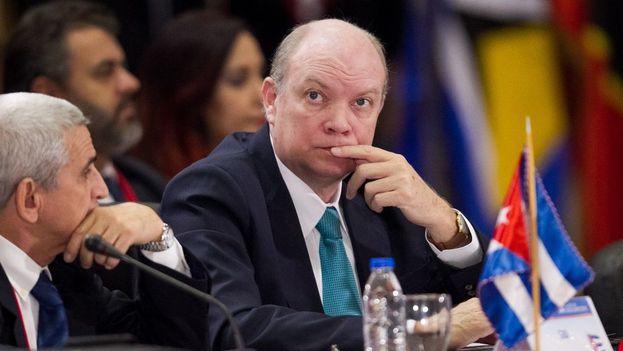
Cuba’s Minister of Foreign Trade and Foreign Investment, Rodrigo Malmierca. (EFE)

14ymedio bigger14ymedio, Havana, 26 December 2016 – Faces of Cuba 2016: An economist with a degree from the University of Havana, Rodrigo Malmierca served in several diplomatic positions before being appointed Cuba’s Minister of Foreign Trade and Foreign Investment. This year has had a particularly intense agenda, trying to attract foreign capital to the island’s shrinking economy.

During the International Fair of Havana (Fihav), in early November, the minister acknowledged that, two years after the reestablishment of diplomatic relations between Cuba and the United States, foreign investment goals have not been achieved and the country must correct its mistakes. The island demands “high rates of investment,” the official said.

Malmierca was the official face during the presentation of the new business portfolio, which includes 395 projects valued at more than 9.5 billion dollars, with a leading role in the tourism, oil, food and energy sectors.

After Half a Century of Trying, Cuba Cannot Replace Imports / 14ymedio, Mario Penton

A man waits in his ‘bicitaxi’ for a customer to tour the streets of Havana. (EFE)

14ymedio, Mario Penton, Miami, 30 December 2016 — “This is the last thing the ship brought,” you hear a young man say, to refer to one of the most recent products imported and sold on the black market in Havana. Being made abroad is synonymous with quality for many Cubans despite attempts to boost local production through state enterprise in a socialist model.

Decades have passed since the first time Cuba’s rulers said it was necessary to replace imports and increase local production to develop the country, a matter that the executive, presided over by the Castro brothers, has suspended year after year.

For the economist Omar Everleny Pérez, one of the gurus of the national economy, this is a fundamentally “ideological” issue. continue reading

“If the State would prefer to avoid paying the Vietnamese in dollars and allocate at least half of those resources to finance domestic production, it would not be necessary to import rice”

“If the state would prefer to avoid paying the Vietnamese in dollars and allocate at least half of those resources to finance domestic production, it would not be necessary to import rice,” Perez says.

However, Raúl Castro – recognizing that Cuba entered a recession this year, with a 0.9% drop in its gross domestic product – once again hopes to salvage the economy using the same formula that has failed for decades.

“It will be necessary to fulfill three decisive premises: to guarantee exports and timely collection of payments, to increase the national production to replace imports, and to reduce all nonessential expenses,” said Castro before more than 600 deputies in the National Assembly.

Exhortations to reduce imports began almost at the same time as the revolutionary government. The phrase can be found over and over in the speeches of the top leaders, but the figures published by officialdom show that, over and over, it has remained just words.

“Stimulating development and diversification of exports and taking advantage of opportunities to replace imports,” is reflected in the document Theses and Resolutions of the First Congress of the Communist Party in 1975.

In the documents of the Second Congress, celebrated in 1980, the same recommendations can be read almost verbatim, which remain unmet and are reformulated at the next Congress in 1986.

“The essential problem of the country’s economy in the five-year period 1981-1985 was that, although we had more than acceptable growth, it was insufficient where we needed it most, that is, in the export of goods and services and in the replacement of imports,” states the conclusive document of the Third Congress.

“When production increases often there is also an increase in the need to import intermediate products necessary for this production, such that it does not necessarily end up positively affecting the global figure for imports.”

Replacing imports is not a Cuban invention. It is a trade policy based on the premise that a country should try to reduce its dependence on the outside world through the development of its local industry, and it was an ideology in vogue in a post-war Latin America that sought to industrialize third world countries and promoted protectionism.

However, as the Cuban economist Antonio F. Díaz explains in a research paper at the University of Havana on the measurement of the effect of replacing imports (2015), it is not simply a matter of dispensing with imports to develop the local industry.

“It is a complex process,” explains Díaz, who states that the government’s progress in replacing imports cannot be effectively measured because of the absence of official statistics.

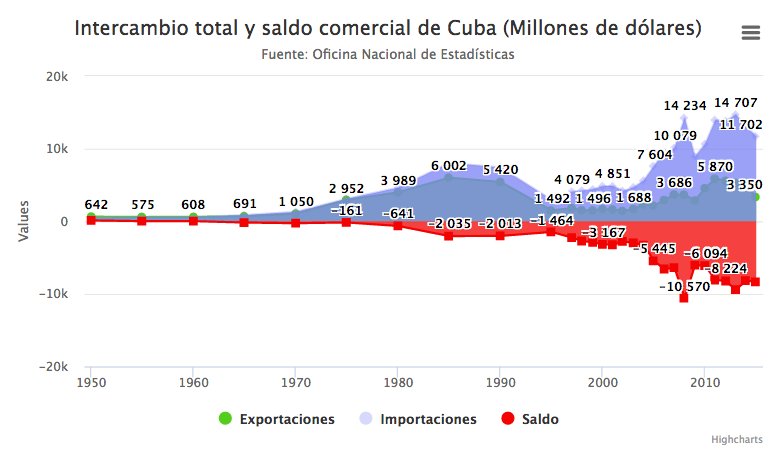
Total Exchange and Trade Balance in Cuba (millions of dollars)

“There has been growth in many of the sectors where there is the attempt to replace imports, but when domestic production increases, often there is also an increase in the need to import intermediate products necessary for this production, such that it does not necessarily end up positively affecting the global figure for imports,” he explains.

“Imports are always going to grow, as happens in all countries, but their replacement [with domestic products] as an economic policy is effective when economic growth is greater than the growth in imports,” the expert explains.

Cuba’s balance of trade over the last decades has shown a trend of increasing deficits, which accelerated in 2008 when the balance of trade was negative 10.57 billion pesos.

In the economic policy guidelines promoted by Raul Castro in 2011 as a guide to “perfecting socialism,” the replacement of imports is mentioned 20 times. The term is revisited in the update of those guidelines for the period 2016-2021.

The reduction of the immense Venezuelan subsidy, as well as the fall in the demand of the export of Cuban services abroad, can not be compensated with the increase of the tourism and the remittances

The document calls for “promoting an accelerated and effective process of import replacement, with mechanisms that stimulate and guarantee the maximum possible use of all the capacities available to the country in the agricultural and industrial sectors and in services and human resources.”

In 2015, Cuba reported a decrease of more than 1.5 billion dollars in exports, motivated to a large extent by the deterioration of economic relations with Venezuela, the island’s main trading partner. Official Cuban statistics reveal that the exchange between both nations decreased by more than 3.0 billion dollars in 2015.

The reduction of the immense Venezuelan subsidy (valued at its peak in more than 100,000 barrels of oil a day, part of which Cuba re-exported), as well as the drop in demand for the export of Cuban services abroad – in healthcare and other sectors – cannot be made up for through increases in tourism (3.8 million visitors) and remittances sent to Cubans on the island from family and friends abroad (more than 3.0 billion dollars).

For now it will be necessary to wait for the postponed plenary session of the Central Committee of the Party, originally scheduled for December 2016. The Central Committee must approve the Conceptualization of the Economic and Social Model and an Economic Development Plan to the Year 2030, in which surely the exhortation will be repeated to replace imports and strengthen local industry.

Burned Dolls, Buckets Of Water And Suitcases: End Of Year Rituals / 14ymedio, Zunilda Mata

Today, different rituals will accompany the end of the year, but all are intended to lead to the same outcome: that 2017 bring better opportunities. (EFE)

14ymedio bigger14ymedio, Zunilda Mata, 31 December 2016 — Before Silvio Lázaro moved to Havana from Guantánamo he had the tradition of burning a doll made out of straw and old clothes every December 31. However, in the capital he has replaced that custom with throwing out a bucket of water at midnight. Today, different rituals will accompany the end of the year, but everyone wants the same thing: for 2017 to bring better opportunities.

The National Assembly of People’s Power has just made a nefarious gift to Cubans. The parliament announced that the recession has taken over the country, expressed in a GDP in negative numbers: -0.9%. Cuba is facing a difficult economic scenario and the next twelve months are a mystery that few analysts dare to decipher. continue reading

Not even the bad omens and the austerity in celebrations imposed by the authorities after the death of the ex-president Fidel Castro, can put the brakes on the deeply rooted custom of the dinner on Saint Silvester’s Day, New yYear’s Eve. This morning you could still see many people carrying home tomatoes, some kind of drink and the little pork left in the agricultural markets.

Silvio Lázaro, 46, shows a special interest in celebrating. “My oldest son has everything prepared to travel to Mexico in the next few days,” he says. The young man will try to it to the border with the United States to reach that country and to avail himself of the Cuban Adjustment Act.

The family plans to change the habit of throwing a bucket of water from their balcony this midnight. “We are going to go out with suitcases and walk around the block so that everything goes well,” says the proud father. He does not hide that he is worried about the journey that his son will make and will even “light a candle so that the saints and orishas” will protect him.

A few yards from Silvio Lázaro lives a mother with a daughter who will get her degree in psychology next July. “This year she will achieve everything I’ve dreamed of,” says the woman, who works as a maid in a hotel in Old Havana. Her party tonight includes “grapes and cider,” which she bought thanks to tips given to her by some customers.

Despite the economic situation in the country, the mother of the future professional feels optimistic. “We have come out of worse things,” she reflects, although she acknowledges that during the last year it has been especially difficult “to buy food and find toiletries.”

A situation that could worsen, because as Raúl Castro clarified in his speech during the last parliamentary session this year, “it has not been possible to overcome the transitional situation we are experiencing in current payments to suppliers.” Imports of commodities could be affected by this delinquency.

The authorities limited the public dances that characterize the last day of the year and have emphasized the celebrations on January 1st, when the 58th anniversary of the Revolution is commemorated. On Monday, a military parade presided over by the Cuban leader will be the climax of official celebrations.

“There is nothing to celebrate, everything goes from bad to worse,” reflects Maurín, 38 and unemployed. The woman believes that “we are bottoming out” and for her family it has been especially difficult to acquire the ingredients for the end of the year dinner. Her brother, who is part of a medical mission in Caracas, has arrived this year to spend the holiday with his family.

“He does not want to return to Venezuela, nor do many of his colleagues,” says the woman. The doctor is greatly affected by the violence, the shortage of basic products and the restrictions of movement in the South American country. Among the few things he could bring on his trip were colorful garlands for the Christmas tree.

On centrally located G Street in Vedado, young people will also gather to bid farewell to the year. This December some have promoted a new custom to mark the date: having money in your hand just when the clock strikes midnight.

“That way it ensures that there is financial solvency for the next year,” says Daniela, a member of Havana’s Goth community, to 14ymedio.

“But it has to be dollars, euros or Cuban convertible pesos … with Cuban pesos it doesn’t work,” the young woman clarifies.

American Chicken for Cuban Christmas / 14ymedio, Zunilda Mata

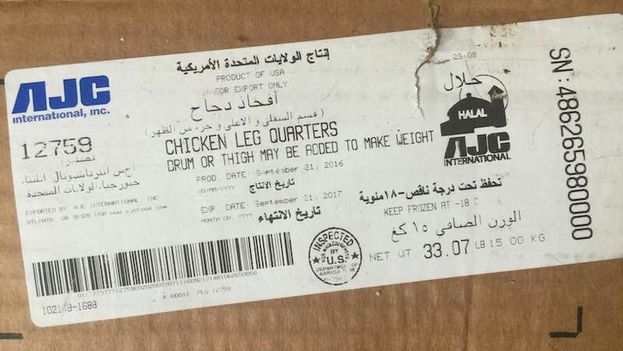
The frozen chicken ‘made in the USA’, a product in great demand in Cuba amid the rise in prices for domestic meat. (14ymedio)

14ymedio bigger14ymedio, Zunilda Mata, Havana, 23 December 2016 — Against all odds, two years after the beginning of the diplomatic thaw between the governments of Cuba and the United States, trade between the two countries has diminished. The Island bought 21% less food from its northern neighbor in the first four months of this year, compared to the same period in 2015.

However, this Christmas Cubans have seen frozen chicken Made in the USA reappear in the network of state markets, a product in high demand amid rising prices for domestic meat. Many have decided to change the traditional pork menu that families eat on December 31 for a plate with breast, thighs or wings.

Imports of US poultry fell by half between January and April 2016 in contrast to last year. Hence, consumers have received happily the news about the recent supply, though they fear the quantity of this yuma (American) product will decline further with the arrival of Donald Trump at the White House.

Cuban Parliament Sessions Predict Somber Times / 14ymedio, Miriam Celaya

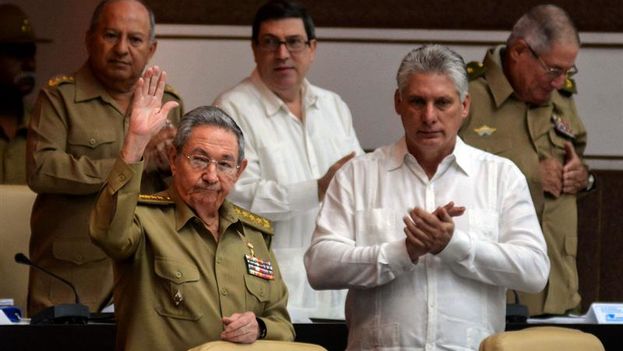
Cuba’s president Raúl Castro, and first vice-president, Miguel Díaz-Canel, at the session of the National Assembly of People’s Power. (EFE / Abel Padrón Padilla)

14ymedio bigger14ymedio, Miriam Celaya, Havana, 28 December 2016 — On December 27th, at the Havana Convention Center, the Eighth Session of the Eighth Legislature of the Cuban Parliament opened, with a balance sheet on the socio-economic results of the year ending and the proposed draft of the National Budget Law for 2017.

This time, there is no good news or triumphant speeches. 2016 ended with a 0.9% drop in Gross Domestic Product (GDP), according to the report presented by Ricardo Cabrisas, Minister of the Economy and Vice-President of the Council of State, and there are no reasonable grounds to date to believe that the forecast of a 2% growth of the GDP for 2017 will be realized. In fact, that was the modest growth prediction for the second half of this year, which finally failed. continue reading

Even more somber, Cubans will start the New Year with overdue payments to suppliers. “It has not been possible to relieve the transitory situation we are experiencing in the current payments to suppliers …”, indicated the general-president, Raúl Castro, in presenting the central report, although he announced, without going into details, “a number of measures that will alleviate the described scenario”.

“It has not been possible to relieve the transitory situation we are experiencing in the current payments to suppliers …” indicated the general-president

As for the 2017 budget plan, he cautioned: “I must warn that financial tensions and challenges will persist that could even increase in certain circumstances.” The current difficulties related to the economic downturn in 2016 will affect next year, the president stated, unless three “permanent and decisive” objectives are met: guaranteeing exports and working immediately to create the conditions to increase them in successive years; identifying the possibilities in the national production and substituting any level of imports; and reducing possible non-essential expenses, among which he indicated trips abroad by the cadres and leaders at different levels.

“We will have a definitive solution to these traditional deficits if we produce more goods and services, both internally and externally, and reduce expenses as much as possible,” said Cabrisas. But the proposed solutions revolve around the usual jingle of the last decades which is never fulfilled, such as the one that proposes the substitution of imports based on the development of national productions “with a well-designed program” encompassing the entire national industry, including the military, or a “greater requirement of the efficient use of carriers to avoid purloining and theft,” in addition to increased controls in this area.

The Cuban president said that he attaches “great importance to the need to boost foreign investment in Cuba” as an essential road for the country’s economic development. However, he made it clear that there are forces opposing this solution, which are blocking this inflow: “I recognize that we are not satisfied in this area and that excessive delays in the negotiation process have been frequent. We need to overcome, once and for all, the obsolete mentality of prejudices against foreign investment and, to resolutely make strides in this direction, we must shed false fears towards foreign capital.”

The report by the Minister of the Economy detailed an opaque and unpromising scenario for now and for the future, because of “the persistence of existing financial constraints due to the non-fulfillment of export earnings, the difficulties faced by some of our main partners due to the fall in oil prices, and by the commercial and financial blockade, strengthened by large fines to international banks that transact business with our country.”

While figures on investments and imports are expressed in dollars, the State’s income and budget -including so-called subsidies and other social benefits -are expressed in CUP

In general, the budget plans for 2017 are similar to those of 2016, except for lower fuel imports, which should stimulate the growth of electric power generation from better utilization of the national capabilities.

One confusing aspect is that, while figures on investments and imports are expressed in dollars, the State’s income and budget – including so-called subsidies and other social benefits – are expressed in Cuban pesos (CUP, that is the “national currency”). This creates a distortion that masks the actual amount of profits and expenses.

For instance, it is stated that the State proposes to invest $1,750,200,000 in food for the population ($82,000 more than in 2016), although total imports in physical terms are similar to 2016. However, we do not know the total amount of foreign exchange revenues generated mainly from tourism, a sector that is controlled by the generalship.

The official reports remain mysteriously silent on this subject. Something similar happens with the issue of monetary duality, an insoluble distortion pending a solution and not mentioned among the great problems that hinder foreign investment in Cuba.

Another problem of the domestic economy during 2016 was the positive reaction of agricultural production, but the industry was unable to respond to production, thus affecting the high level of imports to meet the demand of the population. This is a situation that the Government will try to reverse in the 2017 plans through an “accelerated medium-term program to recover this industry and enable it to respond to both domestic consumption and visitors.”

Another problem of the domestic economy during 2016 was the positive reaction of agricultural production, but the industry was unable to respond to production

The transportation sector is another old and pressing problem, although it is officially acknowledged that “it is strategic for any of the branches of social and economic development of the country”, therefore, its boost is projected for 2017.

In this sense, the State proposes 3% growth compared to 2016, guaranteeing the essential services of national bus companies, transportation for workers and for school children, as well as taxi and cooperative services, in addition for guaranteeing necessary fuel “for buses manufactured in 2017”.

An interesting note was the Minister of the Economy’s reference to maintaining “the current production capacity of bicycles and spare parts” as well as the importation of tires. In the present circumstances, the mere mention of producing bicycles casts over the Cuban population the lugubrious and counterproductive memory of the hardest years of the Special Period.

Other figures for the 2017 plans were the program of 9,700 homes and the start and development of an additional 4,890, similar indicators to those in 2016, which were not met. This program will prioritize the homes affected by Hurricane Matthew in Guantánamo and “those affected by previous hurricanes in Pinar del Río and Santiago de Cuba”.

But the most serious problem is that the solution to our economic ills, foreign investment, remains extremely low at just 6.5% of the plan. In other words, the provisions of Guideline 78, which gives an essential role to this investment, are not fulfilled. Cabrisas stated: “These projects need to be energized,” starting with making a list of investment projects for development that will guarantee the economic development plan until 2030, “concentrating the efforts in strategic and prioritized sectors.”

Thus, 2017 investment takes into consideration supporting priority tourism programs in Havana, Varadero, the Northern Keys, Holguín and in the infrastructures of the Special Development Zone of Mariel (ZEDM) or fuel storage, among others. Measures have also been developed to increase salary systems in the development of tourism and ZEDM sectors.

2017 investment takes into consideration supporting priority tourism programs and in the infrastructures of the Special Development Zone of Mariel (ZEDM) or fuel storage

An increase in the income levels of the population and the absorption capacity of the State is projected in the plans. Productivity will grow by 6.6% and the average wage by 3.5%. To accomplish this, it is essential to avoid payments without productive results, the consistence between the indicators, and taking into account added value, in order to avoid monetary imbalance.

The preliminary draft of the 2017 budget foresees revenue growth of 1.525 million pesos, mainly from taxes on profits, an investment of the state enterprise sector with 6.330 million pesos in increase in expenses with respect to 2016, and an 11. 454 million fiscal deficit, 12% of the GDP.

The report of the Finance and Prices Minister, Lina Peraza, did not offer much detail, other than that of the Minister of the Economy. It seems that the “solution” for the Cuban economy has been reduced to a simple list of elementary considerations, such as deepening the country’s financial obligations, assessing the impact on credit levels, guaranteeing exports and substituting imports, making progress on foreign investment projects, increasing controls in the use and pilfering by energy carriers and stopping the decreasing trends in production, among others. These are about the same solutions as in previous years.

“The plan we are presenting to this Assembly is tense, (…) but we believe we can meet it,” Cabrisas said. “The above calls for willpower, decision, organization, discipline and attention prioritized to all these matters” especially by those responsible for enforcing them.

Apparently, the Cuban economy’s “solution” is reduced to the same solutions as in previous years.

It has been a redundant day to announce the dark clouds that hang over an unborn 2017, a somber gloomy Parliament on a somber Island. No one expected an economic miracle, but perhaps the most candid were trying to picture see some sign of change. For the time being, everything indicates that Cuba is on its leaderless way, tottering towards some enigmatic horizon.

Curiously, the greatest novelties now are what’s missing: this is the first session of Parliament without the shadow of a Fidel Castro -not sufficiently alive or completely dead -vigilant and omniscient; there was no Council of Ministers prior to the sessions, so that the last one, held on July 25 of this year, was referred to; the full plenum of the Communist Party of Cuba (PCC) was not held, and the former Minister of the Economy, Mr. Marino Murillo, who accompanied the “Raúl reforms” for a long time, was not seen at the sessions.

What these signals might mean would be material for another analysis.

Translated by Norma Whiting
Inter-American Press Association Names Henry Constantin Vice President for Cuba

Cuban activist and journalist Henry Constantin with an issue of Time Magazine covering Cuba. (Twitter)

14ymedio bigger14ymedio, 30 December 2016 — The Inter-American Press Association (IAPA) has named independent journalist Henry Constantín Ferreiro as regional vice president for Cuba. Director of the magazine La Hora de Cuba and a resident of the city of Camagüey, the reporter told 14ymedio that he intends to defend and spread “the reality of journalism” on the island from his new responsibility.

A few hours after the announcement, Constantín told this newspaper via phone that he received the news with a mixture of “surprise and pride” and said he was grateful to be part of an organization that “has engaged in numerous battles over the freedom of the press in the region.” continue reading

Born in 1984, Constantín is a contributor to several independent media, including the magazine Coexistence. He studied journalism for several semester as an undergraduate and also the specialty of film direction at the Higher Institute of Art (ISA).

The reporter feels that the journalism in Cuba is going through “a special moment” marked by “an increasing plurality, although still restrained by the government.” On the island there are “media that cover almost the entire political spectrum,” says the new vice president of the IAPA.

“In this new year we will have to defend the national press because although the context is new, the threats are the same and some of them are even growing,” Constantín points out.

Upon his appointment, the reporter will be responsible for reporting the violations of press freedom that occur in the country and for drafting the report that is published each semester by IAPA.

Previously, the vice president for Cuba was occupied by journalist and director of 14ymedio Yoani Sanchez, who assumed the responsibility in 2012.

Last November, Henry Constantín was detained at Customs at the Ignacio Agramonte International Airport in Camaguey, on his arrival from Miami. The dissident was taken to a police station where his mobile phone and his laptop were confiscated.

See also:

Of UMAP and Other Demons / Henry Constantin

Kidnapped Trip / Henry Constantin

The University / Henry Constantin

Constantin Answers in Diario de Cuba / Orlando Luis Pardo Lazo

It’s Time For Politics To Stop Separating Families And Friends / 14ymedio, Pedro Campos

People leaving Cuba during the Mariel Boatlift.

14ymedio bigger14ymedio, Pedro Campos, Havana, 29 December 2016 — The model imposed in Cuba in the name of a socialism that never existed had, among its worst results, the politicization of everything. Families fought over politics. Friends became enemies. This was one of the most disastrous consequences of the “revolutionary intransigence” in which several generations of Cubans were (badly) educated.

This intransigence, generated by the group in power, facilitated the development of others.

The phenomenon affected practically every family and friendship, which according to tradition had always remained very united. The divisions began in 1959, when the provisional government that was intended to give way to the restoration of institutionalized democracy, failed to do so and turned itself into a permanent revolutionary government that began to apply justice in its own way. continue reading

Immediately, more than a few began to see how to advance the centralized and anti-democratic policies, traditionally identified with communism, that had done so much damage in Europe and which, in the island’s past, had been linked to Batista, the tyrant who was expelled from power.

Disagreement in democracy is normal, but when there is none and dissent is considered treason and is not accepted, as in Cuba in the early days after the triumph of the Revolution, thinking differently is identified as “counterrevolutionary.”

With the first “counterrevolutionaries” began the first great exodus and many families stopped seeing each other or even communicating for many years. Then came other waves. In the early 80’s, some of those who had gone into exile began to return to visit and that began to break the ice.

It was not easy for families to welcome “worms” and “traitors” who now returned with gifts and greater incomes, from a country with another language, culture, climate and traditions. People were afraid that they could lose their membership in the Communist Party or a government job.

Some of those who remained in Cuba would not receive their relatives at that time. Or old friends would not visit with them.

With time and new waves of migration, many of those who had refused to receive their relatives or friends also went into exile. During the Mariel Boatlift, some had participated in the repudiation rallies and shouted, “Let the scum go.” They threw eggs. And later, more than a few them took the same path.

The intransigents insist on continuing to confront families and friends over politics, and they still reject friendships between people who think differently, but there are also people who feel individuals are separate from their ideas and they leave them alone, considering them friends. Pope Francis comes to mind when he talked about “social friendship.”

In Miami, on the other side, there are also intransigents. Both sides make it all the more difficult.

Now, in the aftermath of the former leader’s death, we hear again about “revolutionaries” who did not make friendships carry the weight of politics and did not accept judgments about the consequences of their imprint on democracy and socialism. Intolerance is necessary for nothing to change.

There are many people who do not lend themselves to politics destroying families and friendships. They are fundamental pillars of the future Cuba.

Today, because of the wide exchanges among all Cubans, despite the intolerance expressed from the rulers, there is more tolerance. This is part of the preparation necessary to live in a democracy, which will come sooner rather than later.

It is time for politics to stop separating families and friends. We are in a good moment for it. Cuba, to advance, needs to leave behind so much confrontation, so much stubbornness, so much stupidity. Perhaps all that, on both sides, reached the highest possible point in recent days, and now, like all that rises, it must descend.

It must be understood that, regardless of the political differences, we Cubans will one day have to talk to each other and sit together in a democratic parliament leaving behind grudges and the difficult and dramatic moments of our history, leading with the future and looking for a way to accept ourselves in our diversity.

There will have to be apologies and pardons, difficult encounters. If not men, history will punish crimes and abuses. There will have to be changes in political power, it will have to be peaceful and democratic, but blood must be avoided in order not to resume the cycle of violence, if we really want to see Cuba as a great nation with its international economic and political weight. Politics will have to give way to family and friendship. A divided country is easily made a victim of national and global hegemonies.

Citizens… Time To Tighten Your Belts / 14ymedio, Yoani Sanchez

Raúl Castro will preside this January over his first parade, similar to the one shown here, without the shadow of his brother. (EFE / Archive)

14ymedio bigger14ymedio, Generation Y, Yoani Sanchez, 29 December 2016 – My generation knows no good news. We grew up with the grey subsidies of the rationed market, we reached puberty amid the rigors of the Special Period, we raised our children in a country with two currencies, and now they warn us that times of economic stress are coming. It appears there is no respite from this long sequence of disasters, collapses and cuts that we have suffered for decades.

This December the National Assembly of People’s Power acknowledged the negative numbers that reality made clear long ago: Cuba is not growing, production is not recovering, and the so-call Raulist reforms have not given citizens a better life. The island is heading toward the abyss of defaults, cuts in vital sectors of the economy, and continued stagnation. continue reading

In other places, the rulers would resign before the panorama facing this nation, due – in great measure – to bad management. However, since the general president did not win office by a popular vote, no one can punish him at the ballot boxes in the next elections. To the opposition that has demanded his departure, the iron fist of repression and punishment is always applied.

Instead of a mea culpa, the officials who, on Tuesday, detailed the economic debacle and in somber tones said it will continue in the coming year, have called for greater productivity, a reduction in superfluous expenses, and using the so-called “efficiency reserves,” the final official euphemism used to explain what little remains in the national treasury.

However, a few hours after concluding the parliamentary session in which such bad omens were unveiled, the second of the three planned test runs began – Friday will be the third – for the huge military parade that will be staged in Havana’s Plaza of the Revolution on 2 January. A mass gathering, with parades of war tanks and soldiers marching in lockstep, that will cost Cuba hundreds of thousands of pesos, if not millions.

The traffic on the capital’s most important arteries has been paralyzed as of the early morning hours of yesterday, Wednesday. Thousands of state employees didn’t have to complete their workday, and a long line of buses had to travel from various municipalities to the parade grounds. Countless snacks were distributed among the most faithful participants in what is coming to be seen as a “Raulist coronation.” The younger brother has planned his own investiture in power, now on his own, after the death of the former president Fidel Castro.

Why this waste of military resources in the middle of the crisis that the country is going through? Such delusions of grandeur are not consistent with the 0.9% decline in GDP this year. This military parade, with its boasts of strength and a “baring of teeth,” will squander some of the resources needed to repair the deteriorated roads of the island, to give just one example.

In this city that has suffered serious cuts in public lighting, where the last-hour bus terminal have been overwhelmed before the lack of interprovincial transport, and where a pound of pork costs up to two day’s wages, what will take place this coming Monday is far beyond wastefulness, it is a sign of lack of respect.

And so, there are certain politicians. They call – for the umpteenth time – for a tightening of belts and a reduction in the expectations for a better life, while they waste enormous quantities of national resources playing at war.