An employee confirms to this newspaper that water trucks are available immediately in Havana for 100 dollars
 14ymedio, Diego Hernández, Havana, November 3, 2026 / The foreign-capital mipyme [small or medium-sized private enterprise] A Granel continues its unstoppable growth and is diversifying its business. After becoming the first private company to advertise itself as a seller of fuel imported from the US in Havana, it has now just ventured into what looks set to be another of the most lucrative fields of commerce: selling water by the tanker truck. All this after making history by becoming the first sports sponsor of a team in Cuba, the Industriales, who wear its logo on their jerseys in this 65th National Baseball Series.
The company sprang the surprise last October 28, when it published a post on its Instagram account announcing the new service with the slogan “May you never be without water!” The offer is aimed at all kinds of customers – homes, businesses, institutions and construction sites – and the poster includes a phone number to contact via WhatsApp. “Order your service today,” it says.
Availability is immediate, as 14ymedio was able to verify after asking the company through that channel for the price of a water truck for two Havana municipalities, Cerro and Guanabacoa. In both cases the answer was yes: for one hundred dollars you can get drinking water delivered to your door, although the operator was not very clear about the quantity supplied, implying that it would be enough to fill all the containers the customer has.
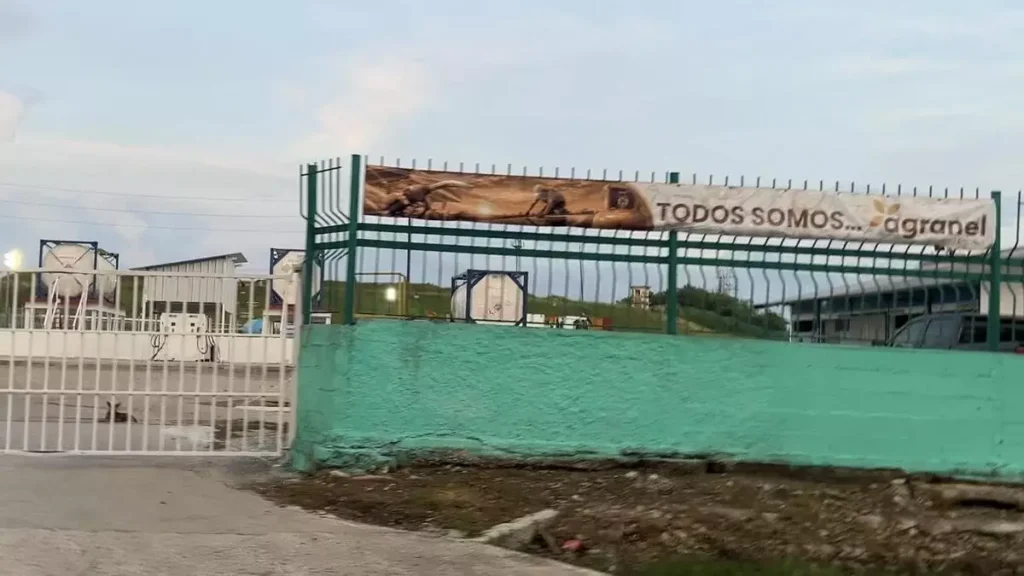
A reporter from this newspaper also went to the company’s warehouse this Monday, but although it was not very late in the afternoon, the premises were closed. What was striking, from outside, was how brightly lit the area was even though it was still daytime. The compound has powerful floodlights that contrast with a capital in permanent blackout. In addition to the isotanks, already well known, a tanker truck – the star of the new business – could be made out in the background.
At the entrance, a huge sign with the company’s logo is preceded by the words “We are all [A Granel],” a slogan as close to officialdom as the mipyme itself, which this Sunday also announced its own gasoline pumps. “We have our own fuel station, where you can fill up your vehicle directly or take the fuel away in your own containers. Gasoline and diesel available, at excellent prices,” the post says. As usual, there is no address, no prices and no other information for the public, who keep asking insistently and with growing annoyance.
But it is the water that has exhausted users’ patience. “The only question I have now is: Where does that water come from? Isn’t there supposed to be no pumping, for whatever reasons? Where are those trucks being filled?” one commenter protested on social media. “They create the need and then sell you the solution,” another snaps. This Monday, President Miguel Díaz-Canel said publicly that Cuba is still socialist – “the state enterprise is not a residual actor or an appendage of the administrative apparatus, but the main subject of the national economy and the fundamental link” – but the population has more than its doubts.
“So now everything in Cuba is private. Great, a step toward capitalism. And now I ask: When are salaries going to start rising so that ordinary Cubans can buy from the private businesses? How absurd it all is!” another user tells A Granel.
Not far from the mipyme’s headquarters is one of the offices of Aguas de La Habana [Havana’s state water utility] where, according to sources at this newspaper, you have to wait in line, be insistent and offer the employee some money if you want to get the same service for which A Granel charges 100 dollars.
The water crisis is also boosting business for small shops. As 14ymedio reported this Monday, in Luyanó five liters are sold for 2,000 pesos (2.2 dollars at the current exchange rate), while a liter goes for 400 (0.40 dollars). “Today I called Aguas de La Habana at 4 in the afternoon and the operator told me they were turning the water on at 4:30. I waited until 5, called again, and the operator answered that it was for the neighboring area,” says a resident of the Diez de Octubre municipality. “I got so upset… because more than a week without water, not even to drink, is like being sentenced to death.”
Exactly one month ago, the Government put the number of consumers with total or partial disruptions to their water supply at 2.7 million, the same figure that the National Institute of Hydraulic Resources (Inrh) acknowledged at the end of May, which means that the problem, far from improving, has at the very least stayed the same. In this context, with 28% of the population without an essential service, a new opportunity comes along for A Granel, whose investors and owners remain a mystery, although its ties to the regime are an increasingly widespread suspicion.
Translated by GH.
______________________
COLLABORATE WITH OUR WORK: The 14ymedio team is committed to practicing serious journalism that reflects Cuba’s reality in all its depth. Thank you for joining us on this long journey. We invite you to continue supporting us by becoming a member of 14ymedio now. Together we can continue transforming journalism in Cuba.