In this prime area for private trade, customers no longer appear, and vendors grapple with shortages and inspectors.
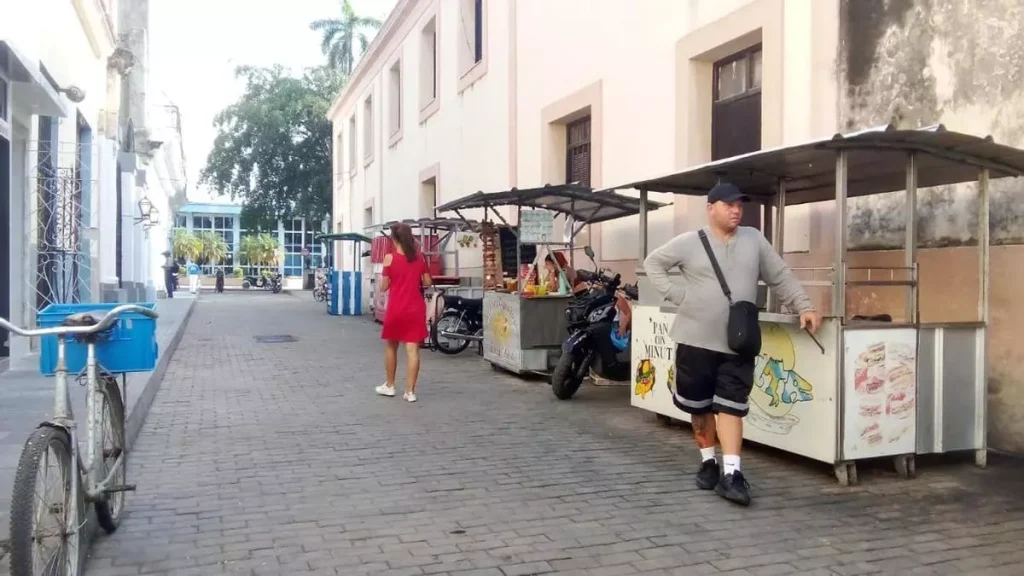
 14ymedio, Matanzas, Julio César Contreras / In the alleyway of the Sacristy in Matanzas, there are timbiriches (food carts) that seem to be waiting for better times. Under their zinc roofs, among parked motorcycles and walls weathered by damp, some remain closed and others survive with minimal offerings. The place, behind the San Carlos Borromeo Cathedral and a few steps from Medio Street, retains the privilege of being in the heart of the city, but it no longer guarantees the flow of customers that once made every square meter a coveted space.
José Alfredo knows all too well how much that wait can cost. After struggling for almost a year to obtain authorization for the space, his mobile stand is now tucked away in a corner alongside others like it. His project to sell hamburgers and soft drinks has been trapped between a lack of suppliers and power outages. “Just buying the cart, including some repairs I made, cost me 60,000 pesos, which I haven’t been able to recoup,” he laments.
He has tried almost everything: running an extension cord from a nearby house, adapting a gas cylinder, and carrying a cooler every day to keep the drinks as cold as possible. Nothing has brought him stability. “For one reason or another, I haven’t been able to work continuously for even two months. I’m paying the license fee, the rent to the Registrar’s Office, the bank security guards who watch over the place at night, and I still can’t get sales back on track.”
“For one reason or another, I haven’t been able to work continuously for even two months.”
José Alfredo is already considering selling everything. It wouldn’t be unusual in an alley where some closed shops are starting to look like part of the street furniture.
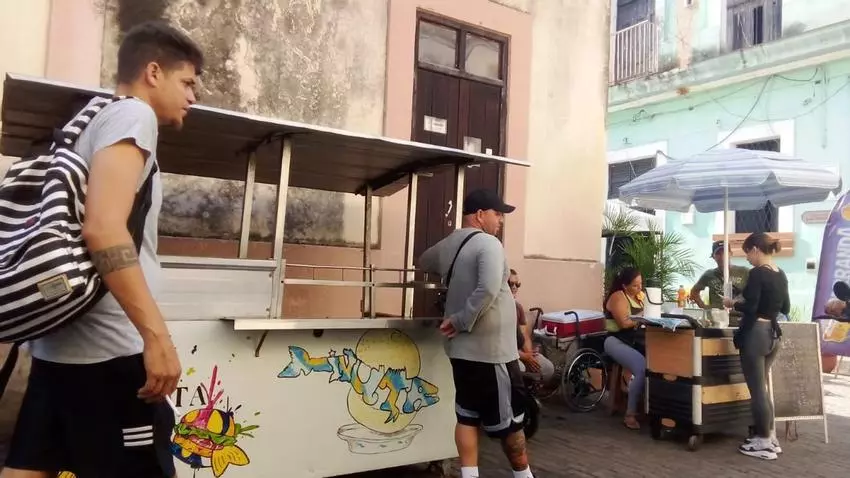
Before money became so scarce in the wallets of Matanzas residents, selling anything in this area was practically a guarantee. Its dual access to the historic center ensured a constant flow of people. “I’ve been selling pan con minutas [fried fish sandwiches] and shaved ice on this very corner since the end of the Covid pandemic. On bad days, by eleven in the morning I’d make at least 3,000 pesos. Now, I rarely make that much by four in the afternoon,” says Roberto from his small, makeshift griddle.
Keeping the stove burning is a feat. Roberto works with six different supply sources. “Sometimes even the small businesses aren’t making bread, oil is scarce, there’s no fish, and even the ketchup goes to waste. Many times I’m up until ten at night looking for things so I can work the next day.”
Inflation does the rest. “If the supplier raises the price of the merchandise, I have no choice but to raise the price to make a profit.” When he started, he recalls, a fish sandwich cost 50 pesos. Now he sells it for 250. “We’ll see how far we can go.”
This price race has been compounded by another shock: the crackdown by inspectors to enforce electronic payments and price caps on certain basic goods. Hefty fines have forced many retailers to scale back, reduce their offerings, or remain closed. For those who depend on suppliers who charge increasingly higher prices, adhering to a maximum price can mean operating on minimal margins or even at a loss.
In the alley by the Sacristy, the retreat is palpable. There are empty metal structures, counters without merchandise, and vendors who have radically changed their offerings. Manuel is one of them. He’s better known as El Chino than by his name.
“Nothing can be kept refrigerated, and there’s nothing to fry with either. So, for now, the solution is to sell popcorn and plastic bags. The investment is minimal, so I can manage to survive. Something is better than nothing,” she explains.
“From time to time they come by to collect what’s theirs in order to maintain the proper silence.”
He says his grandfather taught him to persevere, a lesson Manuel now applies to street vending. He has also learned to navigate a gray area where regulations change and inspectors, he says, “occasionally come around to collect their dues to maintain silence.”
All around, the scene sums up these times: a bicycle leaning against a wall, motorcycles weaving between the stalls, a pizza cart barely moving, and another business that seems to have closed the shutters for good. Those who are still open must arm themselves with patience t while waiting for customers. Because in the alleyway by the Sacristy, every closed cart is a stagnant investment, and every one that opens is a daily gamble.
______________________
COLLABORATE WITH OUR WORK: The 14ymedio team is committed to practicing serious journalism that reflects Cuba’s reality in all its depth. Thank you for joining us on this long journey. We invite you to continue supporting us by becoming a member of 14ymedio now. Together we can continue transforming journalism in Cuba.