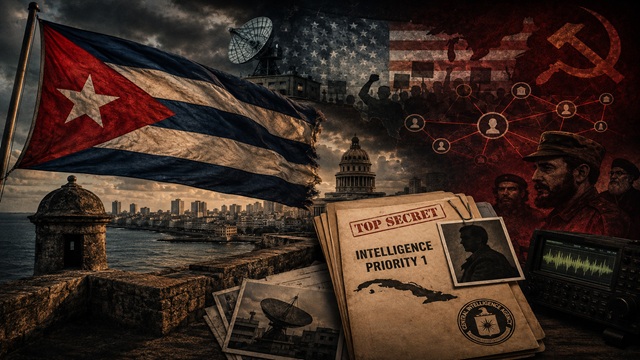
The CubanAmerican Voice, Julio M. Shiling / The elevation of communist Cuba to “Priority 1” status within the National Intelligence Priority Framework places the island on the same plane as China, Iran, and Russia. Some will scoff at the decision. They will measure Cuba by the size of its navy, the range of its missiles, or the volume of its GDP, and declare the ranking absurd. That metric is the wrong one. National security priorities are not a ranking of conventional military mass. They are a ranking of the threats that can most effectively wound the United States—through subversion, intelligence penetration, ideological warfare, and the cultivation of domestic radicalism. By those measures, Castro- Communism has earned its place.
Cuba does not confront America with carrier groups. It confronts America with a doctrine refined over six decades: the deliberate export of Marxist revolution and the systematic penetration of the institutions that shape American political, academic, economic, and cultural life. The State Department’s recent report, “Cuba: The Capital of 21st Century Communism,” maps this strategy with clinical precision. Havana long ago abandoned any pretense of merely defending an island fortress. It positioned itself as the operational and ideological hub of a global project aimed at the internal erosion of Western societies. That project did not end with the Soviet collapse. It adapted, mutated, and found new hosts among the far left in the United States itself. It should not be forgotten that the Cuban communist revolution geometrically fortified what we today know as the “New Left” and cultural socialist precepts.
From the 1960s onward, Cuban intelligence cultivated symbiotic relationships with domestic communist and terrorist networks inside the United States. These were not romantic gestures of solidarity. They were operational partnerships. Training, funding channels, propaganda coordination, and intelligence sharing created durable pipelines between Havana and American radicals. The result is not ancient history. It is a living architecture of influence that continues to shape narratives, recruit cadres, and erode institutional trust. When a foreign power maintains decades-long access to the domestic far left—supplying it with ideological oxygen, tactical experience, and a sense of international legitimacy—that power becomes a force multiplier for America’s adversaries. China, Russia, and Iran understand this. They cultivate Cuba precisely because Havana offers something they cannot easily manufacture: intimate, long-cultivated access to the American radical ecosystem.
Communist Cuba’s value to those powers is not limited to rhetoric. The island hosts sophisticated signals-intelligence facilities operated by Russia and China. These installations sit ninety miles from Florida and are designed to intercept sensitive American communications. Hosting such capabilities is not neutrality. It is active participation in the intelligence war against the United States. Add to this Cuba’s alignment with Iran, its support for transnational terrorist groups, and its role as a logistical and ideological node, and the picture clarifies. Havana, as a matter of fact, functions as a force-projection platform for America’s principal enemies, one that operates below the threshold of conventional conflict yet above the threshold of mere nuisance.
The sophistication of Cuban intelligence itself has been underestimated for too long. The services provided by the Castro regime have repeatedly demonstrated an ability to run agents inside American institutions, to harvest sensitive information, and to shape cultural and academic discourse. Their tradecraft is patient, culturally fluent, and ideologically disciplined. They punch far above the island’s economic weight because they are not constrained by the need to produce consumer goods or maintain a modern industrial base. Their product is influence and information. In an era when information and internal cohesion are decisive, that product is strategically lethal.
The Trump administration’s decision to raise communist Cuba to Priority 1 and the subsequent creation of a dedicated CIA task force simply align resources with reality. The unit—staffed with case officers, analysts, cyber specialists, and covert influence experts—exists to generate the intelligence and operational options necessary to exploit fractures inside the Cuban dictatorial elite and to pressure for the collapse of the kleptocratic Marxist dictatorship. Increased intelligence assets on and around the island are not theater. They are the minimum required to understand a regime that has spent 67 years perfecting the arts of secrecy, denial, and asymmetric warfare. Without current, granular knowledge of Castro-Communist intentions, capabilities, and internal dynamics, any policy—diplomatic pressure, economic isolation, or contingency planning—operates in the dark.
Critics will claim this is overreach, a revival of Cold War paranoia, or a distraction from “real” threats. The opposite is true. Ignoring a dedicated revolutionary state that systematically cultivates domestic subversion, hosts adversary intelligence bases, and serves as a transmission belt for anti-American ideology is the true strategic malpractice. Priority rankings exist to force the intelligence community to allocate scarce resources against the most consequential dangers. Cuba’s military is modest. Its capacity to damage the American body politic from within is not.
Communist Cuba has never been a status-quo power. It has been a permanent revolutionary project directed against the United States and the civilization that produced it. Elevating it to Priority 1 is not an exaggeration. It is overdue recognition that the threat Havana represents is measured not in divisions and warheads, but in the depth of its penetration, the durability of its ideological networks, and the strategic value it provides to America’s most determined enemies. The classification is correct. The only remaining question is whether the resources and resolve that accompany it will be sustained long enough to make the regime confront the consequences of its own history.
© The CubanAmerican Voice. All rights reserved.