The elimination of these tests has left thousands of students who spent years preparing feeling frustrated and has fueled fears of favoritism and declining academic standards.
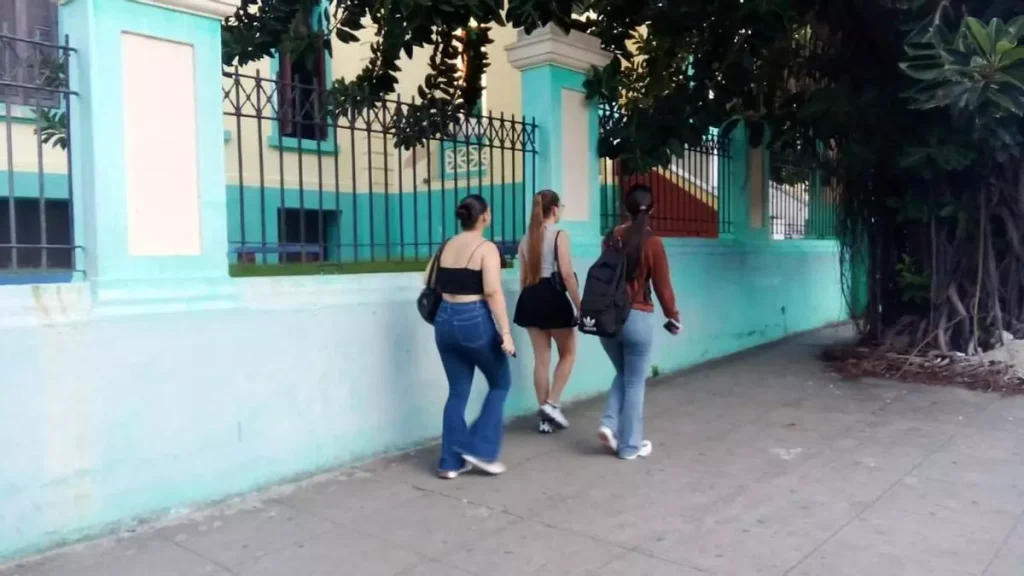
 14ymedio, Julio César Contreras, Matanzas, June 15, 2026 — In the mornings, small groups of students still gather in front of the old Secondary Education Institute of Matanzas on 2 de Mayo Street. On a marble wall, two teenagers chat without much enthusiasm, while a few yards away several pre-university students walk down the sidewalk with backpacks slung over their shoulders. The scene looks like any other end of the school year, but this year there is something different: for the first time in a long while, students finishing twelfth grade will not have to take the traditional university entrance exams.
The news surprised some and confirmed the predictions of others. The Ministry of Higher Education announced that the Mathematics, Spanish, and Cuban History exams had been suspended and that admission to higher education would be determined by students’ cumulative academic averages throughout their pre-university years.
For Betty, a twelfth-grade student at José Luis Dubrocq Pre-University School, the decision came too late and in the worst possible way.
“The way to earn a place in a good degree program was to get high scores on the exams. Now they’re changing the rules when we’re already at the finish line”
“I’ve been preparing for these tests since ninth grade. My parents have spent money on tutors, books, and study materials. Everyone knew that the way to get into a good degree program was to earn high marks on the entrance exams. Now they’re changing the rules when we’re already at the finish line,” she complains.
She hopes to study Psychology. She has a grade-point average of 98.9 but fears that may not be enough.
“They say they’re going to take ‘overall development’ into account. I was never very involved in political events or extracurricular activities. Now I see classmates with lower grades ranked above me. That raises a lot of questions.”
The concerns are precisely the topic most frequently discussed in family conversations. For years, the entrance exams served as a kind of final referee. People could debate the quality of the tests or the inequalities between students who could afford tutors and those who could not, but in the end there was a common national evaluation for everyone.
Now, many parents believe the process will be more difficult to understand and, above all, harder to oversee.
Around the pre-university school on 2 de Mayo Street, where generations of Matanzas residents prepared for university admission, opinions are sharply divided.
“The best degree programs always end up in the hands of those with the most influence. That’s not just me saying it, everyone says it”
“My aunt has important connections in the Education Ministry and is already finding out how all of this works,” admits Magdiel, another senior-year student. “For me, it’s a good thing they got rid of the exams. What matters now is having the right contacts and being well positioned when it comes time to assign university places.”
The young man hopes to enter medical school and speaks with a frankness that makes some uncomfortable. “The best degree programs always end up in the hands of those with the most influence. That’s not just me saying it, everyone says it.”
Although some consider that perception exaggerated, it has spread among students and their families. The elimination of the exams has fueled suspicions that subjective factors may now carry greater weight in the allocation of university places.
A mathematics teacher, who prefers to remain anonymous, acknowledges that the change has caused dissatisfaction among many educators.
“I have outstanding students who spent years training for those exams. Some saw the tests as an opportunity to demonstrate what they knew regardless of their academic record or level of participation in school activities.”
The teacher believes the problem is not only the elimination of the exams. “What worries me is the message it sends. Tenth- and eleventh-grade students are seeing that the rules can change overnight. That affects academic motivation.”
Many teachers fear that the decision will deepen problems already affecting Cuban higher education
Authorities defend the measure by arguing that systematic evaluation over several years can reflect a student’s true performance better than an exam taken over a few hours. They also assure students that everyone will be guaranteed a university place, although not necessarily in the degree program of their choice.
In Matanzas, however, the debate has gone beyond the admissions process itself. Many teachers fear that the decision will aggravate existing problems in Cuban higher education: declining standards, a weakening culture of effort, and difficulties in selecting the best-prepared students.
Meanwhile, the school year is heading toward an early end. Classes will conclude several weeks ahead of schedule because of the energy and transportation difficulties facing the country.
In front of the old Secondary Education Institute building, now converted into a pre-university school, students continue to come and go on fragmented schedules. Some talk about university degree programs, others about blackouts, transportation, or emigration. Yet they all seem to share the same feeling: that they are living through a period of transition in which no one knows exactly what the rules of the game will be.
Translated by Regina Anavy
______________________
COLLABORATE WITH OUR WORK: The 14ymedio team is committed to practicing serious journalism that reflects Cuba’s reality in all its depth. Thank you for joining us on this long journey. We invite you to continue supporting us by becoming a member of 14ymedio now. Together we can continue transforming journalism in Cuba.