The boiler is experiencing another problem, three days after the last repair, and the expected deficit stands at 2,085 megawatts this Monday.
 14ymedio, Madrid, June 15, 2026 / WWhen state journalist Lázaro Manuel Alonso warned on his Facebook account this Monday morning about the Antonio Guiteras thermoelectric plant being taken offline from the national electricity system (SEN), among the responses received one stood out for its simple forcefulness: “It is in its natural state…that is not news.”
The Matanzas unit, the most important in the country, has once again suffered a boiler failure. Alonso highlighted two key facts that summarize the situation well. The first is that this is the fourteenth (fifteenth, as the state company later clarified) disconnection of the thermoelectric plant so far this year. The second is that more than half of those shutdowns have been related to the boiler, an “element showing significant wear due to the continuous burning of domestic crude oil and the postponement of major maintenance.”
Another commenter, in a more serious tone, said: “Stop spending anything more on that pile of charred scrap metal. Surrender!” The public is no longer willing to endure the level of struggle and resistance that the authorities boast about.
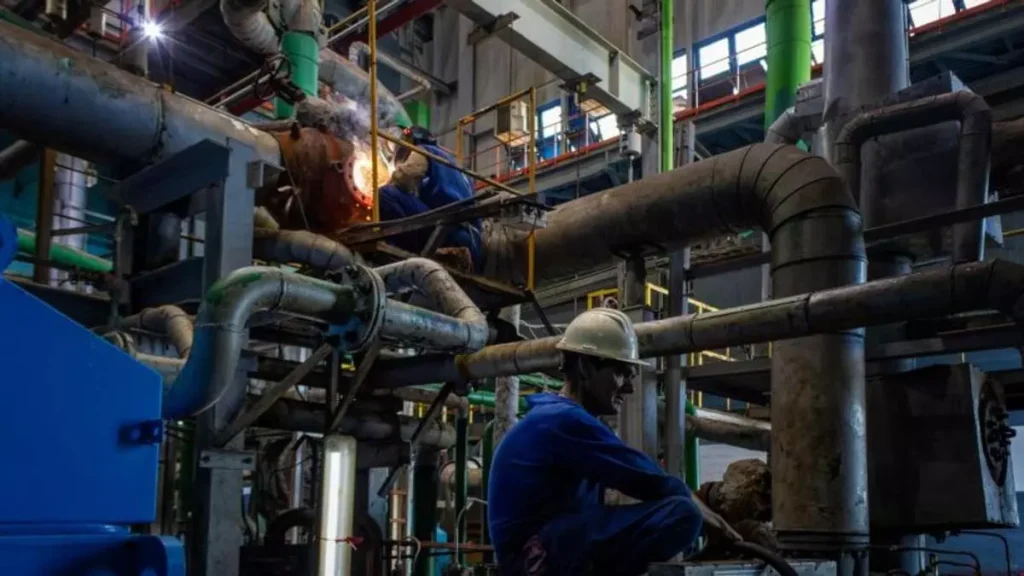
The Antonio Guiteras plant had reconnected to the SEN last Friday, after its fourteenth shutdown seven days earlier due to a boiler leak. The official press had published a glowing interview with Yandy Rojas Greenidge, a 37-year-old welder whose claim to fame is being the worker who has entered the unit’s boiler more times than anyone else. After 18 years dedicated to stitching together the guts of the famous thermoelectric plant, the man has not lost faith in the Revolution.
Asked what his dream in life was, Rojas replied: “That the plant reaches 300 MW when we can carry out the capital investment project, which is what all of us workers at the plant want.” He also declared his happiness, and that of his children, at living on an Island that guarantees them schooling and medical care. “Despite the difficulties facing the sector, it will have to improve at some point, just as the electricity sector itself must recover,” he argued. This Monday, however, another disappointment awaited him.
The shutdown of the thermoelectric plant leaves a forecast of a significant deficit today, although such figures no longer impress anyone. The shortfall is expected to reach 2,085 megawatts (MW) during peak hours, when generation will amount to 995 MW against a demand of 3,050 MW. The morning will be somewhat calmer thanks to the contribution of solar parks, which yesterday, for example, produced 3,070 MWh, with an output of 489 MW.
However, Sunday’s total deficit reached 1,882 MW. Current breakdowns affect Unit 6 of the Máximo Gómez thermoelectric plant, Unit 3 of the Ernesto Guevara de la Serna plant, Unit 2 of the Lidio Ramón Pérez plant, and Unit 3 of the Antonio Maceo plant, in addition to Guiteras. Meanwhile, Unit 5 of the Mariel plant, Units 5 and 6 of the Renté plant, and Unit 5 of the Nuevitas plant are undergoing maintenance. In total, 277 MW of thermal generation capacity is out of service.
The biggest problem, once again, lies in distributed generation, as has been the case ever since oil began to become scarce and then largely stopped arriving. There are 106 plants of this type out of service due to a lack of fuel, representing 890 MW. Added to this are the “patana” [floating power plant] in Regla and the generating engines in Mariel and Moa, creating a gap of 1,203 MW. The official press, which today reports on the consequences of measures taken by the United States, attributes the shortage to what it calls an oil blockade. According to its account, 1,400 MW of capacity are unavailable and “cannot be used because Cuba cannot purchase the diesel and fuel oil required by those generating units, engines, and power barges due to the total blockade on access to oil and its derivatives.”
Translated by Regina Anavy
______________________
COLLABORATE WITH OUR WORK: The 14ymedio team is committed to practicing serious journalism that reflects Cuba’s reality in all its depth. Thank you for joining us on this long journey. We invite you to continue supporting us by becoming a member of 14ymedio now. Together we can continue transforming journalism in Cuba.