Only in tourism is there a possibility of change, still undefined, with “new approaches and new players” to exploit existing infrastructure.
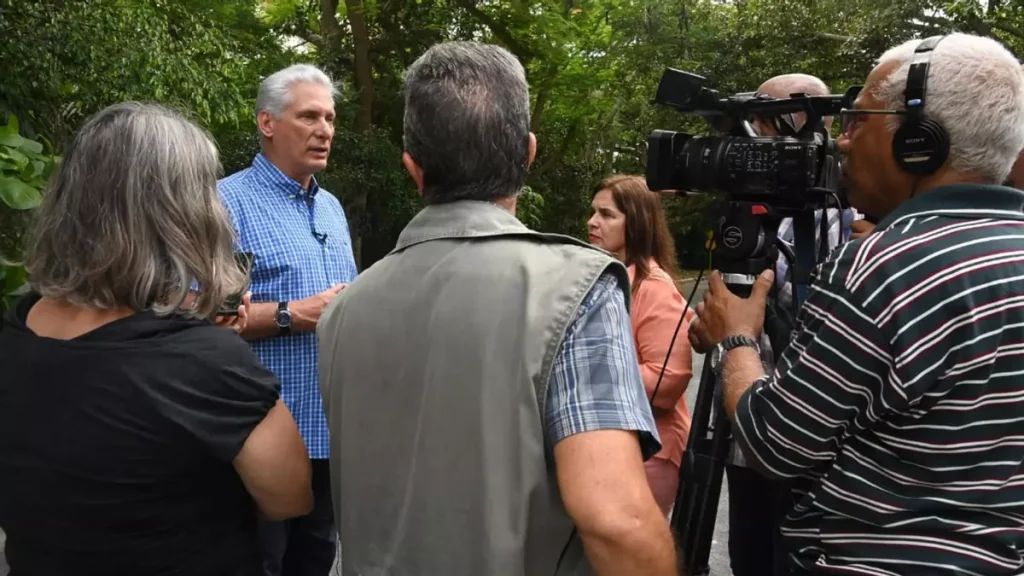
 14ymedio, Madrid, June 12 2026 / Cuba’s official press managed to create expectations for a few minutes by announcing that Miguel Díaz-Canel would make public this Friday a package of economic reforms that would include “new actors in tourism,” among other changes listed by the Cuban Television journalist Lázaro Manuel Alonso.
Among the alleged new features were “direct import and export, elimination of prohibited activities, reduction of the state apparatus, removal of obstacles to the development of companies, use of land by those who can truly produce, entry of new actors into the management and production of energy, and the encouragement of electric mobility.”
“Without first resolving a moderately functional framework for international integration, nothing else could be effective.”
“Belated pragmatism with no apparent clear connections between the measures. Without first resolving a moderately functional framework for international integration, nothing else could be effective. We’ll see the details,” said Cuban economist Pedro Monreal in a swift reaction. He was not mistaken.
At least three of the changes mentioned were already known and had little or no impact on social demands. One is the reduction of the size of the state, which was announced in May and finalized with the bill published this week. The number of ministries is reduced from 27 to 20, and a new Ministry of Information and Social Communication is created, which promises to be another instrument of ideological control.
On the same day, the draft Law on Agricultural and Forestry Lands was released, which establishes state ownership of most lands, with the exception of 20% that already belong to cooperatives and private individuals. The law opens the door for foreign companies to lease land for production, explicitly prohibits the sale of land to non-Cubans, and imposes restrictions on the freedom of agricultural producers, who will be penalized if they leave land idle.
Everything announced is part of the so-called Economic and Social Program for 2026
Nor is the legislation reforming exports new. It was published in April through two decrees that foreshadowed the eventual loss of Acopio’s monopoly, thanks to the entry of private companies, although the state-owned company will continue to have an advantage due to its infrastructure and its political and business clout. These provisions also opened up direct sales, but the State reserved the most profitable sectors for itself.
After so much media fanfare, the announcement amounted to nothing when Cubadebate published the president’s remarks from a lengthy press conference whose duration didn’t reflect the novelty. Everything announced is part of the so-called Economic and Social Program for 2026. Only in tourism is there a glimpse of a possibility, so vague that it can hardly be called an announcement.
Díaz-Canel said that it is necessary to move towards “new modalities, with new players” that will allow for the development of “all the infrastructure we have,” after admitting that the sector has been hit hard by Washington’s sanctions. “We cannot think, at this time, only about the large chains when many of them, due to pressure from the United States government, have withdrawn from the country.” The president said: “We are managing businesses in the real estate and tourism sectors, with new modalities and with other actors who are not those who have traditionally been involved in these areas.” Without more details.
Regarding energy, more of the same. Díaz-Canel insisted that the focus now is on advancing the energy mix and moving towards solar. “We are going to remove, as much as possible, the limitations on vehicle imports. We will always prioritize, in terms of tariffs and prices, the import of electric vehicles that are charged with solar energy,” he added.
More promises: the retention of human capital. The president stated that there are “actions and measures” aimed at attracting, above all, young people, especially through higher wages. He did not explain how better wages can be offered in a devastated economy like Cuba’s, with all sectors destroyed, which has led to the loss of up to 20% of the population in recent years.
Nor was it surprising, in a speech that was yet another exercise in wishful thinking, that he said trade would be promoted and that electronic invoicing would be implemented.
It was also unsurprising, in a speech that was yet another exercise in good intentions by the Cuban regime, that he said trade would be promoted and electronic invoicing would be implemented—given the current state of the telecommunications system and the failure of the banking reform. Furthermore, he “announced”—as Cubadebate explicitly states —that “prohibited activities will be limited,” making it clear that they will not be eliminated entirely, but rather that the corporate purpose “will be as broad as possible” and “the possibilities for shareholding will be expanded.”
Díaz-Canel again appealed to Cuban emigrants for help and said that measures are being taken for the use of bank accounts by foreigners and for the elimination of obstacles, though he did not specify what those measures were. “Also discussed are two particular forms of investment by Cubans: that of Cubans residing abroad and that of Cubans in Cuba; and that they can participate on equal terms as economic actors alongside foreign direct investment, alongside state-owned enterprises, alongside non-state entities and cooperatives in the country’s economic and productive framework,” he insists now.
Another of the topics discussed that was already known is the possibility of different types of business associations, such as the decentralization of certain decisions to municipalities or the ability of each company to design its own salary system.
The talk was preceded by Díaz-Canel’s reflections on the real reason that has led to this point: the tightening of US sanctions. “The United States cannot forgive itself for the fact that, at this stage, with all the maximum pressure they have exerted, the Revolution continues to exist and the country continues to function. And not even they themselves believe what they talk about and repeat so much about a failed State,” he asserted, also announcing that the option of a people’s war remains on the table should an aggression occur.
The president spoke of a “multidimensional aggression as part of a totally aggressive policy by the United States government toward Cuba, with utter contempt and an interventionist character,” and said that this presents an opportunity for new ideas and mechanisms, as happened—he compared—in Vietnam. Then, however, he not only failed to announce anything that could counter the latest decisions from the White House, but rather, on the contrary, seemed to make it clear that there is no economic transition in sight. At least, not under his control.
______________________
COLLABORATE WITH OUR WORK: The 14ymedio team is committed to practicing serious journalism that reflects Cuba’s reality in all its depth. Thank you for joining us on this long journey. We invite you to continue supporting us by becoming a member of 14ymedio now. Together we can continue transforming journalism in Cuba.