Joe García describes eight issues on the table, including political prisoners, the embargo, confiscated properties, internal reforms, and financial reintegration
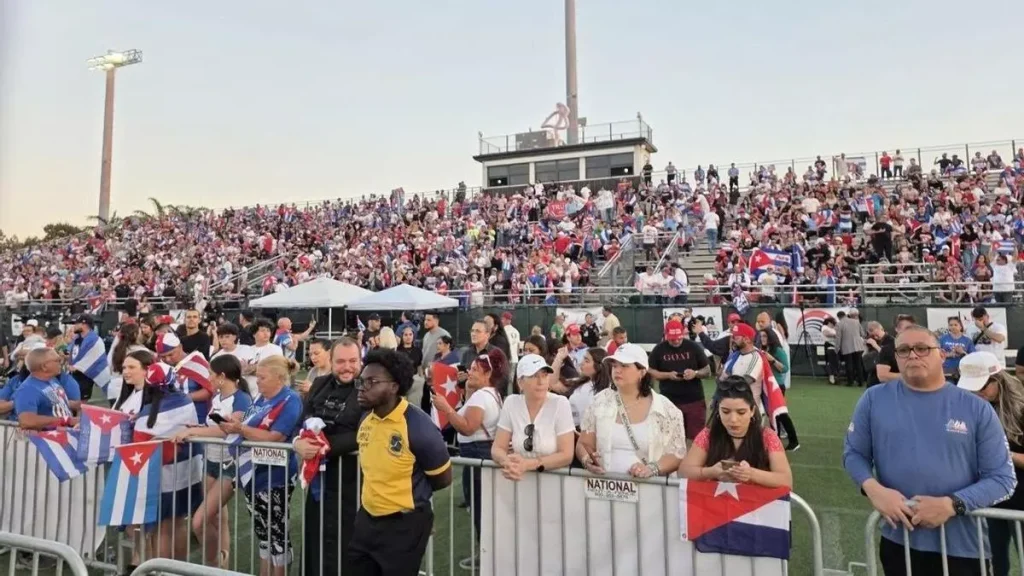
 14ymedio, Madrid, Yunior García Aguilera, May 24, 2026 — Much has been speculated in recent weeks about the secret agenda between Havana and Washington. But now, for the first time with this level of detail, a source with access to officials from both Governments is laying out a concrete roadmap. Businessman and former Democratic congressman Joe García speaks of eight points ranging from the release of political prisoners to the lifting of the embargo. At the center of this possible negotiation, however, appears an issue more thorny than any diplomatic gesture: the return to the Island of up to 500,000 Cubans currently living in the United States.
The figure alone is enough to shake both sides of the Florida Straits. Half a million people is not an abstract category in a federal file. They are families, workers, people who arrived under humanitarian parole, asylum seekers, and individuals with pending cases. It would also include individuals considered inadmissible because they committed crimes. Mixing everyone into the same bag may be politically useful, but humanly dangerous.
In an article published by The Palm Beach Post, García identifies eight main points in the conversations between the United States and Cuba: the release of more than 1,000 political prisoners, economic reforms, compensation for confiscated properties, political reforms, lifting the embargo, readmission of the Island into multilateral organizations, Most Favored Nation status, and the repatriation of hundreds of thousands of Cubans.
The release of political prisoners would be the minimum moral condition needed to sell any agreement to the exile community and to Congress
It would, therefore, not be a simple immigration arrangement, but rather a return to the entire chessboard of the bilateral relationship. Speaking with 14ymedio, García acknowledges that the issue of the half million migrants “is the one that moves the heart,” but he considers the other seven aspects also very “specific” and constituting “a fairly large movement.”
The release of political prisoners would be the minimum moral condition needed to sell any agreement to the exile community and to Congress; economic reforms would open the door to investments that today collide with state and military control over strategic sectors; compensation for expropriations would touch an open wound dating back to 1959 and would require the creation of legal and financial formulas for American and Cuban claims; and political reforms would be the most sensitive point for Havana, because any real opening would call into question the monopoly of the Communist Party.
García’s statements rest on an old rule of American foreign policy: sometimes only a hawk can negotiate with the enemy without being accused of weakness. Nixon was able to open the door to China because his anti-communist record protected him from suspicion. Reagan was able to sit down with Gorbachev after having called the Soviet Union “the evil empire.” And George H. W. Bush was able to manage the Soviet collapse without turning it into a public humiliation that would push Moscow toward chaos. In all those cases, the rapprochement was not sold as sympathy toward the adversary, but as the result of a position of strength.
The talks would not point toward an immediate expulsion, but rather a gradual scheme, with work permits and relocations over several years
That is possibly the card Trump could try to play with Cuba. If he succeeds, he would have managed to extract concessions that no Democrat was able to obtain before. Obama bet on the thaw, and his critics portrayed it as a unilateral concession. Trump, by contrast, could present any shift as a personal victory.
But the migration issue overshadows all the others because of its human burden. Trump wants to show results to his base on his promise of deportations. Havana, meanwhile, does not have the material conditions to absorb a massive return. The country can barely sustain an increasingly reduced and impoverished population. Receiving 500,000 returnees would be equivalent to adding an entire city to an already collapsed system.
That is why, according to García, the talks would not point toward an immediate expulsion, but rather a gradual scheme, with work permits and relocations over several years. Even so, merely raising the idea reveals the extent to which Cuban migrants are no longer untouchable in American politics.
Accepting deportees in large numbers would mean receiving a population that has already known other salaries, other rights, and another relationship with the State
Trump has not explicitly said that he is going to massively deport Cubans back to the Island. But he has repeatedly introduced the idea that many of them “want to return.” The phrase, repeated in different settings, makes return a plausible point on the agenda.
The symbolic blow would be enormous. Many of the Cubans who arrived during the Biden Administration crossed borders, sold properties, put their families into debt, or waited for months for a parole authorization convinced that the United States was a refuge. Now they discover that their permanence depends not only on immigration judges or pending forms, but also on a geopolitical negotiation between Washington and Havana.
The Cuban regime, for its part, cannot celebrate either. Accepting deportees in large numbers would mean receiving a population that has already known other salaries, other rights, and another relationship with the State. They would be citizens with direct experience of life outside totalitarian control. For a Government that fears any spontaneous concentration of discontent, that human mass could become a first-order political problem.
The unknown is whether that pressure seeks a real transition or merely an agreement that allows deportations to be showcased
The possible negotiation also comes at a moment of maximum pressure on Havana. The Trump Administration has tightened sanctions, struck the Island’s oil logistics, and raised the personal cost for the regime’s leadership. The criminal indictment against Raúl Castro for the 1996 shootdown of the Brothers to the Rescue planes adds an unprecedented judicial dimension to the Cuban case.
The problem is that the package described seems too ambitious for a regime whose priority is not reforming the country, but preserving power. Cuba does not have Beijing’s strategic weight nor Moscow’s nuclear arsenal. Its real power lies in its ability to provoke migration crises, sustain hostile intelligence networks, serve as a platform for Washington’s adversaries, and produce a humanitarian emergency 90 miles from Florida.
For that reason, the Cuban file would not be a negotiation between equals, but rather a pressure operation against a dangerous and exhausted regime. The unknown is whether that pressure seeks a real transition or merely an agreement that allows deportations to be showcased, releases some prisoners, and sells as victory what could ultimately end up being another transaction between elites.
Translated by Regina Anavy
______________________
COLLABORATE WITH OUR WORK: The 14ymedio team is committed to practicing serious journalism that reflects Cuba’s reality in all its depth. Thank you for joining us on this long journey. We invite you to continue supporting us by becoming a member of 14ymedio now. Together we can continue transforming journalism in Cuba.