Police arrest Yoan de la Cruz, the young man who broadcast the start of the 11J protests from San Antonio de los Baños
 14ymedio, Havana, May 9, 2026 / An unknown man intercepted journalist Reinaldo Escobar at his front door on Friday and asked if he planned to go out. When told no, the man warned him that neither he nor Yoani Sánchez could leave because there was a special mass for the Pope that day. “And what does that have to do with us, if we’re not even Catholic?” Escobar asked. “That’s what I told you,” the unknown man responded, in a phrase that betrayed the existence of orders from above. The man concluded: “Well, you know, stay upstairs and don’t go out.”
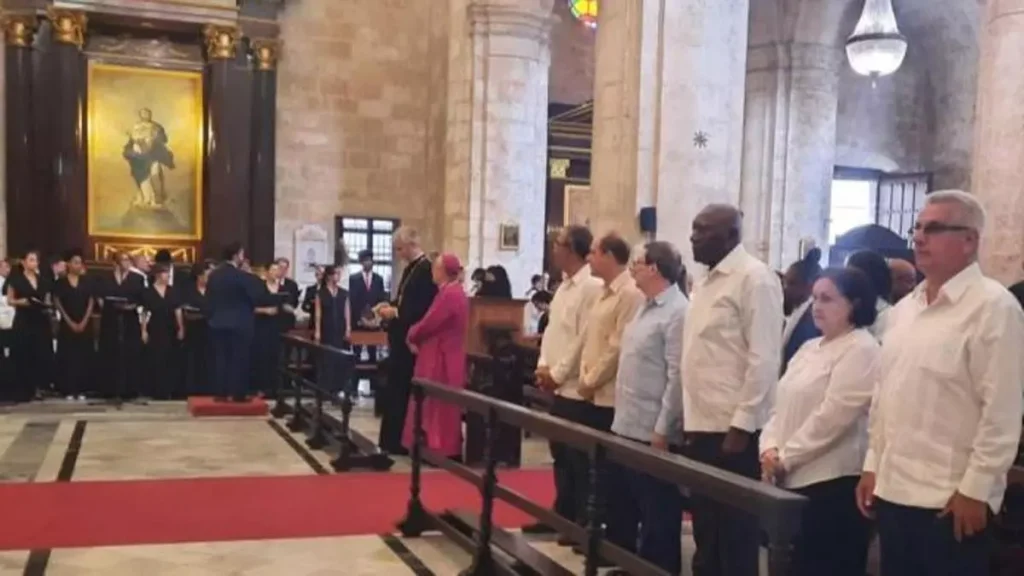
In effect, the Cuban regime once again presented its best diplomatic face to the Catholic Church this Friday. In Havana’s cathedral, Cardinal Juan de la Caridad García, Archbishop of Havana, and the president of the Episcopal Conference, Arturo González Amador, celebrated a Mass of Thanksgiving for the first anniversary of the pontificate of Leo XIV. In the front row were Cuba’s Foreign Minister Bruno Rodríguez and Vice President Salvador Valdés Mesa, both members of the Political Bureau of the Communist Party.
However, outside of the ceremonial language and official photographs, the day was marked by reports of surveillance, police cordons, and pressure against independent journalists and activists.
The Apostolic Nuncio, Antoine Camilleri, focused his message on the Pope’s approachability, simplicity, and spirit of service. He also referred to the more than 90 years of diplomatic relations between the Holy See and Cuba, which he described as a “constant channel of dialogue, respect, and cooperation.” The official newspaper Granma presented the ceremony as a new episode of “respectful and constructive dialogue” between Havana and the Vatican.
While the government speaks of dialogue before the Church and diplomats, its repressive forces keep under control those who could offer a different image of the country.
Several reports of harassment and police blockades circulated on social media in the hours leading up to and following the mass. Opposition members and independent reporters asserted that State Security agents were stationed around their homes to prevent them from leaving. Among those surrounded were journalist Camila Acosta, opposition member Ángel Moya, and Berta Soler, leader of the Ladies in White movement. According to independent journalist José Raúl Gallego, Moya and Soler were detained.
While the government speaks of dialogue before the Church and diplomats, its repressive forces keep under control those who could offer another image of the country: that of political prisoners, those released from prison under surveillance, the mothers of “11J” and the journalists who document the crisis outside the state press.
Adding to this climate was the report about Yoan de la Cruz, the recently released political prisoner who live-streamed the first protests on 11 July 2021, in San Antonio de los Baños. A Facebook post circulated this Saturday alerted the public that the police had arrested him and confiscated money, perfumes, and other items during the operation. “Under what pretext? I don’t know, this is robbery to me,” the post stated, adding that De la Cruz was working and complying with the regulations imposed since his release.
“They seized several items from him, including perfumes, money, a phone, and a computer.”
A source close to the family, consulted by 14ymedio, later confirmed some of the information circulating on social media. “According to neighbors, they confiscated several items from him: perfumes, money, a phone, a computer, and so on. I don’t yet know the reason for his arrest,” the source explained. As of now, it is unknown what charges he was arrested under or whether the authorities have formally informed the family about his situation.
Yoan de la Cruz was first arrested on July 23, 2021, after broadcasting from San Antonio de los Baños the images that sparked the 11J protests across the island. In March 2022, he was sentenced to six years in prison, and in May of that same year, he was released after his sentence was reduced to five years without incarceration.
This system, presented by the authorities as an alternative to prison, functions in practice as supervised release. The offender is obligated to comply with restrictions, subject to police monitoring, and vulnerable to any alleged violation being used as grounds for returning to prison.
The coincidence of the official mass, the reported blockades, and the operation against De la Cruz paints a picture difficult to reconcile with the discourse of openness the regime projects to the Holy See. In the cathedral, officials spoke of respect and cooperation. In the homes of activists and former political prisoners, the police reminded them of the true limitations of that dialogue.
______________________
COLLABORATE WITH OUR WORK: The 14ymedio team is committed to practicing serious journalism that reflects Cuba’s reality in all its depth. Thank you for joining us on this long journey. We invite you to continue supporting us by becoming a member of 14ymedio now. Together we can continue transforming journalism in Cuba.