With most international flights suspended due to the US energy embargo, the island received only 35,561 visitors last month.
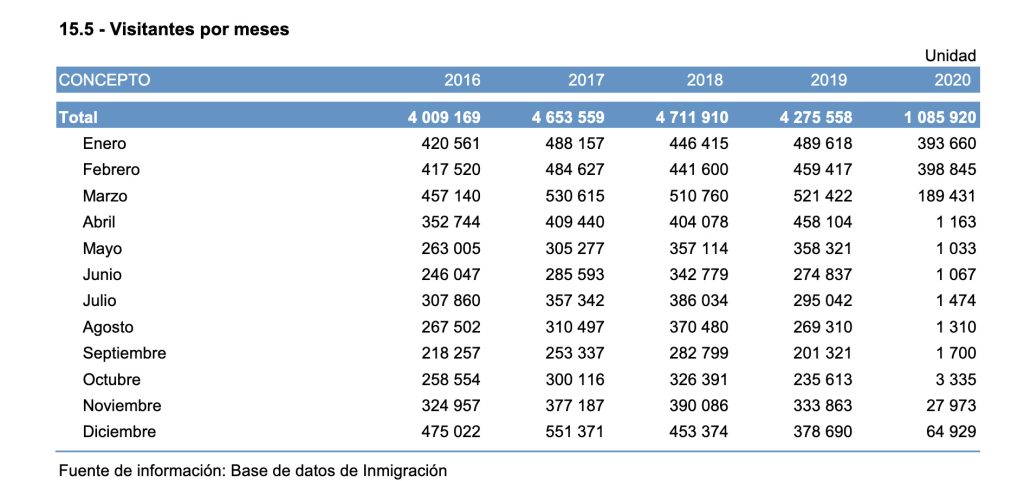
 14ymedio, Madrid, April 27, 2026 – In the first quarter of the year, Cuba has lost almost half the number of tourists it attracted during the same period in 2015, a year that was very negative for the sector that has received the most budgetary resources in recent decades. So far in 2026, 298,057 international travelers have arrived on the island, compared to 573,363 last year, a drop of 48%.
While the figure is negative on its own, the situation becomes even more dire when analyzing just the month of March. Only 35,561 visitors arrived in Cuba, a dramatic figure, given that in the same month of 2020 —with half the world under lockdown due to the coronavirus pandemic—189,431 foreigners arrived on the island. Only in 2021 , when Cuba imposed strict measures due to the worsening COVID-19 situation nationwide, was the figure even worse, with the arrival of 12,542 international travelers.
March has traditionally been an excellent month for the tourism sector, so much so that in 2018 it was the best month of the year, with 510,760 visitors. The record figure, 530,615, was reached in 2017, although that year it fell short of December, when 551,371 visitors were recorded—the highest figure ever for one month in Cuba. Although the situation in this sector has not recovered since the pandemic, both 2023 and 2024 saw significantly more than 250,000 foreign visitors, and March was again the best month in both years.
All these figures highlight the blow that Donald Trump’s decision to veto fuel shipments to Cuba represents for the island. This measure, adopted on January 29, led airport authorities to issue a NOTAM informing that all international terminals lacked jet fuel from February 10 to March 11. The alert has had to be extended for the same reason.
In February, when the news broke, airlines announced suspensions, cancellations, and evacuations, in that order, of tourists in Cuba. Some companies that had initially intended to maintain their flights ended up backing out in less than 48 hours, and all Canadian and Russian airlines focused solely on repatriating passengers. Canadian airlines evacuated more than 10,000 people from the island on various return flights out of the 24,559 who were in Cuba throughout February. Meanwhile, Russian airlines—the second largest source of tourists to Cuba— evacuated 4,300 out of a total of 7,314 that month.
Others, like the Spanish airlines, starting with Iberia, decided to maintain their routes and refuel in the Dominican Republic, but this option has also proven unsustainable. The Madrid-based airline announced on April 13 that it would reduce frequencies in May and suspend all flights to Cuba in June, something that in its 60-year history had only occurred during the company’s severe financial difficulties (2012) and during the pandemic.
March was thus the first month in which Cuba felt the full impact of the flight suspensions. Canadian tourists continue to lead the list thanks to their cumulative numbers, although if we do the math, only 511 Canadians traveled to the island this March, 99.48% fewer than in the same month last year (98,663). In the first quarter, the number has fallen by 54.2%. Russians, the island’s second most important market, only totaled 249 travelers last month.
The largest number of arrivals in March came specifically from Cubans living abroad. There were 11,231 exiles who returned to the island last month.
The largest number of arrivals in March came specifically from Cubans living abroad. There were 11,231 exiles who returned to the island last month, and although this quarter’s decline is 42.8% compared to the same period last year, it is by far the only market that has withstood the economic downturn. Paradoxically, Americans are also a significant presence, with 5,243 tourists: ten times more than Canadians.
Some of the other nationalities that have contributed include Spain, with a paltry 1,429 travelers—a welcome boost in this situation—and China, with 1,102. Argentina, which had been gaining travelers after an intense promotional campaign, also saw a significant increase. Now, in this impossible context, the number of travelers is no higher than last year, but it still represents a considerable sum given the situation in Russia and Canada: 1,622 travelers.
In this challenging environment, the regime is trying to maintain a positive image and is stirring up excitement for FitCuba international trade fair next week. The fair for the sector is traditionally held in Havana, but this year it will take place virtually, beginning on the 7th and 8th, from 9:00 am to 7:00 pm, and concluding with a special event on the 9th from Varadero, with free admission for the public.
According to the exultant official press, the event is “aimed at exceeding all expectations” and “hundreds of tour operators and travel agencies from around the world have confirmed their presence, including those who have never participated before.”
Registered participants can visit digital booths and watch presentations or compete in gastronomy and cocktails. However, judging by the figures, the most challenging aspect seems to be “gathering real-life experiences from customers who enjoy the destination during those days.”
______________________
COLLABORATE WITH OUR WORK: The 14ymedio team is committed to practicing serious journalism that reflects Cuba’s reality in all its depth. Thank you for joining us on this long journey. We invite you to continue supporting us by becoming a member of 14ymedio now. Together we can continue transforming journalism in Cuba.