The Cuban regime celebrates the 60th anniversary of Renté, its most obsolete plant, while announcing a new breakdown at Guiteras
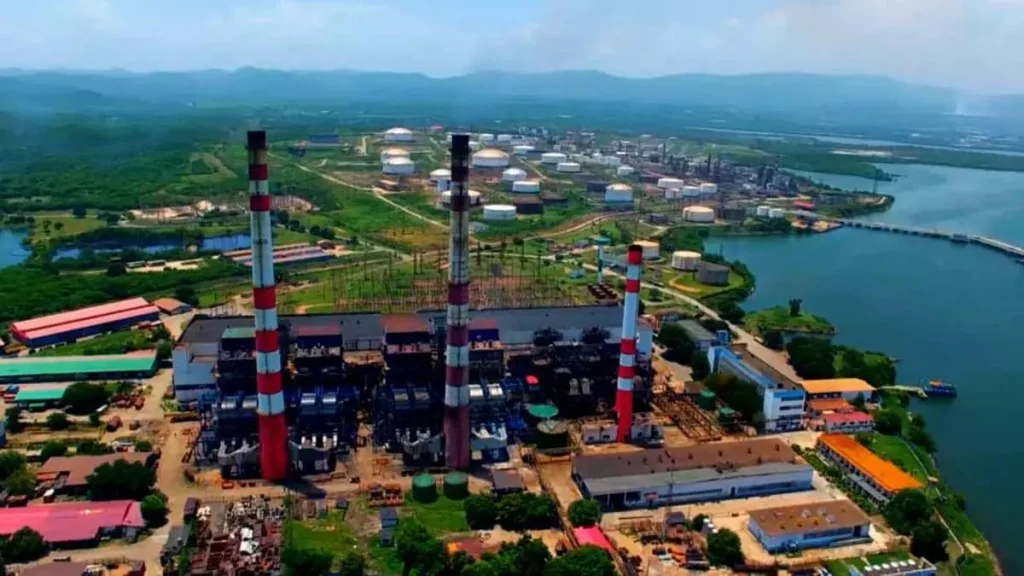
 14ymedio, Havana, April 6, 2026 – This Monday, while Cuba’s Electric Union (UNE) announced the shutdown of the Antonio Guiteras thermoelectric plant, the country’s largest power generator, due to a “boiler puncture,” the official newspaper Granma proudly celebrated the 60th anniversary of the Antonio Maceo Grajales plant, known as Renté, in Santiago de Cuba, a facility whose useful life expired 30 years ago. Since then, the plant has accumulated serious breakdowns and has all three of its only operational units out of service.
Román Pérez Castañeda, general director of the Guiteras plant, reported that the cooling process will take between 30 and 36 hours, and only then will specialists be able to access the area, determine the extent of the damage, and proceed with repairs.
The new breakdown at the Matanzas plant once again places the national electric system (SEN) in a critical situation. At the time it went offline, the plant was generating 170 MW. With this failure, combined with other incidents reported by UNE this Monday, a deficit of 1,845 MW is expected during tonight’s peak hours, for a national demand of 3,020 MW.
Each repair outage has been temporary as the plant fails again shortly after being reconnected to the system
The plant, with more than 36 years of operation, suffers from insufficient maintenance, a shortage of spare parts, and chronic deterioration that authorities have been unable to resolve. Each repair shutdown has been only provisional: the plant breaks down again soon after rejoining the system. Its repeated disconnections have caused most of the nationwide blackouts over the past year and a half.
It is known that Guiteras was designed, manufactured, and assembled by the French firm Alstom. Starting in 2015, when the U.S. company General Electric acquired the French company, access was lost to a French credit line that had channeled all supplies and spare parts.
Public outrage, reflected in comments on UNE’s Facebook page, emphasizes that the energy crisis, which the Government attributes to the U.S. embargo, existed long before, due to structural failures within the system itself.
Meanwhile, almost mockingly, Granma celebrates that “ingenuity is the main fuel,” listing makeshift solutions to cope with the deterioration of the six-decade-old Renté thermoelectric plant in Santiago de Cuba.
The official tribute, similar to the one paid last year, resembles an industrial survival manual for a plant that has already doubled its expected lifespan and survives amid constant failures. According to UNE’s report this Monday, Unit 5 at Renté is broken down, while Units 3 and 6 are out of service for maintenance.
These incidents add to a long list of failures reported today by the UNE: a breakdown in Unit 3 of the Felton plant, another in Unit 6 of Diez de Octubre, the aforementioned failure at Guiteras, and maintenance shutdowns of Units 5 and 6 at Mariel and Unit 5 at Nuevitas.
In the 1990s, after losing its Soviet suppliers, the plant was modernized with technological assistance from French companies to rehabilitate two of its units
The thermoelectric plant being celebrated for its longevity—called “La Renté,” after the peninsula where it is located—was founded in 1966 with Soviet assistance and designed to generate energy from fossil fuels.
In the 1990s, after losing its Soviet suppliers, the plant was modernized with technological assistance from French companies to rehabilitate two of its 100 MW units and make it operate with domestic crude oil, to avoid importing fuel. The name of the French company and the cost of the operation have never been disclosed.
Although the total capacity of the Antonio Maceo plant has not been reached for decades due to a lack of resources for maintenance and repair, it is still considered essential for sustaining the national grid in the eastern region of the country.
The plant’s general director, Jesús Aguilar Hernández, admits that the passage of time has made it impossible to contribute the 500 MW the plant provided in its best years: “with Units 3, 5, and 6nat maximum capacity, only 285 MW can be reached.” These are the same units currently out of service, according to UNE’s report.
According to Ecured, since 2023 the only operational units at Renté have been 3, 5, and 6, as Unit 1 was retired and Unit 4 was temporarily taken offline.
In statements to Granma, Aguilar boasts that before 1959 “the country was barely electrified,” an ironic reminder in the face of prolonged daily blackouts in today’s Cuba, and that it is a “privilege” for the plant to reach 60 years of operation.
“It constitutes a challenge left to us by previous generations and one we must pass on to future ones,” Aguilar boasts, suggesting the plant’s continued operation, and adds: “More than the equipment, what endures is the quality of its workforce.”
Faced with fuel shortages, lack of spare parts, and frozen imports, Aguilar insists that they “expect nothing from abroad, when solutions can be generated here,” adding, almost as if they were oil alchemists with psychic powers, “The slogan is not only to operate, but to create everything possible, because ingenuity is the main fuel.”
Due to the lack of parts, workers themselves are forced to improvise replacements
Regarding Units 5 and 6, which are currently offline with 5 broken and 6 under maintenance, Ángel Fabars Borlot, electromechanical chief at the Power Plant Maintenance Company (Emce), admits: “Unit 6 is slated for an extended repair, and in Unit 5 we had to deal with a failure in the generator’s hydrogen seals.”
“These are extremely complex tasks because these are enormous machines. The smallest part weighs tons, and tolerances are measured in millimeters,” Fabars Borlot confesses, without explaining how ingenuity will solve such problems.
Given the lack of parts, workers themselves are forced to improvise them. Eduardo Morales García, head of the machining workshop and soon to receive a medal for 40 years of service explains: “When a job comes in, we have to make almost everything: the cutting tool, the bar, the material, even the hacksaw blade to cut the pipes.”
Morales cites as an example the manufacturing of shafts for the water pumps of Unit 5, “a part that used to come from Russia, but we were tasked with making it here.”
Mayra CcCalle Irsula, an industrial maintenance specialist at Renté, an engineer who has dedicated more than 35 years of her life to the plant, stated that the main conditions to “guarantee continuity in generation” are remote work and telework, when possible, and consolidating “operators, kitchen staff, security, and technicians into a single transport system.” She did not explain, however, that these are measures ordered by the Ministry of Labor to avoid layoffs in state companies, due to the unprecedented crisis facing the country, aggravated by the U.S. oil embargo.
Fuel shortages not only shut down machines; they also paralyze transportation, disrupt shifts, and put operations at risk. The lack of personnel, due to transportation problems, slows processes. “The response is slower because we don’t have the necessary number of people,” admits the Emce electromechanical chief.
Maximiliano Guisande Agüero, head of Dynamic Equipment with 56 years at Renté and leader of the repair of the damaged Unit 5, says he is trying to attract and retain young workers through agreements with pre-university schools, polytechnics, and the University of Oriente, involving students in internships and training. This strategy, he says, could help address staff shortages, although for now the results remain uncertain.
Translated by Regina Anavy
______________________
COLLABORATE WITH OUR WORK: The 14ymedio team is committed to practicing serious journalism that reflects Cuba’s reality in all its depth. Thank you for joining us on this long journey. We invite you to continue supporting us by becoming a member of 14ymedio now. Together we can continue transforming journalism in Cuba.