The continental average is 71%, with Paraguay and Costa Rica at 100%, followed by Uruguay (98%), Brazil (95%), Venezuela (92%), Colombia (91%), and Ecuador (90%)
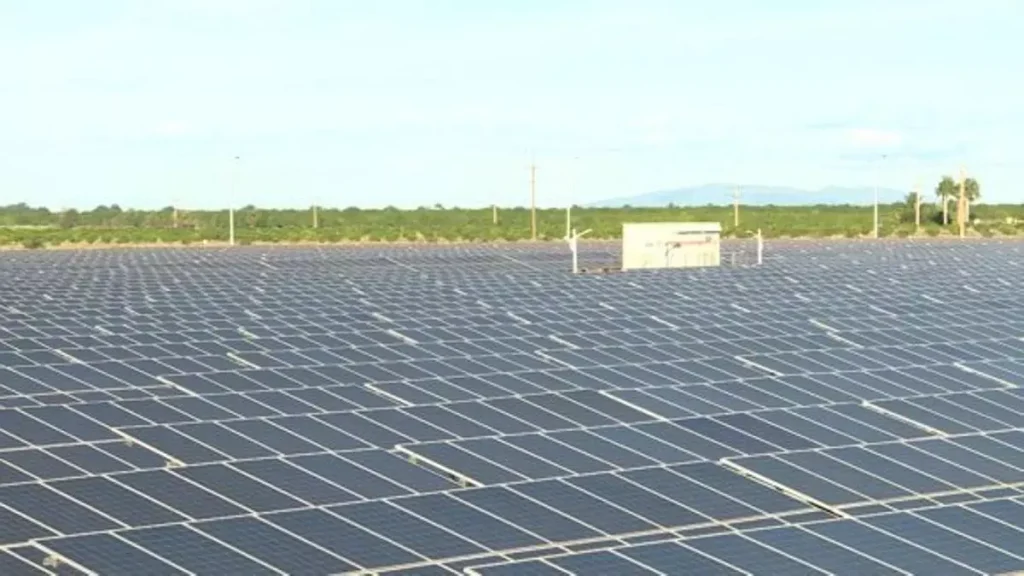
 14ymedio, Madrid, April 6, 2026 – On Monday Cuba’s official press published the transcript of the 42 minutes of the program Cuadrando la Caja, broadcast more than ten days ago, in which several experts sat down to talk about the Island’s “energy matrix change.” It revealed less than a much more concise article today in the Financial Times (FT), which reports the enormous leap China has made in investing in solar energy in Cuba.
If in 2019 Beijing exported photovoltaic panels to the Island worth $16.6 million, in 2024 the amount grew to $48 million. Just one year later, in 2025, the figure rose to $117 million, almost 144% more than the previous year. In addition, batteries, essential for storing energy produced during daylight hours and using it at night, have also grown enormously, increasing from $7.3 million in 2024 to $56 million in 2025. Euan Graham, senior analyst at the energy think tank Ember, told the British outlet that just this January batteries worth about $15 million were imported.
“Just in the last 12 months, the Government successfully installed 1 GW, so they have already reached half of the target” set for 2026, says the expert, who adds that “one gigawatt is a very significant amount in the system, and reaching 2 GW would be truly transformative.”
Euan Graham, senior analyst at the energy think tank Ember, told the British outlet that just this January batteries worth about $15 million were imported
The article, however, asks how the State is financing this enormous investment, since, it says, it is not transparent at all. “The 2026 economic plan indicates that Beijing donated 320 MW of technology. Cuban Prime Minister Manuel Marrero Cruz stated that part of the solar technology was paid for with nickel,” the text notes. The same nickel mines, operated in collaboration with the Canadian company Sherritt, have been halted for several weeks due to lack of fuel.
The Financial Times believes that China’s support has a political objective, but that even so, Cuba will have to pay for a good portion of it, and that will not be easy, since the required investment is large. And with tourism collapsed, there are few options to obtain foreign currency.
In addition to donations, China has invested in Cuba. The company Shanghai Electric has contributed about $60 million to the Mariel solar park, which has 62 MW and is the Island’s first private project through a partnership with the British firm Hive Energy.
Giles Redpath, its chief executive, highlights the effectiveness of the park, which provides up to 10% of renewable electricity in Cuba. “It is a very important part of the Cuban electrical grid, and right now I’m sure it is their cheapest source of electricity,” he says. But his words also reflect the Island’s usual problems, which are why almost no one wants to invest there.
“The only problem, from our perspective, is that they are not very good at paying. Or, to be more precise, they are very good at depositing money into a Cuban bank account, but then the money cannot be taken out of Cuba.” Hive says it has tried to sell the project, “but obviously, it is difficult to sell a project that has not been paid for.”
“Cuba, as an island, could function entirely on renewable energy. They have achieved fantastic results in solar energy and have good wind resources,” Redpath insists. “They just need to fix the economic problems and the international payments system, and then investment would arrive en masse.”
The FT notes that Chinese and Vietnamese donations of solar panels also include kits for homes, schools, and hospitals, but prices, as this newspaper has reported along with other independent Cuban outlets, are very high. In addition, the official press itself has indicated on more than one occasion that even the loans promoted by the Central Bank do nothing.
“They just need to fix the economic problems and the international payments system, and then investment would arrive en masse”
Ricardo Torres, a Cuban energy expert at American University in Washington, values the significant progress of photovoltaic energy on the Island, but also notes that it represents “a growing portion of a [electricity generation] pie that is getting smaller and smaller. The proportion is magnified by the contraction in other sources,” he points out.
The report is blunt. “Not even the dizzying increase in solar energy imports can offer a quick solution for an economy that 40 years ago was the world’s leading sugar exporter but is now in ruins,” it says.
The same is recalled by University of Texas expert Jorge Piñón, who told the Financial Times that although “every small effort helps, this is a temporary solution, not the ‘engine’ that Cuba needs to emerge from the ‘stone age’ of electricity generation and face the challenge of real economic growth in the 21st century.”
Although the program Cuadrando la Caja has been much more optimistic than all this, they could not avoid acknowledging that Cuba, despite the much-touted efforts to change the energy matrix since 2014, which have existed only on paper for almost 10 years, remains far behind the regional average. The Island, where the contribution has barely reached 10%, is far from the global average of 30%, and light-years away from the 71% that Latin America already had in 2025.
Hydropower has the largest share in the region, according to data from Americas Market Intelligence, with 51.3% in 2022, although wind and solar were already rising rapidly in Chile, Brazil, and Mexico.The leading country in the area is Brazil, which already had 89% renewables three years ago, followed by Colombia (75%) and Chile (55%).
In addition, a 2025 report by the Latin American Energy Organization (Olade) noted that nine countries exceeded the regional average index of 71%, with Paraguay and Costa Rica at 100%, followed by Uruguay (98%), Brazil (95%), Venezuela (92%), Colombia (91%), Ecuador (90%), Belize (77%), and Panama (71%).
Bioenergy, which is also a rapidly growing energy source on the continent, is at risk in Cuba, where the collapse of the sugar harvest is also dragging down the country’s main plant: the Ciro Redondo Bioelectric Plant.
Translated by Regina Anavy
______________________
COLLABORATE WITH OUR WORK: The 14ymedio team is committed to practicing serious journalism that reflects Cuba’s reality in all its depth. Thank you for joining us on this long journey. We invite you to continue supporting us by becoming a member of 14ymedio now. Together we can continue transforming journalism in Cuba.