In the middle of the lake, a home restaurant (paladar) offers visitors local products: chicken, lamb, goat, pork and fish
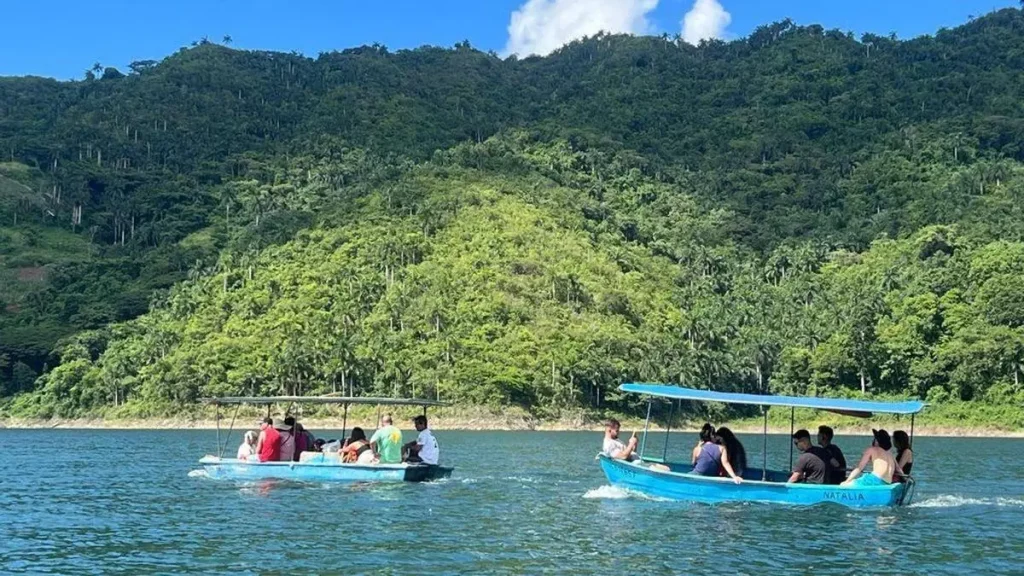
 14ymedio, Darío Hernández, Hanabanilla (Villa Clara), October 12, 2025 — Surrounded by hills and lush nature, the Hanabanilla reservoir, in the heart of the Escambray, is an idyllic landscape away from the garbage and insalubrity of Cuban cities. The area is poor in the old way: they build their own houses with real palm wood and raise animals that are then served at the table. Some remote villages have not even received electricity.
Life is not easy for the residents, but people have always lived in Hanabanilla, even on the islets in the middle of the lake, and are accustomed to moving around in boats and fishing to eat. “For the people on this side, the little boat comes early in the morning at 7:00, picks them up and takes the children to school. And at 4:00 in the afternoon, it returns them,” explains one of the residents on the reservoir .
The hamlets have been around for decades, and in the ’50s, when “an American” wanted to build the hydroelectric power plant that Fidel Castro then nationalized in the ’60s, they were the protagonists — according to the official Ecured report — of “one of the most shameful scenes in the history of Cuba with the eviction of the humble farmers who inhabited the Siguanea Valley. They were mostly Galician emigrants, dedicated, fundamentally, to the cultivation of coffee.”
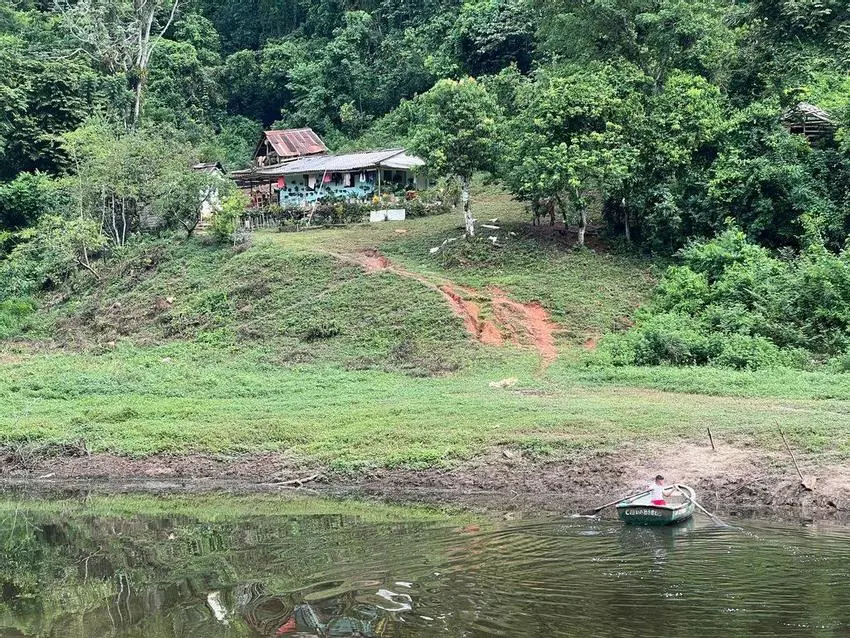
In the old village “there were houses, schools, shops, everything. The American who was going to build the dam bought the houses from the people who lived below,” the neighbors recount. Despite fierce criticism of the “Yankee” project, the Revolution continued the work on the dam and also turned it into a tourist enclave. “All this was done by the Americans; only a few engines were missing. In 1961 the Revolution shut it down and then brought in some Czech engines” to start up the hydroelectric.
Around Hanabanilla, and under the influence of Fidel Castro, numerous businesses emerged that are now in decline due to the low influx of travelers. Some, however, survive, and the paladar El Guajiro, of wide renown among residents and anyone who has ever visited the lake, is an example. The only way to reach the rustic restaurant is by boat, and, as soon as the visitor approaches the shore, he hears the sizzling of hot oil and smells the odor of roast beef.
The shack, made entirely of wood, serves everything that is missing in Cuba, for prices between 1,800 and 2,000 pesos: “chicken, lamb, goat, pork steak or fried pork and fish.” Each dish is served with its portion of rice, snacks and salad, and everything, as the cook himself says, is produced in the paladar. “We produce the pigs ourselves, also the cassava, malanga… The lake gives us the fish: trout and tilapia,” he says with pride.
The guajiros of Hanabanilla live to the rhythm of the boats
Before, he recalls, they even saw deer on the hills that came down to drink at the shore. “I caught them before by swimming, right here in the lake. These are the things (the fish) that are being lost. If I don’t catch them, someone else will,” he reflects.
The possibility of exploiting resources in the area is a relief for the residents. According to the man, who lives at times between the lake and the village of Cumanayagua, “here [in the hamlet] you can live without electricity. Down there [in the village] I can’t live without it: mosquitoes, despair, having nothing to cook with. Not here. Coal is used here permanently, for everything.”
Businesses like El Guajiro, one of the first paladares, founded “before 2012” according to its owner, mark the day to day on the lake. “You arrive at the hotel [Hanabanilla] or anywhere on the lake and tell the boatman ‘I want to eat at Guajiro’s House’ and come to Guajiro’s House to eat. They have to bring them here, and then we give lunch to the boatman,” explains the worker.
The paladar also has other workers, who, when they have shifts all day, stay to sleep in a small house near the restaurant, made, like all the others, of wood.
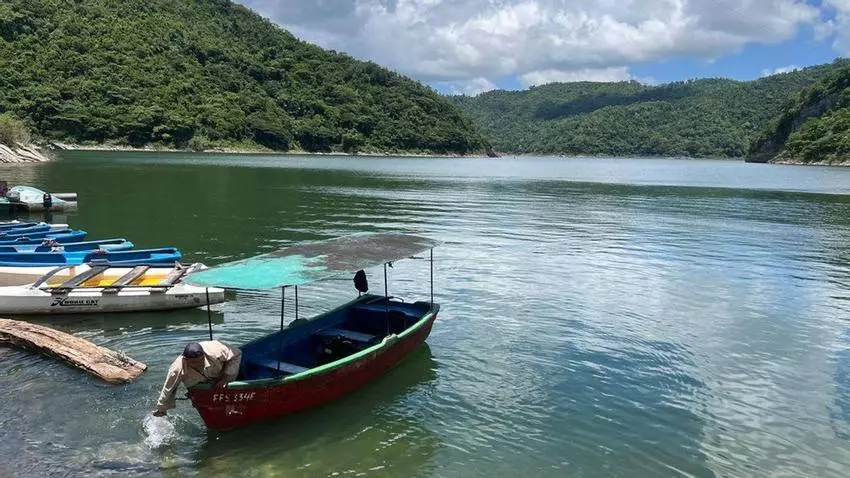
The boatmen are a whole guild of neighbors who know each other and have been crossing the lake for years. They also have their own businesses and do the tourist routes to the different corners of the lake. “We give excursions to Jibacoa, from Jibacoa to the canopy, and we return to the waterfall and Guajiro’s House. The other excursion that we have is the one that goes to Nicho, (part of the Topes de Collantes nature park)” says one of them.
The canopy, through which visitors hang from a thick cable over the lake, is a very recent attraction. Installed just last year, it is “the longest in Cuba, in the Jibacoa-Hanabanilla park,” says one of the managers, dressed in gloves, helmet and harness.
The boats and barges are part of the ecosystem. Each family has its own, some motorized, others with oars. The boatmen, surrounded by ancient and Taino names such as Hanabanilla, Jibacoa and Cumanayagua, choose to name their boats with more modern names like Natalia or Príncipe.

The boats come and go from the hotel Hanabanilla, a multi-storey building that Fidel Castro ordered to be built, and which with the passing years and deterioration is losing more and more charm. The majority of tourists who pass through the area still arrive there.
When night begins to fall, the hotel is filled with music and the noise of the kitchen even though it is mostly empty. On the shore, a few boats, two or three, wait at a tiny floating dock, hoping that some visitor is encouraged to take a tour on the lake, although the demand is almost as small as the boats themselves. However, many prefer to hire private boatmen.
With the passage of time and the decline of the hotel complex, the engines break, there are irreparable gaps in the hulls, and the boatmen depart. The hotel itself has become a graveyard for boats. In its surroundings, dozens of boats rest face down, becoming a refuge for lizards, snails and small animals.
Translated by Regina Anavy
____________
COLLABORATE WITH OUR WORK: The 14ymedio team is committed to practicing serious journalism that reflects Cuba’s reality in all its depth. Thank you for joining us on this long journey. We invite you to continue supporting us by becoming a member of 14ymedio now. Together we can continue transforming journalism in Cuba.